When a sofa manufacturer asks me which leather material to specify, I don’t start with price lists. I start with one question: what’s your Martindale cycle target? Because a sofa that needs to survive 10 years of daily use requires a fundamentally different leather material than a showroom piece replaced every three years. The gap between “premium” and “fails in year three” is wider than most procurement teams realize — and it comes down to test data, not marketing claims.
In our testing lab, we’ve put every major leather material for sofa production through the same protocol: Martindale abrasion per ISO 11640, hydrolysis resistance per ISO 14268, and UV colorfastness per ISO 105-B02. The results tell a very different story than showroom swatches do. Here’s what the data actually shows — and how to specify leather material sofa production that holds up.
What Makes a Leather Material Sofa Survive 200K Martindale Cycles?
The Martindale test is the single most predictive metric for sofa leather longevity. It simulates repetitive friction — the kind a sofa cushion experiences when someone shifts position 30 times a day. The standard calls for 20,000 cycles for residential use and 40,000 for commercial. But those thresholds were written decades ago, when replacement cycles were 5-7 years.
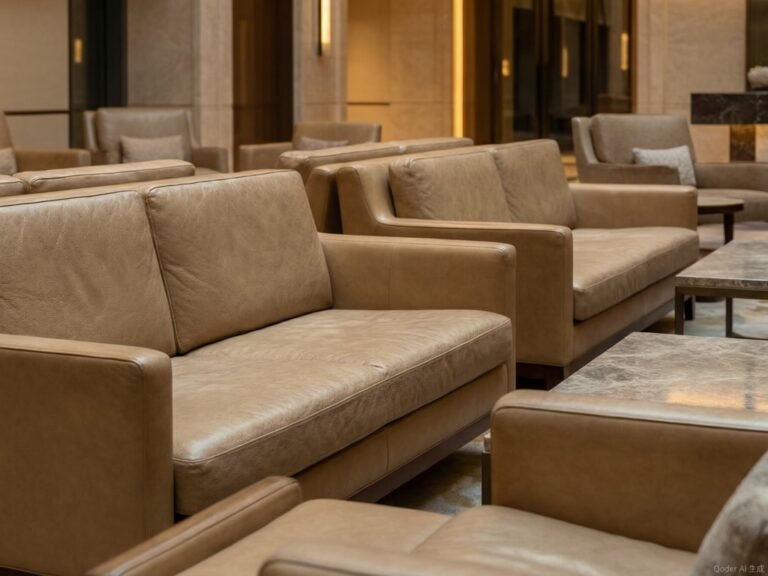
Today’s procurement specs are moving higher. We’ve seen hospitality clients require 100,000+ cycles for lobby furniture. One resort group specified 200,000 cycles after their PU sofas failed en masse at year three. That’s the point where full-grain leather and silicone leather are the only materials still standing. If you’re sourcing the best leather material for sofa production, Martindale data is where you start — not thickness, not hand-feel, not price per yard.

Calendering line where silicone leather achieves its final surface density — directly affecting Martindale performance.
Key finding: PU leather marketed as “heavy-duty” typically reaches 25,000–40,000 Martindale cycles before surface breakdown. Silicone leather consistently exceeds 200,000 cycles. That’s a 5× performance gap that directly translates to replacement frequency.
Four Sofa Leather Materials Compared: Performance Data
Most specifiers work from four material categories. Understanding sofa leather material types means understanding where each one fails. We’ve tested all four under identical conditions — same lab, same technician, same protocol.
| Material | Martindale (cycles) | Hydrolysis Failure Point | Colorfastness ΔE | Real-World Lifespan |
|---|---|---|---|---|
| Full-Grain Leather | 100K+ | N/A (organic) | 3.2 | 15–25 years |
| PU Leather | 25K–40K | 3–5 years | 8.7 | 2–5 years |
| PVC Leather | 40K–60K | 5–7 years | 6.1 | 4–7 years |
| Silicone Leather | 200K+ | No failure | 1.4 | 10–15+ years |
The data speaks for itself. PU and PVC fail not from abrasion alone — they fail from the combination of abrasion, hydrolysis, and UV exposure working in tandem. Full-grain leather performs admirably but carries animal-sourcing and tanning-chemical concerns. Silicone leather addresses both performance and sustainability gaps. When you’re running a leather sofa material durability comparison, the question isn’t just “how long does it last?” — it’s “what causes it to fail?”

Swatch rack showing color and texture options available for sofa leather specification.
Hydrolysis: The Silent Killer of Sofa Leather
Here’s the thing most spec sheets don’t mention: the majority of PU and PVC sofa failures aren’t from abrasion. They’re from hydrolysis — the chemical breakdown of polyurethane coatings when exposed to ambient moisture over time. I’ve opened up “worn out” PU sofa cushions and found the coating had turned to powder. The frame was fine. The foam was fine. The leather was gone.
Hydrolysis is temperature and humidity dependent. A sofa in a humid climate like Florida or Southeast Asia will fail 40% faster than the same sofa in Arizona. That’s why I always ask clients about deployment environment before recommending a material. If your sofas are going into humid environments, PU leather’s 3-5 year hydrolysis timeline becomes 2-3 years. Hydrolysis-resistant silicone leather doesn’t have this failure mode — its silicon-oxygen backbone is inherently stable against water molecules.
Watch how silicone leather performs in luxury furniture applications — see the material that exceeds 200K Martindale cycles.
In our lab, we run accelerated hydrolysis testing per ISO 14268. PU samples show measurable coating degradation at 72 hours in 70°C / 95% RH conditions. Silicone leather shows zero degradation at 240 hours under the same conditions. That’s not a marginal difference — it’s a category difference. For a leather sofa quality specification, hydrolysis data should be on your spec sheet alongside Martindale numbers.

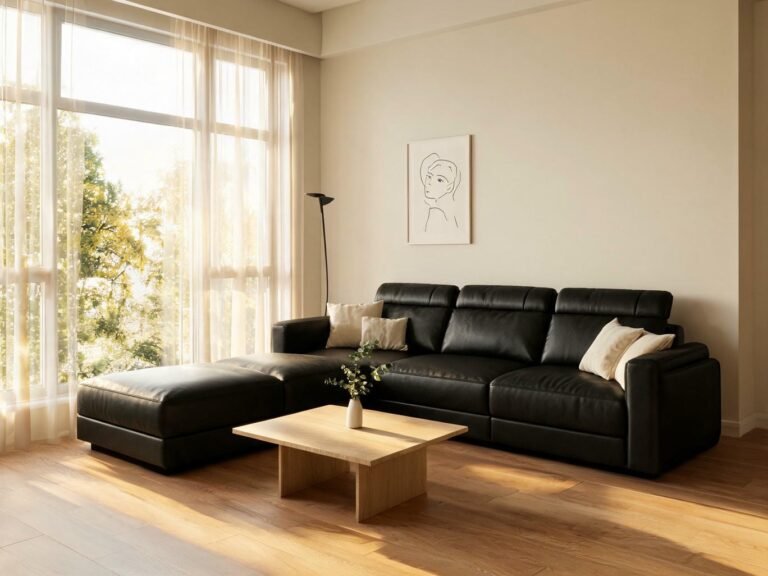
Residential sofa upholstered with premium leather — where material choice determines 10-year vs 3-year replacement cycles.
Specifying Leather Material for Commercial Sofa Production
For B2B procurement teams, the specification process should go beyond “looks good, feels good.” Here’s what I recommend putting on your spec sheet for commercial sofa leather material specifications:
- Martindale cycles: Minimum 100K for commercial, 200K for high-traffic hospitality
- Hydrolysis resistance: Request ISO 14268 test data; specify “no degradation at 240 hrs”
- UV colorfastness: ΔE ≤ 2.0 after 1,500 hours per ISO 105-B02
- Chemical resistance: Pass isopropyl alcohol 70% and diluted bleach per ASTM D1308
- Tear strength: ≥ 25 N/mm per ISO 23910 for sewing integrity
One of our clients — a hospitality furniture group supplying 300-room resorts — switched from PU to silicone leather after their PU sofas required full reupholstery at year 2.5 in tropical climates. The silicone leather sofas are now in year 6 with no measurable surface degradation. The TCO math was simple: one reupholstery cycle costs more than the material upgrade. You can read more about leather for sofa upholstery sourcing on our resource page.

Finished leather rolls packaged and ready for sofa manufacturing — each roll carries test data documentation.
Frequently Asked Questions
What is the most durable leather material for a sofa?
Full-grain genuine leather and silicone leather are the two most durable options. Full-grain achieves 100K+ Martindale cycles and lasts 15-25 years. Silicone leather exceeds 200K Martindale cycles, lasts 10-15+ years, and resists hydrolysis — the failure mode that kills PU and PVC leather. For B2B procurement where replacement cost matters, silicone leather offers the best performance-to-lifespan ratio.
How many Martindale cycles should sofa leather withstand?
Residential sofas should specify minimum 20,000 Martindale cycles. Commercial applications require 40,000 minimum. For hospitality and high-traffic environments, we recommend specifying 100,000+ cycles. If the sofa needs to last 10+ years without reupholstery, look for materials tested to 200,000+ cycles — only full-grain leather and silicone leather consistently reach this threshold.
The Bottom Line: Test Data Over Marketing Claims
The leather material sofa industry runs on showroom swatches and hand-feel demonstrations. But when you’re specifying material for 500 sofas across a hotel chain, the only thing that matters is how the material performs in year three, year five, year ten. Martindale cycles, hydrolysis resistance data, and UV colorfastness numbers — these are the metrics that separate a material that lasts from one that peels.
Our recommendation: always request lab test data before placing an order. If a supplier can’t provide Martindale, hydrolysis, and UV test reports, that’s your answer. The right leather material for sofa production should come with documentation — not just a nice swatch.
Request Martindale Test Reports
About TOPSUN
TOPSUN manufactures silicone leather material for sofa producers, furniture brands, and hospitality specifiers requiring verified 200K+ Martindale cycle performance across residential and commercial seating applications.
In-house Martindale abrasion testing per ISO 11640 · Hydrolysis resistance validation per ISO 14268 · UV colorfastness certification per ISO 105-B02 · REACH and FDA food-contact compliant