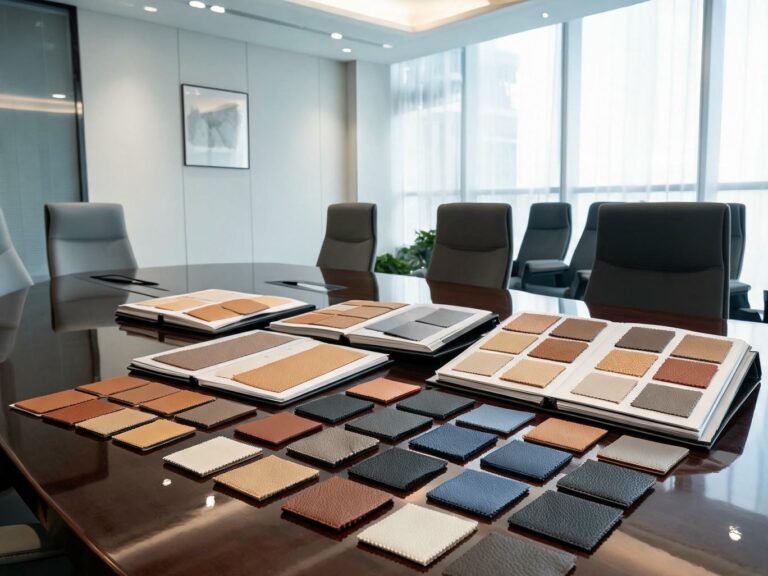
When a B2B buyer requests “OEKO TEX leather” on a specification sheet, they’re asking for more than a certification label. They’re requesting documented evidence that the material has been tested against a standardized list of harmful substances — and that every production batch meets those limits. The LEATHER STANDARD by OEKO-TEX is the only globally recognized certification system specifically designed for leather materials at all production stages. Understanding what it tests, how it classifies products, and how it compares to other standards is essential for procurement teams managing compliance across international markets.
This guide covers OEKO TEX leather certification fundamentals, testing parameters, product classification, and how eco-friendly silicone leather aligns with OEKO-TEX substance requirements. For TOPSUN’s full certification portfolio, visit our certificates page.
Request Certified Leather Samples
What Is OEKO TEX Leather Certification?
LEATHER STANDARD by OEKO-TEX is a globally unified, independent testing and certification system that tests leather and leather products for harmful substances at every production stage — from raw hides through finished goods. Established by the Hohenstein Institute in Germany, the standard is updated annually to reflect new scientific findings and regulatory changes. The 2025 update introduced compliance requirements with the EU Deforestation Regulation (EUDR), updated PFAS (per- and polyfluoroalkyl substances) limits, and tightened threshold values for multiple substance categories.
The certification matters for B2B procurement because it provides third-party verification that a material meets defined safety thresholds. Without it, buyers rely on supplier self-declarations, which carry legal and reputational risk. OEKO-TEX certification requires laboratory testing by authorized institutes, annual renewal, and unannounced factory inspections — a level of scrutiny that self-declarations cannot match. For products entering the EU market, where REACH compliance is mandatory, OEKO-TEX certification serves as supplementary evidence of substance compliance beyond the REACH SVHC list.

Chemical handling in leather production — OEKO-TEX certification verifies that residual substances remain below defined safety thresholds
OEKO TEX Leather Testing Parameters
The LEATHER STANDARD tests for over 100 regulated and harmful substances. The table below summarizes the key testing categories most relevant to B2B leather procurement:
| Test Category | Key Substances | Typical Limit | Relevance to Leather |
|---|---|---|---|
| Chromium VI | Cr(VI) compounds | Below detection (≤2 mg/kg) | Chrome tanning byproduct — carcinogenic |
| Formaldehyde | Free formaldehyde | Class I: ≤16 mg/kg | Tanning and finishing agent |
| Heavy Metals | Pb, Cd, As, Hg, Sb | Substance-specific limits | Pigments and tanning agents |
| PCP / TeCP | Pentachlorophenol | ≤0.5 mg/kg | Historic leather preservative |
| Banned Azo Dyes | 24 restricted amines | ≤30 mg/kg each | Dyestuff breakdown products |
| PFAS | Per/polyfluorinated compounds | Total: ≤1 µg/m² (2025) | Water/stain repellent treatments |
| Benzene | Aromatic hydrocarbon | ≤5.0 mg/kg | Solvent residue from finishing |
| PAHs | Polycyclic aromatics | Substance-specific | Mineral oil residues in tanning |

Laboratory testing — OEKO-TEX certification requires testing by authorized institutes, not supplier in-house labs
Product Classes and Application Levels
OEKO-TEX LEATHER STANDARD classifies products into four classes based on intended end-use and exposure level. The class determines which limit values apply — stricter thresholds for products with higher human contact:
- Class I (Baby and toddler): Materials for products used by children under 3 years — the strictest limits. Applies to baby stroller upholstery, infant car seat covers, and children’s leather goods. Formaldehyde limit: ≤16 mg/kg.
- Class II (Direct skin contact): Materials with prolonged skin contact — garments, watch straps, footwear linings, and furniture with bare-skin contact. Formaldehyde limit: ≤75 mg/kg.
- Class III (No direct skin contact): Materials without prolonged skin contact — outerwear, bags, and upholstered furniture with minimal skin contact. Formaldehyde limit: ≤150 mg/kg.
- Class IV (Decorative materials): Furnishing and decorative materials — upholstery, wall coverings, and interior textiles. Formaldehyde limit: ≤300 mg/kg.
For B2B furniture buyers, Class III or IV typically applies. However, if the product is marketed for children’s use (e.g., nursery furniture, children’s seating), Class I limits apply regardless of the buyer’s intended market — a compliance trap that catches manufacturers who assume Class III is sufficient. Always specify the target product class in purchase orders and require certification documentation matching that class.
OEKO TEX Leather vs Other Certification Standards
Procurement teams often encounter multiple certification requirements on the same project. Understanding how OEKO-TEX LEATHER STANDARD relates to other standards prevents redundant testing and clarifies which certification delivers which assurance:
REACH compliance is mandatory for all products sold in the EU and restricts specific SVHCs (Substances of Very High Concern). OEKO-TEX goes beyond REACH by testing for a broader range of substances — including parameters REACH doesn’t address, such as color fastness and skin-sensitizing disperse dyes. Bluesign focuses on production process environmental impact rather than finished product substance testing. GREENGUARD measures VOC emissions from finished products in indoor air, which OEKO-TEX does not directly test for. For comprehensive compliance, many buyers require both OEKO-TEX (substance testing) and GREENGUARD (emissions testing) certifications.
Silicone leather offers a structural advantage here: its solvent-free manufacturing process means most OEKO-TEX target substances are absent by design rather than controlled to limit. No DMF, no chromium, no plasticizers, no azo dyes — the material’s chemistry naturally avoids the substances the standard regulates. For buyers seeking solvent-free synthetic leather, this simplifies the certification pathway significantly, though individual product testing is still required.

Finished goods warehouse — each production batch should ship with certification documentation matching the specified OEKO-TEX product class
Custom Production with OEKO TEX Compliance
For buyers specifying custom leather formulations — unique colors, textures, or backing fabrics — maintaining OEKO-TEX compliance requires attention throughout the development process. Custom colors may introduce non-compliant pigments; custom backings may contain restricted flame retardants; custom surface treatments may add PFAS-based repellents. Each modification triggers a new testing requirement.
The procurement specification for custom OEKO-TEX compliant leather should include: the target product class (I-IV), the list of colorants and additives approved for use, the backing fabric specification with its own OEKO-TEX certificate number, and a testing protocol that requires laboratory verification before mass production begins. TOPSUN’s production process supports this workflow through solvent-free silicone leather manufacturing, where custom color development uses pigments pre-screened for compliance, and the coating process introduces no restricted substances. Buyers can request pre-screening documentation for custom color formulations before committing to production volumes.

Quality and safety compliance signage — OEKO-TEX certification requires documented quality management systems and unannounced factory inspections
What is the difference between OEKO TEX LEATHER STANDARD and STANDARD 100?
LEATHER STANDARD by OEKO-TEX is specifically designed for leather and leather products at all production stages, testing for substances relevant to leather processing such as chromium VI, PCP, and tanning agents. STANDARD 100 applies to textile materials. While both share similar testing frameworks, LEATHER STANDARD includes leather-specific substance categories and limits that reflect the unique chemical processes involved in leather manufacturing. A product containing both leather and textile components may require both certifications to cover all materials.
Does silicone leather pass OEKO TEX LEATHER STANDARD certification?
Silicone leather can pass OEKO-TEX LEATHER STANDARD certification because its solvent-free manufacturing process eliminates the harmful substances the standard targets — no DMF, no plasticizers, no heavy metals, and no chromium. However, OEKO-TEX certification is product-specific and batch-specific, so each silicone leather product line must undergo individual testing and certification through an authorized OEKO-TEX institute. The certification must be renewed annually, and the production facility is subject to unannounced inspections to maintain certification status.
Request OEKO TEX Compliance Documentation
About TOPSUN
TOPSUN manufactures silicone leather through a solvent-free process that structurally avoids the harmful substances targeted by OEKO-TEX LEATHER STANDARD — no DMF, no chromium, no plasticizers, no azo dyes, and no PFAS-based treatments. Our quality management system integrates REACH SVHC compliance, ISO 10993-5 biocompatibility testing, FDA 21 CFR Part 177.2600 food contact certification, and EN 13773 flame retardancy verification into every production batch. Custom color formulations are developed using pre-screened pigments with compliance documentation available before mass production. Our facility maintains documented chemical management protocols and welcomes third-party factory inspections as part of certification renewal processes. Buyers can request substance test reports, certificate packages, and compliance declarations matched to their target OEKO-TEX product class.
Related reading: Synthetic leather care guide · Leather and PU compliance safety · Silicone leather introduction