A hospitality group sourcing manager we worked with last quarter needed 12,000 meters of leather upholstery fabric for a 450-room hotel renovation. She received three quotes within 48 hours — all within 8% of each other on unit price, but with wildly different lead times, MOQ thresholds, and compliance documentation. The cheapest option carried a 12-week lead time and no REACH SVHC declaration. The most expensive delivered in 4 weeks with full third-party test reports. She chose the expensive one — and saved $47,000 in project delay penalties.
That story captures the core reality of sourcing upholstery materials: unit price is the least important number on the quotation. This guide gives procurement teams a structured framework for evaluating leather upholstery fabric across material types, durability specs, supply chain risk, and compliance — the four dimensions that actually determine project success.
Leather Upholstery Fabric Types: What Procurement Teams Need to Know
The term “leather upholstery fabric” covers four distinct material families, each with radically different procurement profiles. Understanding leather upholstery fabric types comparison starts with knowing what you are actually buying — because two quotations that both say “leather upholstery fabric” may describe completely different products.
Genuine leather is animal hide — typically cowhide for upholstery. It offers unmatched natural aesthetics but comes with volatile pricing (tied to global hide markets), 15–30% cutting waste from natural imperfections, and increasingly complex traceability requirements under regulations like the EU Deforestation Regulation.
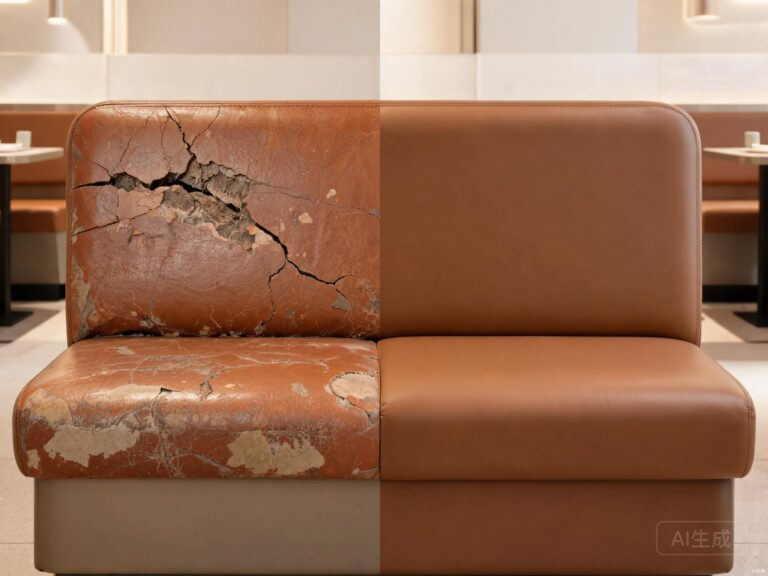
PU (polyurethane) leather is the most common synthetic alternative — a PU coating on textile backing. It dominates mid-range furniture upholstery because it balances cost, appearance, and basic durability. However, PU degrades through hydrolysis in humid environments, with typical lifespans of 3–5 years in commercial settings before cracking or peeling begins.
PVC (vinyl) leather is the budget option — a plasticized PVC coating on fabric. It is waterproof and cheap but carries the highest compliance risk: phthalate plasticizers appear on REACH SVHC lists, and chlorine content creates end-of-life disposal problems in regulated markets.
Silicone leather is the newest category — 100% silicone polymer cured onto woven backing with zero plasticizers, zero solvents, and a temperature range of -40°C to 250°C. It commands a premium unit price but delivers 10+ year lifespans with full eco-certified compliance documentation out of the box.

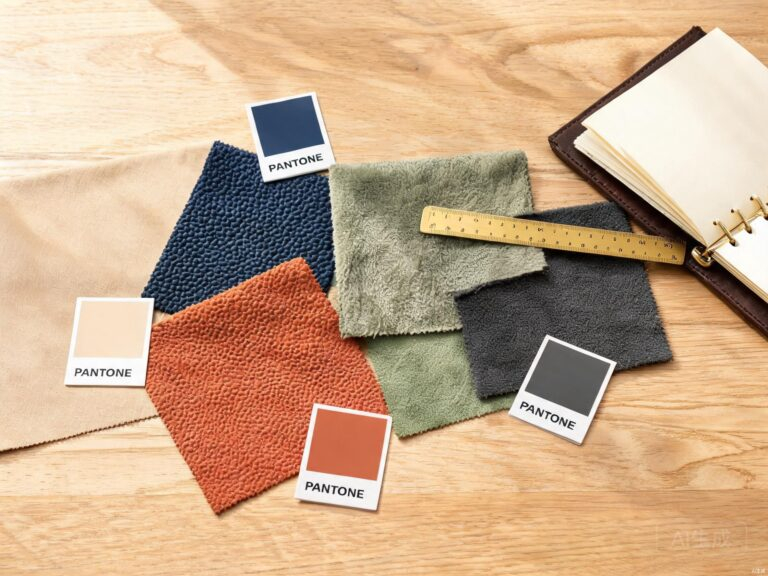
A full-color swatch rack — the first stop for any procurement team evaluating material families
Durability Specifications That Define Commercial-Grade Performance
Procurement teams often specify upholstery fabric using a single metric — thickness. That is a mistake. Thickness tells you nothing about how the material will perform after 50,000 seating cycles in a hotel lobby or 3 years of UV exposure in a sunroom. Four leather upholstery fabric durability specifications should appear on every purchase order for commercial projects.
Martindale abrasion resistance (ISO 12947 or ASTM D4966) measures surface wear under cyclic rubbing. For residential furniture, 25,000 cycles is acceptable. For commercial hospitality, 50,000 is the floor. Premium silicone leather achieves ≥100,000 cycles — the threshold we verify on every production batch in our testing lab before shipment.
Seam strength and tear resistance determine whether upholstery survives the stress of furniture construction — stretching, stapling, sewing. Request tear strength data (ASTM D2261, minimum 25N for commercial grade) and seam slippage results. Budget synthetics often fail here, leading to seam failure during installation rather than during use.
Color fastness (xenon arc, ISO 105-B02) and flex resistance (Bally flex, ISO 5402) round out the critical four. In our experience, color fastness is where budget materials fail silently — the fabric looks fine at delivery but loses 30–40% of color saturation after 100 hours of xenon arc exposure, equivalent to 6 months of window-adjacent sunlight.

Bending flexibility testing — verifying that upholstery fabric survives repeated flexing without surface cracking
Leather Upholstery Fabric Comparison: Genuine, PU, PVC vs Silicone
When procurement teams ask us for a synthetic leather upholstery fabric comparison, the conversation almost always centers on the same trade-off: upfront cost versus lifecycle value. The table below summarizes what we have observed across hundreds of commercial furniture projects.
| Material Type | Typical Cost ($/m) | Commercial Lifespan | Compliance Risk | Best Application |
|---|---|---|---|---|
| Genuine leather | $15–40 | 8–15 years | Medium (traceability) | Luxury residential, executive offices |
| PU leather | $3–8 | 3–5 years | Low–Medium (VOC) | Mid-range residential, light commercial |
| PVC leather | $2–5 | 2–4 years | High (phthalates, chlorine) | Budget projects, non-regulated markets |
| Silicone leather | $8–18 | 10–15+ years | Low (full compliance docs) | Hospitality, healthcare, premium commercial |
The procurement insight here is not that silicone is always the right choice — it is that the material comparison must include lifecycle cost, not just unit price. A PVC fabric at $3/meter replaced every 3 years costs more over a 12-year furniture lifecycle than silicone at $12/meter replaced once — before factoring in reupholstery labor and downtime.
MOQ, Lead Times, and Supply Chain Risk Management
Supply chain reliability separates functional procurement from strategic procurement. A supplier quoting $0.50 less per meter but requiring 12-week production lead times forces you to carry excess inventory or risk stockouts. When evaluating wholesale leather upholstery fabric suppliers, three supply chain metrics matter more than unit price.
Minimum order quantity (MOQ) determines your flexibility. Standard stock items typically carry MOQs of 100–300 meters. Custom colors or exclusive textures push MOQs to 500–1,000 meters. For pilot projects or product development phases, negotiate sample-to-bulk MOQs — start with 100 meters for evaluation, then commit to bulk after quality verification.
Production lead time includes order processing, manufacturing, quality inspection, and packaging. Standard colors from stock: 7–10 days. Custom colors: 15–25 days. Custom textures with new roller engraving: 4–8 weeks. Always build a 30% buffer into your project timeline for production delays — especially during Q4 peak season when Chinese factories face capacity constraints.
Dual-sourcing strategy is procurement’s best hedge against supply disruption. We have seen buyers who single-sourced from one factory lose 6 weeks when that factory had an equipment failure. Identify a primary supplier (70% volume) and a qualified secondary (30% volume) with pre-approved quality standards. You can read more about supplier evaluation in our commercial upholstery fabric guide.

Finished goods warehouse — visible stock levels signal a supplier’s ability to meet aggressive lead times
When Compliance Audits Derail Your Upholstery Project
Nothing derails a furniture project faster than a compliance failure discovered at customs. We have seen shipments worth $80,000+ held at Rotterdam for 3 weeks because the PVC upholstery fabric lacked a current REACH SVHC declaration. Compliance is not a checkbox — it is a procurement deliverable that must be verified before the PO is issued.
For leather upholstery fabric for commercial furniture destined for regulated markets, procurement must collect four documents minimum: REACH SVHC declaration (EU), California Prop 65 compliance statement (US), VOC emissions test report (for indoor air quality certifications like GREENGUARD or LEED credit), and restricted substances test report (for phthalates, formaldehyde, heavy metals).
In our documentation package, every shipment includes third-party test reports from SGS or Intertek — not factory self-declarations. The difference matters: we worked with a buyer whose previous supplier provided a “REACH compliance certificate” that turned out to be a self-signed declaration with no lab backing. When the buyer’s quality team tested the material independently, phthalate content exceeded SVHC thresholds by 400%. The shipment was rejected, the project was delayed, and the procurement manager spent two months finding a replacement supplier.
Procurement rule: No PO without third-party compliance documentation. A supplier who cannot produce current (within 12 months) test reports from accredited labs is a supply chain risk — regardless of how attractive their pricing looks.

Commercial furniture upholstery — where material choice directly impacts warranty exposure and guest experience
Frequently Asked Questions
What MOQ should I expect for custom leather upholstery fabric orders?
For custom colors (Pantone or RAL matching), expect MOQs of 300–500 meters depending on the supplier and material type. Custom textures with exclusive embossing rollers typically require 500–1,000 meters. Standard stock colors and textures may be available from 100 meters. Always negotiate a pilot-run provision: order 100–200 meters for quality evaluation before committing to the full MOQ. Reliable suppliers will accommodate this with a slight premium on the pilot batch.
How do I verify leather upholstery fabric compliance for EU export?
Request four documents: (1) REACH SVHC declaration from an accredited lab (SGS, Intertek, or TÜV), (2) phthalate test report (if the material contains PVC), (3) formaldehyde emission test, and (4) heavy metals analysis. All reports must be dated within 12 months. Cross-check the lab accreditation number on the report against the lab’s official website. If a supplier provides only a self-declaration without lab backing, treat it as non-compliant and require third-party testing before PO issuance.
Sourcing Upholstery Fabric Strategically
Procurement success in leather upholstery fabric comes down to looking past the unit price line on the quotation. Material type determines lifespan and compliance risk. Durability specifications determine warranty exposure. MOQ and lead times determine inventory carrying costs. And third-party compliance documentation determines whether your shipment clears customs without penalties. Build these four dimensions into your supplier evaluation matrix, and you will avoid the costly surprises that turn a “great deal” into a project delay. For more on sofa-specific applications, see our leather fabric sofa guide.
About TOPSUN
TOPSUN supplies silicone-based leather upholstery fabric to furniture manufacturers, hospitality groups, and commercial interior specifiers across 30+ countries.
Martindale ≥100,000 cycles verified · REACH/PAHs/FDA/Prop 65 compliant · MOQ from 500 meters · 15-day standard lead time · Pantone color matching in 7–15 days · Zero VOC emissions certified