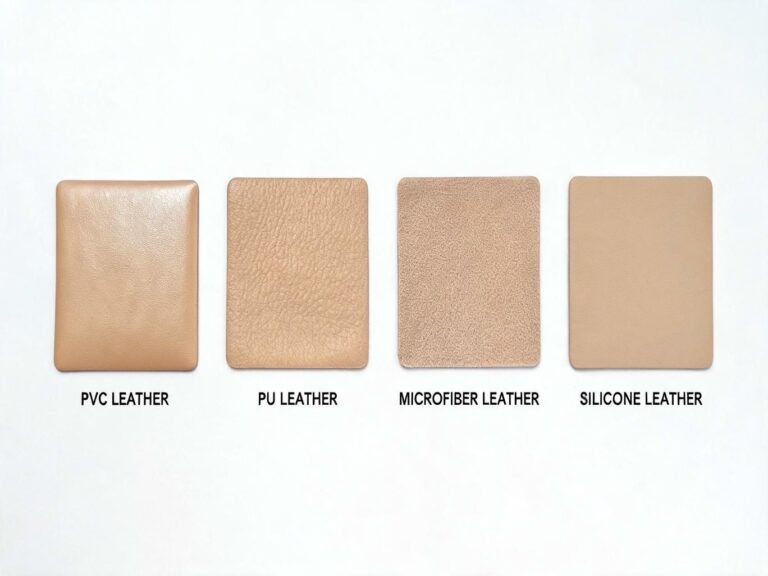
Dimethylformamide (DMF) has been the workhorse solvent of synthetic leather production for decades — and it is now squarely in regulatory crosshairs. The European Chemicals Agency added DMF to its REACH Candidate List of Substances of Very High Concern, and brands across automotive, furniture, and fashion are racing to eliminate it from their supply chains. Solvent free synthetic leather is not just a sustainability talking point; it is becoming a procurement prerequisite.
This guide examines the production technologies behind solvent-free manufacturing, the regulatory timeline driving adoption, and how silicone leather fits into the compliance landscape.
What Makes Synthetic Leather Solvent-Free?
Conventional synthetic leather — both PU and PVC — relies on organic solvents to dissolve and apply the polymer coating onto a fabric backing. DMF is the most common, followed by MEK (methyl ethyl ketone) and toluene. These solvents evaporate during drying, releasing VOCs into the atmosphere and leaving residual chemicals in the finished material.
Solvent-free production replaces this chemistry with reactive systems that cure through chemical crosslinking rather than solvent evaporation. Two main approaches exist:
- Solvent-free PU: Uses 100% solid reactive polyurethane that cures under heat. No water, no solvent — the coating crosslinks directly onto the substrate.
- Silicone coating: Uses addition-cure silicone polymers that crosslink via platinum catalysis. No solvent is introduced at any stage, and the curing byproduct is minimal.
The distinction matters for buyers. “Solvent-free” on a data sheet should mean zero solvent input — not just low solvent content. In our testing of supplier samples, we have found materials marketed as “solvent-free” that still contained 3-5% residual DMF from primer layers. Always request a technical data sheet with GC-MS test results to verify.

Chemical mixing station — solvent-free formulations require precise reactive chemistry rather than solvent dilution.
The DMF Problem: Why Regulations Are Tightening
DMF is classified as toxic to reproduction (Category 1B) under the CLP Regulation. Chronic exposure through skin contact or inhalation causes liver damage and developmental toxicity. The ECHA Candidate List inclusion means that any article containing DMF above 0.1% by weight triggers SVHC notification obligations under REACH Article 33.
Beyond REACH, three regulatory frameworks are accelerating the phase-out:
- ZDHC Roadmap to Zero: Over 170 signatory brands (including Nike, Adidas, H&M, Inditex) commit to zero discharge of hazardous chemicals. DMF is on the ZDHC Restricted Substances List with progressive limit reductions.
- China’s GB standards: China has introduced emission limits for DMF in synthetic leather factories (GB 21902), pushing domestic producers toward solvent-free technology.
- Oeko-Tex Standard 100: The 2025 update further tightened DMF limits across all product classes, affecting materials destined for consumer contact.
Compliance tip: If your end customer is a ZDHC signatory brand, your material must meet MRSL (Manufacturing Restricted Substances List) limits — not just finished product limits. This means the production process itself must be solvent-free, not just the output.
Solvent Free Synthetic Leather vs Water-Based PU
Water-based PU is often confused with solvent-free PU, but the two are distinct technologies with different compliance profiles. Water-based PU replaces organic solvents with water as the carrier medium — a significant improvement, but it still requires co-solvents (typically 5-15% NMP or NEP) for film formation. Solvent-free PU eliminates all carriers through reactive chemistry.
Silicone leather takes the concept further by changing the polymer system entirely. Since silicone polymers cure through platinum-catalyzed addition reactions, no solvent or co-solvent is needed at any stage — not even in the primer. The table below compares the four main approaches:
| Method | VOC Emissions (g/m²) | DMF Residual | Regulatory Risk |
|---|---|---|---|
| Conventional Solvent PU | 80–150 | 100–500 ppm | High — SVHC notification |
| Water-Based PU | 10–30 | 10–50 ppm (co-solvent) | Moderate — NMP under review |
| Solvent-Free PU | 1–5 | Not detectable | Low — compliant with ZDHC |
| Silicone Leather | <1 | Zero (no DMF used) | Minimal — inherently SVHC-free |
The cost implication is real but narrowing. Solvent-free PU typically carries a 15-25% premium over conventional PU, while silicone leather commands a higher premium but delivers longer service life and broader certification coverage. For applications where water-based PU was previously the default upgrade, solvent-free PU and silicone are becoming viable alternatives as scale increases.

Solvent-free coating line — no solvent recovery towers or exhaust scrubbers needed, reducing both capex and compliance burden.
Production Technology: How Zero-VOC Coating Works
The technical challenge of solvent-free production is achieving uniform coating without a carrier solvent to level the polymer. TOPSUN solves this through a knife-over-roll coating process with precision viscosity control. The silicone formulation is mixed as a two-component system — base polymer and platinum catalyst — that begins crosslinking immediately upon application.
Key process parameters that differ from solvent-based production:
- Viscosity window: Reactive systems have a narrow working window (2000-5000 mPa·s) before gelation begins, requiring precise metering and temperature control.
- Cure temperature: Silicone coatings cure at 150-180°C, comparable to solvent-based PU, but without the flash-off zone needed for solvent evaporation.
- Line speed: Without solvent drying, the production line can run faster — TOPSUN achieves 8-12 m/min compared to 5-8 m/min for solvent PU on comparable substrates.
- Air handling: No solvent recovery system is needed. The exhaust air contains only trace moisture from the substrate, not VOC-laden solvent vapor.
One of our furniture clients evaluated both solvent-free PU and silicone leather for a contract seating program. The silicone option eliminated the need for a solvent recovery unit in their factory — a capex saving of approximately $200,000 — while meeting the same durability targets at 50,000 Martindale cycles. Read more about our manufacturing process for technical details.
Watch how TOPSUN’s zero-VOC production line operates — no solvent fumes, no recovery towers, no DMF exposure.
Cost and Compliance: The B2B Sourcing Equation
The decision to switch to solvent-free synthetic leather involves more than material unit cost. Procurement teams should calculate the total compliance cost — the sum of material cost, testing cost, certification cost, and risk cost.
- Testing cost: Each SVHC notification requires third-party testing ($500-1,500 per test). Solvent-free materials that are inherently SVHC-free reduce ongoing testing burden.
- Certification cost: Oeko-Tex and ZDHC certifications require annual renewal and audit fees. Materials that exceed limits require corrective action plans.
- Risk cost: A single SVHC violation can trigger product recalls, customer chargebacks, and brand reputation damage. The cost of non-compliance often exceeds the material cost premium within a single production cycle.
- Waste cost: Solvent-based production generates hazardous waste (spent solvents, contaminated rinse water) that requires licensed disposal. Solvent-free production generates only inert waste.

Water-based and solvent-free PU lines share some equipment, but solvent-free eliminates the wastewater treatment stage entirely.
For buyers sourcing high-performance materials for regulated applications, the equation increasingly favors inherently solvent-free options. The 15-25% material premium is offset by eliminated testing cycles, simplified compliance documentation, and reduced supply chain risk. Understanding the hidden problems with conventional PU leather helps frame this cost-benefit analysis.
Frequently Asked Questions
Is solvent-free PU leather the same as water-based PU?
No. Water-based PU replaces organic solvents with water but still requires 5-15% co-solvents (NMP or NEP) for film formation. Solvent-free PU uses 100% solid reactive chemistry with no water and no solvent. Silicone leather goes further by using a completely different polymer system that requires no solvent at any production stage.
Does solvent-free synthetic leather cost more than conventional PU?
The material unit cost is typically 15-25% higher for solvent-free PU and higher still for silicone leather. However, the total compliance cost — including testing, certification, waste disposal, and risk — often narrows or eliminates the gap. One client saved $200,000 in equipment capex by eliminating solvent recovery infrastructure.
The Road Ahead for Low-Emission Materials
The regulatory trajectory is clear: DMF restrictions will tighten, ZDHC limits will decrease, and brand requirements will become more stringent. Solvent free synthetic leather is not a future trend — it is a present-day compliance requirement for any supplier serving regulated markets. The question for B2B buyers is not whether to transition, but which solvent-free technology offers the best combination of performance, cost, and future-proofing.
Silicone leather’s inherent solvent-free chemistry, combined with its durability and certification breadth, positions it as a material that solves the compliance equation without requiring ongoing offsetting or process workarounds.
About TOPSUN
TOPSUN engineers solvent-free silicone leather through an addition-cure coating process that requires no DMF, no MEK, and no toluene at any stage of production, serving automotive, furniture, and consumer electronics manufacturers facing tightening VOC regulations.
Zero-solvent silicone formulation · REACH SVHC-free · ZDHC-aligned production · Oeko-Tex Standard 100 certified