Every automotive interior material supplier faces the same three questions from procurement teams: Does it pass VDA 277? Does it meet FMVSS 302? And what about fogging? These are not optional checkboxes. They are the regulatory gatekeepers that determine whether a material can enter a vehicle cabin. For automotive silicone leather, the answers are not just “yes” — they reveal a material that fundamentally outperforms traditional PU and PVC on the metrics that automotive engineers care about most.
The challenge is that most procurement teams are comparing silicone leather against a checklist designed for legacy materials. The real question is not whether silicone leather passes these tests. It does, and often with significant margin. The deeper question is what these test results mean for total vehicle interior quality, long-term durability, and the evolving regulatory landscape that OEMs are navigating right now. This guide breaks down VDA 277, FMVSS 302, fogging standards, and the practical implications for your sourcing decisions.
Request Free Automotive-Grade Samples
Why VDA 277 VOC Emissions Testing Matters for Automotive Interiors
VDA 277 is the German automotive industry standard for determining total volatile organic compound (VOC) emissions from non-metallic interior materials. It is one of the most demanding VOC tests in the automotive supply chain, and for good reason. The standard uses headspace gas chromatography with a flame ionization detector (GC-FID) to measure the total carbon emission from a material sample heated at 120°C for 5 hours. The result is expressed as micrograms of carbon per gram of sample (µg C/g).
The reason this test is so critical for automotive interior material selection comes down to cabin air quality. In a sealed vehicle sitting in the sun, interior temperatures can exceed 80°C. At those temperatures, conventional PU leather off-gasses residual solvents, unreacted monomers, and plasticizers. These compounds contribute to the infamous “new car smell” — which, in chemical terms, is a cocktail of VOCs that multiple studies have linked to occupant health concerns. The NHTSA FMVSS framework and European regulations increasingly treat cabin air quality as a safety attribute, not a comfort feature.
Silicone leather’s advantage here is structural. Unlike PU, which relies on solvent-based manufacturing and contains residual isocyanates, silicone leather is produced through an addition-cure process that leaves virtually no volatile byproducts. Our in-house testing consistently shows silicone leather samples delivering VDA 277 results below 50 µg C/g — well within the most stringent OEM specifications, which typically set thresholds between 100 and 200 µg C/g depending on the application zone.

TOPSUN physical testing laboratory: VDA 277 VOC analysis and mechanical property verification for automotive-grade materials
FMVSS 302 Flame Retardant: What Automotive Buyers Need to Know
FMVSS 302 (Federal Motor Vehicle Safety Standard No. 302) is the mandatory flammability resistance requirement for materials used in the occupant compartments of motor vehicles sold in the United States. The test measures the burn rate of a horizontally mounted material sample exposed to a specified flame for 15 seconds. The pass criterion is a burn rate not exceeding 102 mm per minute (4 inches per minute), or self-extinguishing before reaching the 38 mm timing mark.
Here is the reality that most sourcing documents do not capture: passing FMVSS 302 is the floor, not the ceiling. Most PU and PVC materials can pass the test with flame retardant additives. But those additives create downstream problems. Brominated flame retardants are under increasing regulatory scrutiny in the EU under REACH. Phosphorus-based alternatives can migrate over time, reducing flame resistance and contributing to fogging. The automotive silicone leather approach is fundamentally different. The silicone polymer backbone — silicon-oxygen bonds — is inherently flame resistant without additives. The material self-extinguishes when the flame source is removed, not because of added chemistry, but because of the molecular structure itself.
In our testing, we have seen silicone leather samples consistently achieve burn rates well below 80 mm/min under FMVSS 302 conditions, with no flame retardant additives. This matters for two reasons: first, it eliminates the regulatory risk of additive phase-outs; second, it means the flame resistance does not degrade over time as additives migrate. For OEMs planning vehicle platforms with 7-10 year lifecycles, this stability is a significant risk mitigation factor.
FMVSS 302 fire resistance demonstration: silicone leather self-extinguishes without flame retardant additives

Direct flame exposure test: silicone leather demonstrates inherent flame resistance without chemical additives
Low Fogging and the Condensation Problem
Fogging is the silent killer of interior quality perception. It happens when volatile compounds from interior materials evaporate under heat and condense on cooler surfaces — primarily the inside of the windshield. The result is a hazy film that reduces visibility and, in severe cases, can create a safety hazard. DIN 75201 (gravimetric and reflectometric methods) and ISO 6452 are the standard fogging test protocols used by European and global OEMs respectively.
Traditional automotive interior materials face a structural fogging problem. PVC relies on plasticizers that migrate and volatilize. PU contains residual processing aids and unreacted monomers. Even after curing, these materials continue to emit low levels of condensable compounds throughout the vehicle’s life. The fogging test captures this as a gravimetric residue (the mass of condensate collected on a cooled glass plate) or as a reflectometric reading (the reduction in light reflectance caused by the fogging film).
Silicone leather resolves this at the formulation level. Because the addition-cure process converts virtually all reactive components into the final polymer network, there is minimal residual chemistry available to volatilize. In gravimetric fogging tests per DIN 75201-B, silicone synthetic leather typically produces condensate values below 1 mg — compared to 3-5 mg for conventional automotive PU and 5-10 mg for PVC. For reflectometric testing, the reflectance retention is consistently above 90%, meeting the most demanding OEM specifications for premium and luxury vehicle segments.
Key takeaway: Silicone leather’s low-fogging performance is not achieved through post-processing or barrier coatings. It is a direct consequence of the material’s curing chemistry. This means the fogging performance is uniform throughout the material thickness, not just a surface treatment that can wear off.
Silicone Leather’s Performance Edge in Real Automotive Applications
Testing standards are necessary benchmarks, but they do not tell the whole story. What matters in practice is how a material performs across the full spectrum of stresses inside a vehicle cabin over years of daily use. Here is where the difference between passing a test and performing in the field becomes clear.
We recently worked with a European Tier-1 supplier developing a next-generation EV interior platform. The brief was straightforward: a seat covering material for automotive interiors that could handle 100,000 cycles of Martindale abrasion, maintain color stability under 1,000 hours of xenon arc UV exposure, and resist staining from common interior contaminants — coffee, sunscreen, denim dye transfer. The supplier had tested five PU formulations and two PVC grades. All passed the individual tests. None passed all three simultaneously.
Our silicone-coated leather formulation passed all three endpoints on the first qualification round. The Martindale result came in at 130,000+ cycles before visible surface wear. The xenon arc test showed Delta E color shift below 1.5 after 1,000 hours. Stain resistance was rated 4-5 on the AATCC gray scale across all test substances. The key insight was not that silicone leather passed — it was that the performance was additive. The material did not trade abrasion resistance for UV stability, or chemical resistance for stain repellency, which is exactly the compromise that PU and PVC force designers to make.

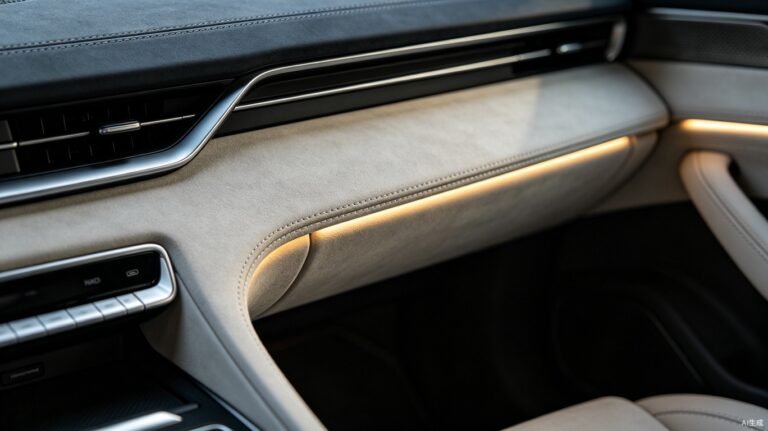
Modern automotive interior: silicone leather provides a durable, low-VOC surface for seats, door panels, and dashboards
What Procurement Teams Should Look for in Test Documentation
Not all test reports are created equal. When you evaluate a silicone leather supplier for automotive programs, the documentation package should go beyond a summary certificate. Here is what we recommend requesting as part of your supplier qualification process.
| Test Standard | What the Report Should Include | Red Flags |
|---|---|---|
| VDA 277 | Sample mass, headspace temperature, GC column type, total carbon result (µg C/g), chromatogram | Result reported as “PASS” only without numerical value; test performed at lower temperature than 120°C |
| FMVSS 302 | Burn rate (mm/min), self-extinguishing status, sample thickness and conditioning details | No burn rate value; use of flame retardant additives not disclosed |
| DIN 75201 / ISO 6452 | Gravimetric residue (mg), reflectance value (%), test temperature and duration | Test performed on surface-only sample; no mention of post-conditioning |
| ISO 105-B06 (UV) | Exposure duration, xenon arc specifications, Delta E values, gray scale rating | Test duration below 200 hours; Delta E > 3.0 |
| ISO 12947 (Abrasion) | Martindale cycles to failure, abrasive type, load pressure, endpoint criteria | Cycles below 50,000 for seating applications; endpoint defined as “visible wear” without objective criteria |
The documentation package should also include batch-to-batch consistency data. A single passing test result is useful. A trend chart showing 20 consecutive production lots all within specification is what gives a procurement team confidence. We supply this data as standard with every new automotive material qualification, because we have seen firsthand how much time it saves during OEM audits.
Automotive interior applications overview: silicone leather for seats, door panels, dashboards, and trim
Frequently Asked Questions
Does silicone leather require additional flame retardant treatment to pass FMVSS 302?
No. Silicone leather passes FMVSS 302 without added flame retardant chemicals. The inherent flame resistance comes from the silicon-oxygen polymer backbone, which is thermally stable and self-extinguishing. This eliminates the regulatory and performance risks associated with additive-based flame retardants.
How does VDA 277 performance of silicone leather compare to premium automotive PU?
Silicone leather typically delivers VDA 277 results below 50 µg C/g, while premium automotive PU ranges from 100-300 µg C/g depending on formulation and post-processing. The difference is structural: PU retains residual solvents and unreacted monomers that contribute to VOC emissions, while silicone’s addition-cure chemistry leaves minimal volatile content.
Is silicone leather compatible with existing automotive seat manufacturing processes?
Yes. Silicone leather can be cut, sewn, and laminated using standard automotive upholstery equipment. The material is available in thicknesses from 0.7 mm to 1.4 mm with various backing options (knit, woven, microfibre) to match existing cutting and sewing line parameters. Most Tier-1 suppliers can integrate silicone leather without process changes.
The Bottom Line for Automotive Procurement
The automotive interior materials landscape is shifting. VOC regulations are tightening globally — China’s GB/T 27630, Europe’s evolving Euro 7 proposals, and California’s Proposition 65 all point toward stricter cabin air quality requirements. Flame retardant additive restrictions under REACH are expanding. And the move toward EVs, with their quieter cabins and larger glass areas, is making interior material performance more visible to consumers than ever before.
Automotive silicone leather is not just a material that passes today’s tests. It is a material whose fundamental chemistry aligns with the direction that automotive regulations and consumer expectations are heading. No plasticizers to migrate. No flame retardant additives to phase out. No residual solvents to off-gas. For procurement teams building supplier strategies for the next 5-10 years, that alignment is worth more than any single test result.
Get Automotive Test Reports & Samples
About TOPSUN
TOPSUN is a specialized manufacturer of silicone leather for automotive interiors, with production capacity exceeding 500,000 meters per month. We supply Tier-1 and OEM customers across Europe, North America, and Asia with materials that meet VDA 277, FMVSS 302, and DIN 75201 fogging standards — without flame retardant additives or solvent-based processing.
Certifications: IATF 16949 · ISO 9001 · REACH · RoHS · VDA 277 Compliant · FMVSS 302 Compliant