As a material specifier, I’ve learned that asking what leather is made of gets you different answers depending on who you ask. A tanner says “collagen.” A chemist says “cross-linked protein fibers stabilized by chromium complexes.” A PU manufacturer says “polyurethane resin on polyester backing.” A silicone leather producer says “polysiloxane derived from silica.” They’re all correct — and they’re all describing fundamentally different materials sold under the same word. For B2B buyers, understanding what leather is made of at the molecular level isn’t academic trivia. It’s the difference between specifying a material that lasts 15 years and one that peels in 24 months.
Download Composition Spec Sheet
Leather Is Made Of Collagen: The Protein Foundation
Genuine leather is made of collagen — the most abundant protein in the mammalian body. An animal hide is approximately 65% water, 30% protein (predominantly collagen), 3% fat, and 2% minerals. When the water and non-collagen proteins (keratins, globular proteins) are removed through the beamhouse process, what remains is a dense network of collagen fibers arranged in a three-dimensional interlocking matrix. That fiber network is the structural foundation of leather — everything else in the tanning process exists to preserve and modify it.
Collagen’s molecular structure is a triple helix — three polypeptide chains twisted around each other like a rope. This helical arrangement gives leather its characteristic combination of tensile strength and flexibility. Cowhide is the dominant raw material globally because cattle collagen is particularly dense and uniformly arranged, making it ideal for upholstery and furniture applications. Goat, sheep, and pig hides produce softer but less durable leather due to looser fiber packing. The silicone leather introduction matters here because collagen’s properties — porous, moisture-responsive, organic — create inherent limitations that silicone’s inorganic Si-O-Si structure doesn’t share.
Leather is made of collagen. But “faux leather” is made of polyurethane or PVC. And “silicone leather” is made of polysiloxane. Three materials, one word.

The raw materials lifecycle display shows every stage from silica to finished silicone leather.
From Hide to Finished Leather: The Tanning Process
The journey from raw hide to finished leather involves 12-14 distinct stages, but they all serve one purpose: permanently bonding a tanning agent to the collagen fibers so the hide stops decomposing. The factory production process for silicone leather is fundamentally different — no animal inputs, no tanning chemicals — but understanding the traditional process clarifies why “leather” carries chemical liabilities that synthetic alternatives don’t.
Chrome tanning dominates industrial production — approximately 90% of global leather output. It uses chromium(III) salts to cross-link with collagen’s carboxyl groups, stabilizing the protein structure in days rather than months. The result is soft, supple, water-resistant leather. The trade-off: chromium residues remain in the finished product at trace levels, requiring REACH and California Proposition 65 compliance disclosure. Vegetable tanning uses tannins extracted from tree bark (oak, chestnut, mimosa) and takes 30-60 days, producing firmer leather with a richer patina but higher cost. Both processes consume significant water volumes and generate effluent requiring treatment.

The silicone leather production flow chart — no tanning, no chromium, no animal inputs.
What PU and PVC Leather Are Made Of
The materials labeled “faux leather” or “vegan leather” in most B2B spec sheets are polyurethane (PU) or polyvinyl chloride (PVC). Both are carbon-based polymers derived from petrochemical feedstocks. PU leather is made of a polyurethane resin coating bonded to a fabric backing (polyester, cotton, or microfiber). The coating provides the leather-like appearance and initial water resistance. PVC leather adds phthalate plasticizers to rigid PVC to achieve flexibility — without plasticizers, PVC is a rigid pipe material.
The chemical reality behind these materials explains their performance limits. PU production uses dimethylformamide (DMF) as a primary solvent — a substance classified as a reproductive toxin under EU regulations. Phthalate plasticizers in PVC migrate out of the material over time, causing the embrittlement and cracking that defines PVC leather’s 2-5 year failure window. Neither material is biodegradable. Both shed microplastics throughout their service life. When procurement teams ask what artificial leather material options are made of, these chemical facts should appear on the spec sheet — not just the product name.

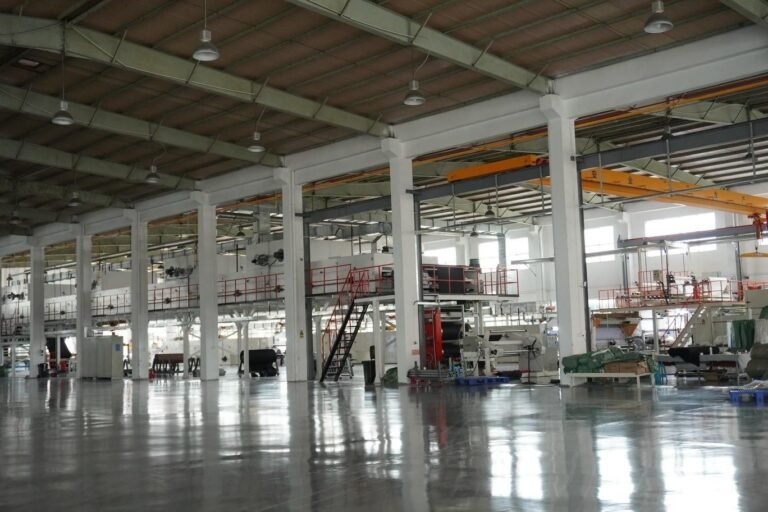
Solvent-free production means no DMF drums in TOPSUN’s workshops — a visible difference from PU manufacturing.
What Silicone Leather Is Made Of
Here’s where the material story changes fundamentally. Silicone leather is made of polysiloxane — a synthetic polymer built on a silicon-oxygen-silicon (Si-O-Si) molecular backbone. The silicon is derived from silica (SiO₂), commonly known as sand — the second most abundant element in the Earth’s crust. This is not a petrochemical product. It’s a material engineered from one of the most plentiful raw materials on the planet.
The three-layer structure of TOPSUN’s silicone leather is transparent on a spec sheet: a 100% food-contact-grade silicone coating layer, a 100% silicone adhesive layer (solvent-free), and a backing fabric (polyester, microfiber, or custom substrates). No plasticizers provide the flexibility — the Si-O-Si chain is inherently flexible at the molecular level. No DMF is used in production. No phthalates, no BPA, no heavy metals. The eco-friendly silicone leather composition means the material passes ISO 10993-5 biocompatibility testing and FDA 21 CFR 177.2600 food-contact standards without chemical treatment or modification.
| Material | Primary Component | Source | Chemical Class |
|---|---|---|---|
| Genuine Leather | Collagen fibers | Animal hide | Protein (organic) |
| PU Leather | Polyurethane resin | Petrochemical | Carbon polymer |
| PVC Leather | Polyvinyl chloride + phthalates | Petrochemical | Carbon polymer |
| Silicone Leather | Polysiloxane (Si-O-Si) | Silica (sand) | Silicone polymer (inorganic) |
An introduction to silicone leather properties — from molecular composition to end-use performance.

The “what is it made of” question applies to all leather alternatives — not just traditional animal hide.
Frequently Asked Questions
Is leather a natural material or synthetic?
Genuine leather is a natural material — it’s preserved animal hide, primarily collagen protein. However, the tanning process uses synthetic chemicals (chromium salts, syntans, dyes) that permanently alter the collagen structure. The Leather Working Group provides environmental certification for tanneries, but certified leather still contains tanning residues. Silicone leather is synthetic but derived from silica — a natural mineral — not petroleum.
What makes silicone leather different from PU leather chemically?
The fundamental difference is the molecular backbone. PU leather is built on carbon-carbon (C-C) bonds requiring plasticizers for flexibility — those plasticizers migrate and cause degradation. Silicone leather is built on silicon-oxygen-silicon (Si-O-Si) bonds that are inherently flexible without additives. This is why silicone leather maintains its properties for 10-15+ years while PU begins hydrolyzing within 2-5 years. You can learn more about what vegan leather is made of and how silicone compares to other synthetics.
Composition Is Destiny
The question “what is leather is made of” reveals more than material trivia — it exposes the entire performance curve of a product. Collagen gives genuine leather its strength and breathability but also its chemical liabilities (tanning residues) and maintenance burden (conditioning, UV sensitivity). Carbon polymers give PU and PVC their low cost but also their 2-5 year failure window and microplastic shedding. The Si-O-Si backbone of silicone leather gives it inherent flexibility, non-porosity, UV stability, and zero-VOC production — properties that don’t require additives to maintain. For B2B sourcing teams, the molecular composition on the spec sheet is the most reliable predictor of lifecycle performance. Ask what your leather is made of. The answer determines everything that follows.
About TOPSUN
TOPSUN produces silicone leather made from 100% pure polysiloxane derived from silica — the second most abundant element on Earth — engineered into non-porous, stain-resistant surfaces for furniture, automotive interiors, and medical applications where material composition directly determines regulatory compliance and long-term performance.
Solvent-free manufacturing · FDA 21 CFR 177.2600 food-contact · ISO 10993-5 biocompatibility · 100% recyclable · Zero plasticizers, zero phthalates, zero DMF