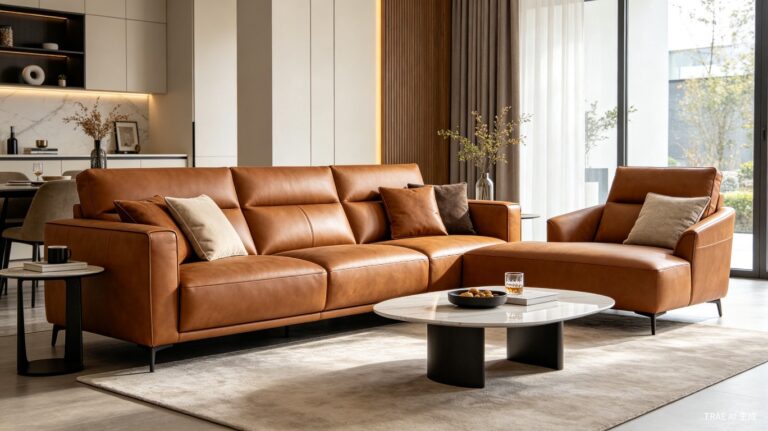
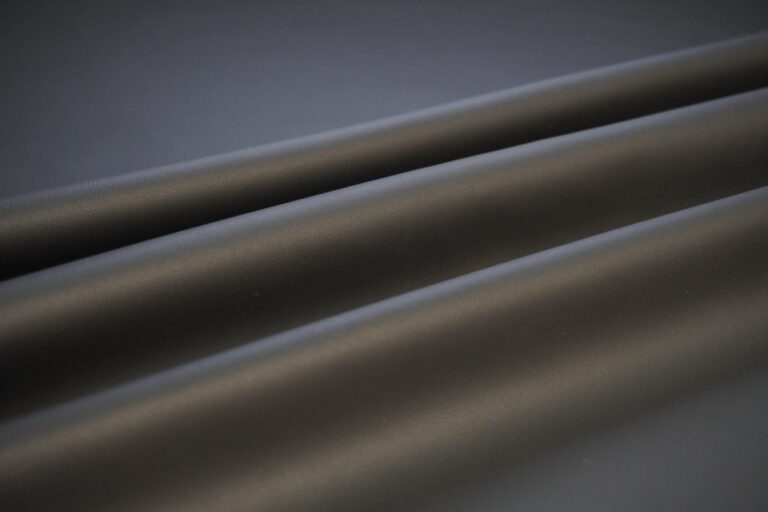
Run two fingers across the samples on the studio board. The first vegan microfiber swatch resists, then gives: a dense, short pile, matte as felt, forgiving to a scratchy thumbnail. The second swatch is cool and closed. It takes the light, throws it back in a controlled sheen, and wipes clean with one pass of a cloth.
Both swatches carry the same class of base fabric, a nonwoven of ultra-fine fibers built to imitate the collagen network of hide. They behave like two different materials because, at the surface, they are two different materials. One route buffs the fibers open. The other seals them under a functional film. This article is the spec-desk comparison: what each route does, where each one wins, and how to write the line that picks between them.

Two skins, one skeleton: the difference between your two swatches is made in the last finishing passes.
The Suede Route: Buffed Fiber, Open Pile
The suede route starts where every microfiber build starts, with the fiber skeleton. Then it diverges. A buffing pass cuts the surface fibers, leaving a dense, uniform pile of fiber ends. Touch is the physics of those ends. Your hand meets thousands of elastic tips, not a sealed film, which is why the surface reads warm, matte, and forgiving. The open pile is also why the material breathes. Micro-porosity between fibers passes water vapor while holding back liquid droplets, a property documented in microstructure analyses of microfiber constructions.
Spec it for touch-led programs: garment panels, luxury trim, steering wraps, and matte surfaces where a sheen would read as plastic. Its liabilities are the same pile. It shades under directional light, so cutting layouts must run one way. It drinks liquids unless a barrier finish is specified. And pile crush at high-contact points is a wear signature no re-stretch fixes.
The Smooth Route: Skin Over Structure
The smooth route builds a napa face. A thin functional film, typically micro-porous polyurethane, coats the fiber skeleton and takes an embossing pattern. Touch now comes from two layers: the softness of the film itself and the micro-geometry of the emboss. The surface is closed, continuous, and wipeable, which is why it dominates public-facing programs.
Spec it where cleaning cycles, color matching, and light behavior outrank tactile warmth: contract seating, headrests, public transport interiors, and device covers. Its liability is the film. The film is the first layer to age, the layer that hydrolysis attacks, and the layer whose emboss slowly flattens. When a smooth-face vegan microfiber fails in the field, it fails at the skin, not the skeleton.

The smooth face: film softness plus emboss geometry, closed enough to wipe clean in one pass.
The Same Skeleton Under Both Skins
Here is the part of the comparison most spec sheets miss. Both routes sit on the same structure: a three-dimensional network of ultra-fine fibers doing the load-bearing, with elastomer filling the gaps. Microstructure studies describe it as rebar and concrete. The fiber network carries tear strength, tensile strength, and dimensional stability. The elastomer bonds the network, cushions it, and resists abrasion.
The consequence for the spec desk is straightforward. Strength numbers belong to the base, and both routes inherit them. Aging behavior belongs to the surface, and the routes split there. Consumer-facing durability roundups put daily-use life for vegan microfiber and standard PU in the same 2-to-5-year band, with stress and sun exposure deciding the gap. The differentiation that matters is not strength. It is which surface failure mode your program can live with: pile wear or film wear.

Same skeleton in every roll: the route is chosen at the finishing line, not the coater.
The Spec Desk: Six Dimensions, Two Columns
The studio board compresses into the table below. Six dimensions, two columns, and a verdict you can write into a spec line.
| Dimension | Suede route | Smooth route |
|---|---|---|
| First hand impression | Warm, matte, forgiving pile | Cool, controlled sheen |
| Breathability | High, open pile passes vapor | Moderate, film limits vapor |
| Cleanability | Needs barrier finish | One-pass wipeable |
| Directional light | Shades with nap direction | Consistent in any layout |
| Aging signature | Pile crush, nap loss | Film wear, emboss flattening |
| Best programs | Wearables, trim, acoustic panels | Contract seating, public interiors |
Where vegan claims must survive a compliance review, ask for the input declaration alongside the spec. The word vegan is a content claim, not a texture claim, and the claim rules now in force penalize loose wording. The organic vegan leather audit in this series covers that language. Our silicone microfiber line is the third option when a program needs microfiber hand with silicone-grade aging data behind it, and the fashion and sports applications page shows where suede-route programs run today.

In the cabin, the routes split the program: touch-led wraps take pile, wipeable panels take film.
The Decision Tree
Work top to bottom. The first yes answers your spec line.
Does the surface meet skin for hours at a time, in wearables, steering wraps, or premium seating arms? Yes: write the suede route, add a barrier finish, and mark nap direction on the cutting plan. No: continue. Does the program run public cleaning cycles with aggressive wipes, or sit under display lighting where color lots must match? Yes: write the smooth route, and specify film thickness plus emboss depth. No: continue.
Is the program acoustic, matte, or deliberately anti-gloss? Yes: suede route, with a pile-height tolerance logged. Is it outdoor-adjacent or high-UV? Then neither route alone: write the UV-stabilized construction into the spec, because sun kills both skins faster than use does. The verdict this comparison promises: suede wins touch, smooth wins specification control, and the skeleton you never see carries both.
Two Questions the Board Gets Every Week
Is vegan microfiber genuinely vegan? As a rule, yes: the fiber and the elastomer are synthetic, with no animal inputs. The risk sits in finishes and processing aids. Ask for a supplier declaration covering every input, the same document compliance teams use to defend the word vegan.
Which route lasts longer? The base carries the strength for both. The smooth route’s film is usually the first layer to age under sun and humidity. The suede route ages by pile wear instead. Specify by the failure mode your program tolerates, and demand the aging file either way.
Talk to Our Design Team
Request Suede-and-Smooth Sample Sets
References
1. https://www.sdmicrofiber.com/newsdetails.asp?id… — Microstructure physics: buffed fiber ends create the suede hand; micro-porous PU film plus emboss creates the napa face; fiber network as load-bearing frame
2. https://www.winiwmicrofiber.com/news/battle-of-… — Consumer durability roundups: vegan microfiber and PU in the same 2–5 year daily-use band, sun exposure as the deciding stress