A procurement team recently sent us a spec sheet requesting upcycled leather material for a 50,000-unit furniture contract. The document listed no certification requirements, no bonding agent specifications, and no recycled content thresholds. That gap between sustainability ambition and procurement reality is exactly where most upcycled leather projects fail — not in the marketing, but in the material science.
The term “upcycled leather” gets used loosely across the industry. Some suppliers mean mechanically reconstituted fiber sheets; others mean chemically bonded scrap composites. The performance difference between these two is enormous, and the certification paths are completely different. If your team is evaluating upcycled leather material for bulk procurement, the definitions, manufacturing processes, and compliance frameworks below will help you separate genuine circular materials from greenwashed bonded leather.
Download Sustainability Datasheet

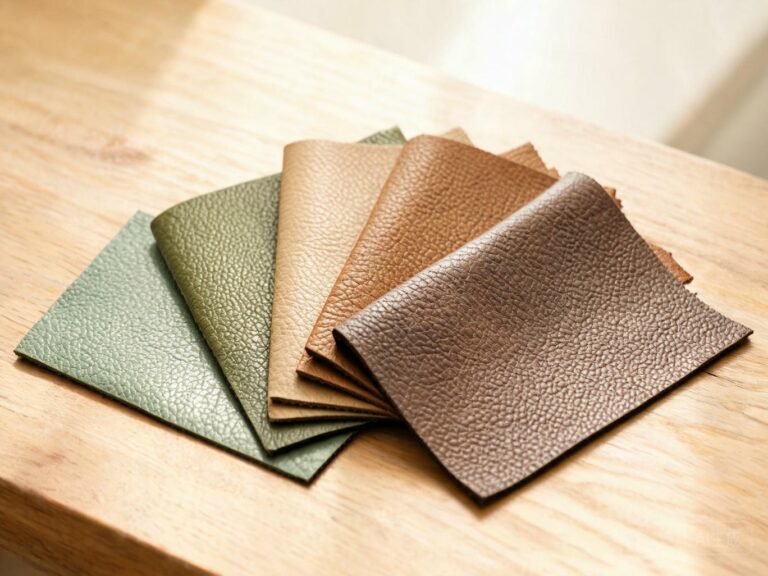
Raw material lifecycle display — understanding input streams is the first step in verifying upcycled content claims.
What Is Upcycled Leather Material? Industry Definitions Decoded
There is no single ISO or ASTM standard that defines “upcycled leather material” as a distinct product category. The term is a marketing-driven label that encompasses several materially different products. Understanding what you are actually buying requires digging past the label into the manufacturing process.
The three most common products sold under the upcycled leather umbrella are:
- Bonded leather — leather scraps and fibers ground into a pulp, then bonded with polyurethane or latex binders onto a fabric backing. Typically contains 10-30% actual leather fiber. The remainder is binder, backing fabric, and surface coating.
- Reconstituted fiber sheets — leather trimmings mechanically processed into nonwoven sheets without chemical binders. Higher recycled content (60-90%) but lower structural integrity and tear strength.
- Upcycled offcut composites — larger leather pieces stitched or laminated together to create patchwork sheets. Closest to genuine leather in hand feel but limited in roll width and color consistency.
The UNIDO Guidelines for Assessing the Environmental Footprint of Leather, released in 2026, provides a harmonized framework for measuring environmental impacts across the leather value chain — but it does not define upcycled leather as a separate category, according to the Sustainable Leather Foundation’s announcement. This means buyers must rely on supplier documentation and third-party certifications rather than a unified industry standard.
Manufacturing Realities: How Processing Determines Performance
The bonding method is the single most influential variable in upcycled leather performance. In our testing lab, we have observed that the binder system — not the leather fiber content — determines roughly 80% of the material’s durability profile, including delamination resistance, flex endurance, and UV stability.
Here is what happens with each common bonding approach:
- Polyurethane-bonded: The most common and cheapest method. PU binder holds fibers together but degrades under UV and repeated flexing. Delamination typically begins at edges and seams within 2-4 years of commercial use.
- Latex-bonded: Natural rubber latex offers better flexibility than PU but has poor ozone resistance. Not suitable for automotive or outdoor applications despite the “natural” marketing appeal.
- Thermally bonded: Fibers fused through heat and pressure without chemical binders. Highest recycled content but lowest tear strength — suitable for decorative applications, not load-bearing upholstery.
In one project we reviewed, a hotel chain specified bonded leather for 800 guest room headboards based on a 40% recycled content claim. Within 18 months, the PU binder began breaking down under ambient UV from windows, causing surface peeling across 30% of the installations. The recycled content was real — the durability was not. This is the core tension in upcycled leather material sourcing: sustainability credentials do not automatically translate to field performance.

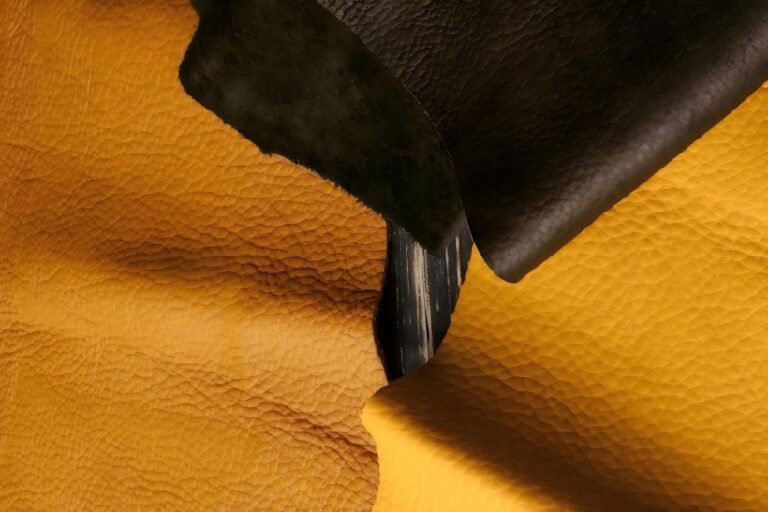
Physical testing laboratory — Martindale abrasion, flex endurance, and peel strength tests reveal the gap between recycled content claims and real-world durability.
GRS Certification and Chain-of-Custody Verification
The Global Recycled Standard (GRS), managed by Textile Exchange, is the most widely recognized third-party certification for recycled content materials. It requires a minimum of 20% recycled content for certification eligibility and 50% for use of the GRS label. The standard also covers chain-of-custody traceability, social and environmental practices, and chemical restrictions throughout the supply chain.
However, GRS certification has a critical limitation for leather buyers: it was designed primarily for textile supply chains. When applied to leather, the certification verifies that recycled fiber content meets the threshold, but it does not test the performance characteristics of the final composite material. A GRS-certified bonded leather with 50% recycled fiber can still delaminate in two years.
The Sustainable Leather Foundation (SLF) is working to bridge this gap with its own certification scheme, which combines environmental footprint assessment with product performance criteria. SLF is currently pursuing UKAS accreditation, which would give its certification independent third-party credibility. For now, B2B buyers should treat GRS as a necessary but insufficient qualification — pair it with your own durability testing.
A practical supplier verification checklist for upcycled leather material:
- Request the GRS Transaction Certificate (TC) for the specific batch — not just the facility-level certification
- Ask for the recycled content percentage breakdown by weight, including binder and backing
- Require Martindale abrasion test results (minimum 25,000 cycles for decorative, 50,000+ for seating)
- Demand a full chemical disclosure including chromium VI, formaldehyde, and azo dye testing
- Verify chain-of-custody from offcut source through to finished roll — request input/output mass balance records

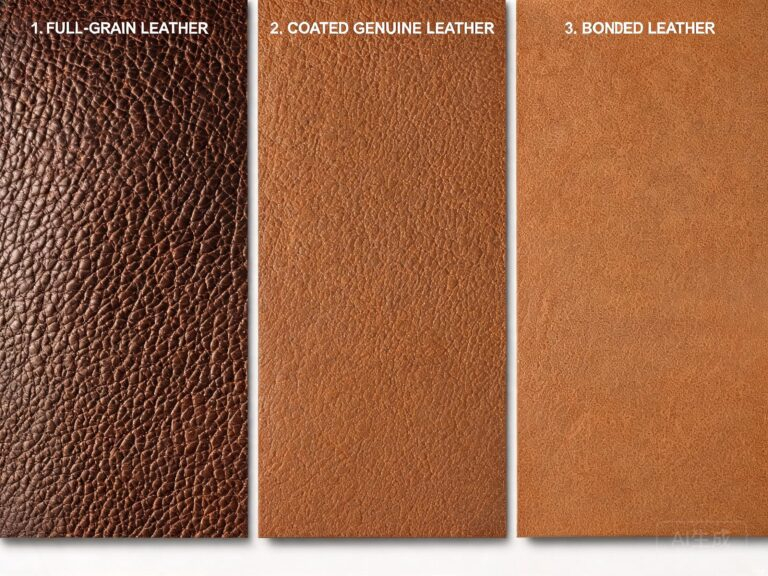
Material texture comparison — visual and tactile differences between upcycled leather, bonded leather, and virgin synthetic alternatives.
Performance Gaps in Upcycled Leather Material Bulk Orders
When you scale from prototype to bulk production, the performance inconsistencies in upcycled leather material become amplified. Batch-to-batch variation in fiber source, binder ratio, and curing conditions can produce rolls that look identical but perform completely differently in the field. This is the hidden cost that most sustainability-focused procurement teams discover too late.
The comparison below illustrates the trade-offs across material categories. It is based on data we have compiled from supplier testing reports and our own laboratory evaluations of commercially available upcycled and bonded leather samples.
| Material Type | Source Input | Bonding Method | Typical Lifespan | Certification Path |
|---|---|---|---|---|
| Bonded Leather | Ground leather scraps (10-30%) | PU or latex binder on fabric | 2-4 years (delamination risk) | GRS eligible; no performance standard |
| Reconstituted Fiber Sheet | Leather trimmings (60-90%) | Thermal or mechanical bonding | 3-6 years (low tear strength) | GRS eligible; SLF assessment |
| Virgin Silicone Leather | 100% silicone polymer (no animal input) | Solvent-free coating on base fabric | 10-15+ years | REACH, PAHs, ISO 10993; zero-waste process |
The table reveals a fundamental procurement dilemma: materials with the highest recycled leather content tend to have the shortest service life, while materials engineered for longevity (like solvent-free silicone leather) do not contain recycled animal leather at all. The sustainability calculus depends on whether you prioritize circular material input or total lifecycle footprint.

Production process flow — TOPSUN’s zero-waste coating line reprocesses production offcuts into regrind feedstock for subsequent batches.
A lifecycle perspective changes the equation. A material that lasts 12 years and is manufactured through a zero-waste process may deliver a lower total environmental footprint than a bonded leather product that requires replacement every 3 years — even if the bonded leather contains 50% recycled fiber. This is why forward-thinking procurement teams are shifting their sustainability criteria from “percentage of recycled content” to “total environmental impact per year of service life.”
Frequently Asked Questions
Does upcycled leather material meet REACH and ZDHC chemical limits?
Not automatically. The leather fibers themselves may contain residual chromium, azo dyes, or heavy metals from the original tanning process. The PU binder can introduce VOCs and phthalates. REACH compliance must be verified through batch-level chemical testing — specifically for chromium VI, formaldehyde, and restricted aromatic amines. Request a ZDHC Manufacturing Restricted Substances List (MRSL) conformity report from the supplier. If they cannot provide one, treat the material as non-compliant regardless of recycled content claims.
Can upcycled leather achieve Martindale abrasion ratings above 50,000 cycles?
Rarely. Most commercially available bonded and upcycled leather products test between 15,000 and 35,000 Martindale cycles. The PU binder breaks down before the leather fibers do, creating surface pilling and eventual delamination. For comparison, solvent-free silicone leather routinely exceeds 200,000 Martindale cycles because the silicone polymer itself is the wearing surface — there is no separate binder layer to fail. If your application requires 50,000+ cycles (commercial seating, transit, hospitality), upcycled leather material is generally not the right specification.
About TOPSUN
TOPSUN manufactures solvent-free silicone leather through a zero-waste coating process that diverts production offcuts into regrind feedstock for subsequent batches — eliminating the landfill waste stream that makes traditional leather manufacturing environmentally costly. Our approach to circularity is built into the process, not bolted on as a marketing claim.
Our facility maintains ISO 14001 environmental management certification, full REACH chemical disclosure for every production batch, and batch-level traceability protocols compatible with GRS chain-of-custody requirements. We also hold ISO 10993 biocompatibility certification for medical-grade applications and PAHs compliance for consumer products. For buyers who need both sustainability credentials and verified durability, our silicone leather material provides a 10-15 year service life with a manufacturing process designed to minimize total environmental footprint per year of use.
If your procurement team is evaluating upcycled leather material against alternative sustainable options, request our sustainability documentation pack. It includes GRS-compatible traceability records, REACH/ZDHC chemical test reports, Martindale and flex endurance data, and a lifecycle comparison worksheet that calculates total environmental impact per year of service life across material categories.
Request Sustainability Documentation Pack
Related reading: PU Polyurethane Leather Procurement Guide | Silicone vs PU Material Comparison | TOPSUN Factory Production Process