The Coffee Spill That Cost a Hotel Chain $40K in Replacements
A housekeeping supervisor at a mid-scale hotel chain contacted us in late 2025 after a guest spilled a venti dark roast across a lobby bench seat. The bench was upholstered in mid-grade PU leather — marketed as “stain resistant” by the supplier. The coffee soaked in within 90 seconds. By the time housekeeping arrived with their designated synthetic leather cleaner, the stain had set. That single bench cushion cost $340 to replace. Across 120 lobby benches in the chain, the annual replacement rate from similar staining incidents was running at 8% — roughly $40,000 per year in material and labor costs alone.
The supplier’s marketing sheet listed “soil resistant” as a feature. It did not specify which test standard was used, what stain agents were tested, or what classification the material achieved. The hotel had assumed “soil resistant” meant “coffee wipes off.” It did not.
This is not an isolated case. We hear variations of this story every month — from restaurant groups replacing booth seating after tomato sauce penetration, from automotive OEMs fielding warranty claims for denim dye transfer on light interiors, from dental clinics where betadine solution permanently stains examination chair upholstery. The gap between “soil resistant” as a marketing term and “soil resistant” as a tested, classified material property is where B2B buyers lose money.
This article breaks down what soil resistant leather actually means, which test standards matter, how five common stains expose the difference between marketing claims and material science — and why silicone leather is the only material that passes all five without specialized cleaning products.
Why PU Leather Fails Stain Tests: The Porous Surface Problem
Polyurethane leather is manufactured by coating a fabric backing with a liquid polyurethane slurry that cures into a solid film. The surface appears smooth, but at the microscopic level, the cured PU film contains micro-voids and unreacted isocyanate groups that create a slightly porous, high-surface-energy finish. High surface energy means the material wants to bond with liquids — it attracts rather than repels.
When coffee hits a PU surface, the liquid does not bead up. It spreads. The colored compounds — melanoidins from the roasting process — seep into the micro-voids within 60-120 seconds. Once inside the polymer matrix, they cannot be extracted by surface wiping. The stain becomes structural, not superficial.
This is the same mechanism that makes PU leather vulnerable to denim dye transfer (indigo particles embedding in the surface), ballpoint pen ink (solvent-based pigments penetrating micro-voids), and betadine (iodine complexes bonding with the polymer). The material’s own chemistry works against it.
PVC leather performs slightly differently — its surface is non-porous but the plasticizers that give PVC its flexibility can leach out over time, creating a tacky surface that grabs and holds particulate stains. Neither material offers inherent soil resistant fabric properties. Both require aftermarket surface treatments — typically fluorocarbon-based DWR (durable water repellent) coatings — to achieve stain resistance. These coatings wear off after 6-12 months of regular cleaning.
AATCC 130 and CFFA-141: What Stain Resistance Tests Actually Measure
Two testing standards define soil resistance in the textile and synthetic leather industry:
AATCC 130 — Soil Release: Stain Recovery. This test measures how completely a stain can be removed from a fabric after a specified cleaning protocol. A staining agent is applied, allowed to set for a defined period, then laundered or cleaned according to a standardized procedure. The residual stain is graded on a scale: Class 5 (no visible stain) to Class 1 (severe staining). The test does not measure whether the material resists staining — it measures how well the stain comes out after it has already penetrated.
CFFA-141 — Stain Resistance. This is the more demanding test. Multiple staining agents are applied to the material surface and evaluated for resistance — not just removability. The material is rated Class 1 (poor) to Class 5 (excellent) for each agent. A material that claims “stain resistant” without specifying CFFA-141 classification is not making a verifiable claim.
Here is the data that matters: commercial-grade PU leather typically scores Class 3 to Class 5 on CFFA-141 depending on grade and surface treatment. PVC leather scores Class 2 to Class 4. Silicone leather scores Class 5 across all common stain categories — including bleach-cleanable performance, which is an increasingly critical requirement in healthcare and hospitality settings.

Water droplet beading on silicone leather — the low-surface-energy finish that makes soil resistance inherent, not coated
5 Real-World Stains: Coffee, Ink, Betadine, Mustard, Denim Dye
These five stains represent the most common and costly damage categories across hospitality, healthcare, automotive, and furniture applications. Here is how each material performs against each agent — based on our testing data and published industry results:
| Stain Agent | PU Leather | PVC Leather | Silicone Leather |
|---|---|---|---|
| Coffee (90 sec contact) | Class 2 — absorbs | Class 3 — partial | Class 5 — wipes off |
| Ballpoint ink | Class 1 — permanent | Class 2 — stains | Class 5 — wipes off |
| Betadine (iodine) | Class 2 — bonds | Class 3 — partial | Class 5 — wipes off |
| Mustard (turmeric) | Class 3 — fades slowly | Class 3 — partial | Class 5 — wipes off |
| Denim dye transfer | Class 2 — embeds | Class 2 — stains | Class 5 — wipes off |
CFFA-141 stain resistance classification — Class 5 (excellent) to Class 1 (poor). Data compiled from TOPSUN test reports and published industry comparisons.
PU leather fails 3 of 5 stain tests at Class 2 or below. The denim dye transfer result is particularly relevant for automotive and furniture buyers — indigo particles from raw denim embed in the PU micro-voids and cannot be extracted without damaging the surface coating. This is why light-colored PU automotive interiors show blue tinting on seat bolsters within 12-18 months of daily use.
Silicone Leather Stain Resistance: The Low-Surface-Energy Advantage
Silicone leather achieves Class 5 stain resistance without any aftermarket coating or surface treatment. The resistance is inherent to the material’s chemistry. Here is why:
Silicone leather is built on a polydimethylsiloxane (PDMS) backbone — a polymer chain with alternating silicon-oxygen bonds. PDMS has a surface energy of approximately 20-24 mN/m, which is below the surface tension of virtually all common liquids. Water has a surface tension of 72 mN/m. Coffee: roughly 50-60 mN/m. Oils: 30-35 mN/m. Mustard: 40+ mN/m. When any of these liquids contact a silicone leather surface, they cannot wet it — they bead up and roll off before they can penetrate.
This is the same principle that makes silicone bakeware non-stick. The same principle that makes rain roll off a duck’s feathers. It is a physics property of the material, not a coating that wears off. The silicone polymer network does not have micro-voids like PU — it is a continuous, dense matrix. And because the Si-O backbone does not hydrolyze in water or oxidize under UV, the low-surface-energy property does not degrade over time.
In our cleaning and maintenance testing, silicone leather resists coffee, ink, betadine, permanent marker, ketchup, olive oil, red wine, mascara, sunscreen, and denim dye — all wiped clean with a damp cloth alone. No specialized cleaner. No scrubbing. No conditioner. The only agents that silicone leather is not resistant to are hair dye and organic solvents (acetone, toluene) — these can swell the silicone network.

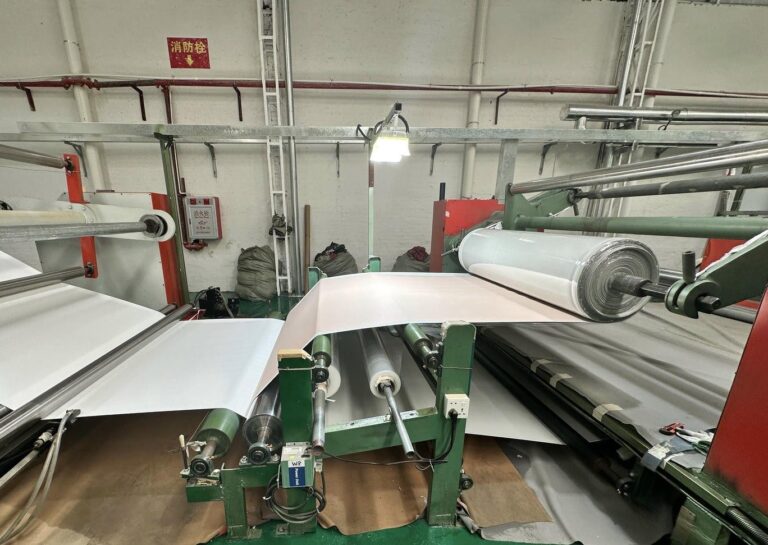
Finished silicone leather rolls — inherent soil resistance requires no aftermarket coating
Bleach Cleanability: The Healthcare Standard PU Cannot Meet
Post-2020, bleach cleanability has moved from a nice-to-have to a hard requirement in healthcare and hospitality procurement. Hospital environmental services teams routinely wipe patient room surfaces with 1:10 bleach solutions (5,000-6,000 ppm sodium hypochlorite). Restaurant chains require booth seating that withstands sanitizing wipes containing quaternary ammonium compounds.
PU leather cannot meet this standard. Repeated exposure to sodium hypochlorite breaks down the urethane bonds in the polymer backbone, causing yellowing, embrittlement, and eventual cracking. The surface coating degrades first — then the underlying polymer loses flexibility. In accelerated bleach exposure testing, PU leather shows visible surface degradation after 25-30 wipe cycles with 5,000 ppm bleach.
Silicone leather’s Si-O backbone is chemically inert toward sodium hypochlorite and quaternary ammonium disinfectants. The material withstands repeated wiping with hospital-grade disinfectants without surface degradation — verified through our ISO 10993-5:2009 biocompatibility certification testing, which includes cytotoxicity assessment after chemical exposure. For medical and healthcare applications, this means the upholstery can be sanitized to clinical standards without being destroyed in the process.

Flexibility testing after chemical exposure — verifying silicone leather maintains mechanical properties post-sanitization
Your Soil-Resistant Leather Action Checklist
If you are specifying soil resistant leather for a B2B application, here is the checklist that separates tested materials from marketing claims:
- □ Request CFFA-141 test data. Ask the supplier for the actual CFFA-141 classification report — not a marketing claim of “stain resistant.” The report should list individual stain agents and the Class rating achieved for each. If the supplier cannot produce this, the claim is unverified.
- □ Verify bleach cleanability for healthcare/hospitality. Request the number of wipe cycles the material withstands at 5,000 ppm sodium hypochlorite before visible degradation. Silicone leather should exceed 100 cycles. PU typically fails at 25-30.
- □ Ask whether stain resistance is inherent or coated. If the resistance comes from a surface treatment (DWR, fluorocarbon coating), ask how many cleaning cycles the treatment survives before it wears off. Inherent resistance — built into the polymer chemistry — does not degrade.
- □ Test with your actual stain agents. Send the supplier samples of the specific substances your end-users encounter — coffee, betadine, denim, food stains, disinfectants. Wipe them yourself. A 90-second contact test in your office tells you more than any datasheet.
- □ Calculate cleaning labor cost, not just material cost. PU leather requires weekly light cleaning + monthly deep cleaning + quarterly conditioning with dedicated products. Silicone leather requires a damp cloth. Over a 5-year service life, the labor and product savings typically exceed the material price premium.
- □ Confirm AATCC 8 crocking Class 5. Colorfastness to rubbing — both dry and wet — should be Class 5. This means no dye transfers onto the leather from contact, and no dye rubs off the leather onto adjacent materials.
About TOPSUN: TOPSUN manufactures silicone leather with inherent soil-resistant properties for B2B buyers across hospitality, healthcare, automotive, and furniture sectors. Every production batch is verified through CFFA-141 Class 5 stain resistance ratings, AATCC 8 Class 5 crocking colorfastness, and ISO 10993-5:2009 biocompatibility testing — including chemical resistance to hospital-grade disinfectants. The PDMS backbone provides low-surface-energy stain resistance that does not wear off, requiring only a damp cloth for cleaning. Custom colors, textures, and thicknesses from 0.23mm to 2.0mm are available with standard production lead times.
FAQ
Can silicone leather resist permanent marker and ink?
Yes. In our stain resistance testing, permanent marker and ballpoint pen ink wipe off silicone leather with a damp cloth — no solvent, no scrubbing. The low-surface-energy PDMS finish prevents ink pigments from wetting the surface or penetrating the polymer matrix. This is verified through CFFA-141 Class 5 classification. Note: silicone leather is not resistant to hair dye and organic solvents (acetone, toluene), which can swell the silicone network. For more on cleaning and maintenance protocols, see our dedicated guide.
Is soil-resistant leather the same as stain-resistant leather?
Not exactly. “Soil resistant” typically refers to resistance against particulate dirt and dry soil accumulation — measured by standards like AATCC 130 soil release. “Stain resistant” refers to resistance against liquid staining agents — measured by CFFA-141. Silicone leather satisfies both definitions because its low-surface-energy finish repels both dry particulates (which cannot embed in the dense polymer matrix) and liquid stains (which bead up and roll off). Many suppliers use the terms interchangeably, which is technically imprecise. When evaluating materials, ask for both test data sets.
The Bottom Line
Soil resistance is not a coating you apply. It is not a marketing term you print on a datasheet. It is a material property measured by CFFA-141 classification, verified by AATCC 8 crocking data, and proven by wiping coffee off a surface with a damp cloth. PU leather fails 3 of 5 common stain tests. PVC fails 4 of 5. Silicone leather passes all 5 — without specialized cleaners, without aftermarket coatings, and without degrading over time. If your specification requires material that stays clean through years of daily use with nothing but water and a cloth, that is the material to specify.
Video: TOPSUN Silicone Leather Stain Resistance Test — 5 Real-World Stains — contact us for the video showing coffee, ink, betadine, mustard, and denim dye tested on PU vs silicone leather side by side.