PVC leather material starts dying the day it leaves the factory. The plasticizers that make it soft enough to mimic leather — typically phthalates like DEHP or DINP — begin migrating to the surface immediately. Within 24 months, the material has lost enough plasticizer to become brittle, cracked, and potentially non-compliant with REACH SVHC limits. This is not a manufacturing defect. It is the material’s inherent chemistry. For B2B buyers specifying pvc leather material in 2026, understanding these three failure modes is the difference between a product that ships and one that gets recalled.
The 3 Failure Modes of PVC Leather Material
PVC (polyvinyl chloride) leather material fails in three predictable ways. Each one is a direct consequence of the material’s molecular structure — not a quality control issue that a better supplier can solve.
1. Plasticizer Leaching (Month 6–18). PVC is naturally rigid — without plasticizers, it is essentially the same material as PVC pipe. To make it flexible enough for upholstery, manufacturers add phthalates at concentrations of 20–40% by weight. These plasticizers are not chemically bonded to the PVC polymer chain. They are physically mixed in, which means they migrate out over time — through surface contact, heat exposure, and evaporation. As plasticizer leaves the material, the surface hardens, loses flexibility, and eventually cracks. In our testing, PVC leather material shows measurable shore-A hardness increase of 15–20 degrees within 18 months of ambient exposure — a direct indicator of plasticizer loss.
2. UV-Induced Dehydrochlorination (Month 12–24). When UV light hits PVC, it triggers a chain reaction called dehydrochlorination. The polymer releases hydrogen chloride gas, which both degrades the material structurally and creates an acidic environment that accelerates further breakdown. The visible result is yellowing, followed by surface cracking and embrittlement. PVC leather material typically shows visible UV damage within 1,000 hours of accelerated weathering — compared to silicone leather’s 1,000+ hours with zero degradation.
3. Compliance Failure on Restricted Substances (Ongoing). REACH Annex XVII restricts DEHP, DBP, BBP, and DIBP to ≤ 0.1% (1,000 ppm) each in articles placed on the EU market. PVC leather material that was compliant at the factory may become non-compliant as plasticizers migrate and concentrate at the surface — or as regulatory thresholds tighten. PVC is classified as the “highest risk material” for import compliance testing, requiring the most extensive phthalate panels and carrying the highest rejection rate at customs.

Chemical mixing equipment — the starting point where PVC resin, plasticizers, and stabilizers are combined. The chemistry that creates flexibility also creates the failure timeline.
The Regulatory Timeline: Why 2026 Is the Tipping Point
The regulatory pressure on PVC leather material is not a future possibility — it is a present reality. Multiple regulations are converging in 2026 to make PVC sourcing increasingly risky for B2B manufacturers:
- EU REACH Annex XVII Entry 63 (November 2024): Banned lead content above 0.1% in PVC articles — effective immediately for new production. Recycled soft PVC, which often contains legacy lead stabilizers, is effectively barred from the EU market.
- REACH SVHC list (2026 update): The European Chemicals Agency’s SVHC list continues expanding. As of 2026, the EU enforces zero-tolerance for SVHC in imported textiles, requiring DMF-free, water-borne alternatives.
- U.S. EPA TSCA rules (October 2026): Expected to prohibit distribution of articles containing PIP (3:1), impacting fashion and footwear manufacturing equipment that processes PVC.
- Phthalate restrictions (DEHP, DBP, BBP, DIBP): Restricted to ≤ 1,000 ppm each under REACH. These are the same phthalates used as primary plasticizers in PVC leather material — meaning compliant PVC requires alternative plasticizers like DOTP, which cost more and have less long-term data.
Regulatory signal: PVC leather material is classified as “highest risk” for import compliance testing. Each shipment requires phthalate panel testing (4+ types), azo dye testing, and heavy metal screening. Failed shipments are destroyed or returned — at the buyer’s cost.
PVC Leather Material vs Alternatives: A Compliance Matrix
The compliance landscape makes the material comparison stark. Here is how PVC leather material stacks up against PU and silicone across the compliance factors that determine whether your product clears customs:
| Compliance Factor | PVC | PU | Silicone |
|---|---|---|---|
| Phthalate content | High (20–40% by weight) | Low (some formulations) | Zero |
| REACH SVHC risk | High — highest testing burden | Moderate — DMF residues | Low — no restricted substances |
| VOC emission | Contains plasticizers | Contains solvents | Zero / near-zero |
| UV stability | Cracks in 1–2 years | Cracks in 1–2 years | 1,000+ hours stable |
| Recyclability | No (chlorinated polymer) | Limited | Yes (100% recyclable) |
| Service life | 2–3 years | 3–5 years | 10+ years |
The pattern is clear: PVC leather material carries the highest compliance burden, the shortest service life, and the worst recyclability of the three options. The cost savings per meter — typically $1–2 less than PU — evaporate when you factor in testing costs, failed shipments, and replacement cycles. For a deeper analysis, our silicone vs PU comparison provides the technical baseline for evaluating alternatives.

Flame retardant testing — PVC releases toxic hydrogen chloride gas when burned, a safety concern that silicone leather does not share.

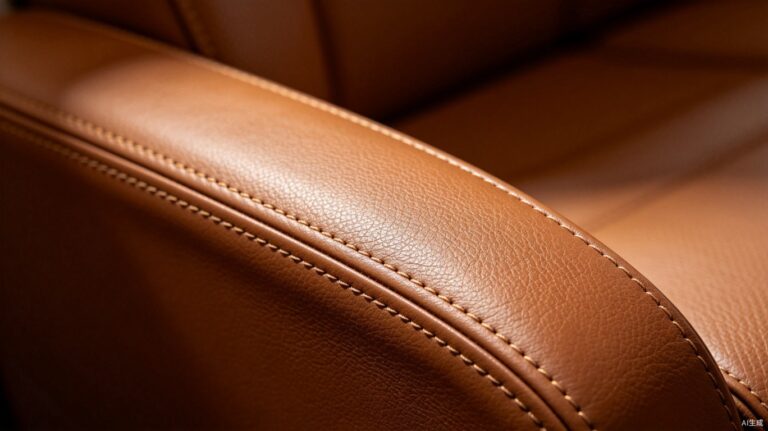
PVC leather surface under close inspection — the plasticizer sheen that gives initial softness is the same compound that migrates, cracks, and fails compliance testing.
What Replaces PVC: The Material Migration Path
Three B2B categories are quietly phasing out PVC leather material in 2026: automotive interiors (driven by ELV recyclability mandates), children’s products (driven by phthalate bans), and medical surfaces (driven by disinfection compatibility requirements). The replacement material in each category shares a common requirement: zero restricted substances, long service life, and full compliance documentation.
For manufacturers making the transition, the path typically follows: PVC → PU (cost-optimal interim) → silicone (compliance-optimal long-term). PU eliminates the phthalate problem but retains solvent and hydrolysis issues. Silicone eliminates all three failure modes — plasticizer leaching, UV degradation, and compliance risk — but carries a higher upfront cost. The application requirements determine which step of the migration path is appropriate for your product.
For manufacturers already past the PVC stage and evaluating the PU-to-silicone step, the eco-friendly silicone leather option provides a PVC-free, phthalate-free, solvent-free alternative with verified compliance documentation. The key is to make the transition proactively — before a failed customs inspection or a product recall forces it.
For those still weighing PVC against alternatives, reviewing PVC leather industry alternatives or the PVC vs PU comparison provides the full decision framework.
The Material That Fails Itself
PVC leather material is not failing because of poor manufacturing. It is failing because its molecular structure cannot maintain flexibility, UV stability, or compliance over a commercially viable service life. The plasticizers that make it work are the same molecules that leach out, trigger regulatory action, and concentrate at the surface where human contact occurs.
The B2B buyers who specify PVC leather material in 2026 are buying a material with a known expiration date — 24 months, give or take, before the compliance and performance costs exceed the initial savings. The alternative is not a better PVC formulation. It is a different chemistry entirely: silicone, which does not rely on plasticizers, does not leach restricted substances, and does not degrade under UV. The migration is happening now. The question is whether you lead it or follow it.
About TOPSUN
TOPSUN manufactures PVC-free silicone leather for B2B buyers who need material that passes REACH SVHC testing without restricted plasticizers or heavy metals — replacing PVC with a chemistry that does not fail itself.
Solvent-free dry coating process | Zero phthalate content verified by SGS | FDA 21 CFR 177.2600 food-contact compliant | 100% recyclable at end-of-life | REACH, RoHS compliant