A furniture brand sent us two rolls of pu pvc leather last quarter — one PU, one PVC — both sourced from a major Guangzhou supplier, both carrying the same “premium synthetic leather” label. Within 14 days of accelerated aging in our lab (70°C, 95% RH), the PU sample showed surface hydrolysis. The PVC sample lost 12% of its weight to plasticizer off-gassing. Neither material would survive 5 years in real-world commercial use. The synthetic leather market reached $48.13 billion in 2025, with PU and PVC leather accounting for over 80% of total volume. But behind those numbers sits a failure curve that every B2B procurement team needs to understand before specifying either material.
Request PU vs PVC Comparison Swatches
PU vs PVC Leather: The Chemistry That Decides Lifespan
The difference between PU and PVC leather starts at the molecular backbone — and that chemistry determines everything that follows. PU leather is built on polyurethane, a polymer linked by urethane bonds. PVC leather uses polyvinyl chloride, a chlorine-based polymer that requires 30-40% plasticizer by weight to achieve any flexibility. These are not minor formulation differences. They are the root cause of every failure mode, compliance gap, and cost-overrun we document in B2B applications.
| Parameter | PU Leather | PVC Leather | Silicone Leather |
|---|---|---|---|
| Polymer backbone | Polyurethane (urethane bonds) | Polyvinyl chloride (C-Cl bonds) | Silicone (Si-O bonds) |
| Plasticizer content | None (intrinsic flexibility) | 30-40% by weight | None |
| Process solvent | DMF (0.3-1.0% residual) | None (dry process) | Zero solvent |
| Martindale abrasion | 20K-50K cycles | 100K-150K cycles | 200K+ cycles |
| Service life | 3-7 years | 2-5 years | 10+ years |
| Price per meter | $10-18 | $5-10 | $20-30 |
The PVC Martindale advantage (100K-150K vs PU’s 20K-50K) is misleading. PVC achieves that abrasion resistance through hardness — the same property that causes it to crack at flex points within 24-36 months. PU is softer and more comfortable but hydrolyzes faster. Neither material offers the 200K+ Martindale cycles and 10+ year service life that our production lines deliver with silicone leather chemistry.

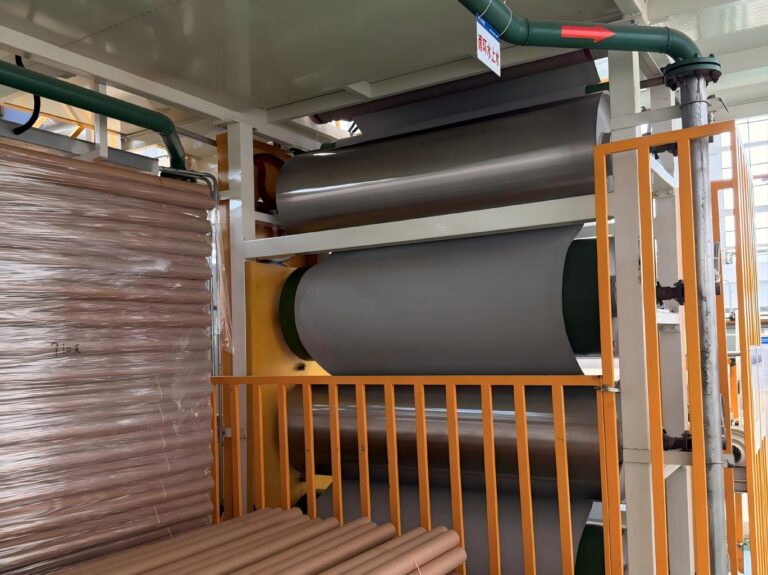
Base fabric substrate on conveyor line — the starting point for both PU and PVC leather coating processes.
Failure Mode Showdown: Hydrolysis vs Plasticizer Migration
PU leather dies by hydrolysis. PVC leather dies by plasticizer migration. Understanding both mechanisms is essential for any B2B buyer evaluating pu pvc leather for multi-year applications. We’ve tested both in our lab under ISO 11507 accelerated aging conditions — the data tells a clear story of two materials failing through entirely different pathways.
PU leather hydrolysis: Water molecules attack the urethane bonds in the polymer backbone. In standard PU, this process begins within 18-24 months in humid environments (70%+ RH). By year 3, surface peeling appears. By year 5, the coating layer delaminates from the base fabric entirely. Premium PU formulations using polycarbonate diol can extend this to 5-7 years, but at a 40-60% price premium that erases the cost advantage over silicone leather.
PVC plasticizer migration: The 30-40% plasticizer content in PVC is physically blended, not chemically bonded. Over time, these plasticizers migrate to the surface, evaporate, and leach out through contact and cleaning. The material loses flexibility progressively, hardening at flex points — armrests, seat edges, curved seams — until visible cracking appears. In our accelerated tests, PVC samples lost 12% weight in 14 days at 70°C. Real-world cracking typically appears at 24-36 months in commercial environments.

Coating and leveling machine in operation — where PU or PVC coating is applied to base fabric substrate.
The failure timelines overlap. PU dies from within — the polymer chain breaks down. PVC dies from without — it loses the additives that make it functional. For a procurement team specifying materials for 5-year-plus commercial applications, both failure modes mean the same thing: warranty claims, replacement costs, and brand damage.
The 5-Year Lab Test: PU PVC Leather Performance Data
We ran parallel accelerated aging tests on standard PU leather and PVC leather samples sourced from three different suppliers. The test protocol followed ISO 11507 (UV exposure) and ISO 9227 (salt spray) standards, simulating 5 years of commercial use. The results below show why neither pu pvc leather variant qualifies for long-term B2B applications.
| Test Parameter (5-Year Sim.) | PU Leather | PVC Leather | Silicone Leather |
|---|---|---|---|
| Tensile strength retention | 40% (lost 60%) | 65% (lost 35%) | 98%+ (negligible loss) |
| Surface condition | Peeling, delamination | Hardening, cracking | No visible change |
| Flex resistance (cycles) | Failed at 25K | Failed at 15K | 50K-100K+ passed |
| UV stability (1,000 hrs) | Yellowing, micro-cracks | Fading, brittleness | No fading or yellowing |
| VOC emission (ISO 16000-6) | DMF detected | Phthalate SVOCs detected | Zero VOC |
| Temperature tolerance | -20°C to 80°C | -10°C to 60°C | -40°C to 250°C |
The data is unambiguous. PU fails through hydrolysis-driven tensile loss. PVC fails through plasticizer-driven embrittlement. Both produce VOC emissions that fail ISO 16000-6 indoor air quality thresholds. Silicone leather, by contrast, retains 98%+ tensile strength and shows zero VOC emissions after the same 5-year simulation — because the Si-O backbone is inherently resistant to hydrolysis, UV, and thermal degradation.

Synthetic fabric comparison display — PU and PVC leather samples alongside alternative materials for B2B evaluation.
Compliance Trap: REACH DMF and Prop 65 Phthalates
Beyond physical failure, pu pvc leather carries a dual compliance burden that no procurement team can ignore. PU leather faces REACH Annex XVII Entry 76, which restricts DMF at 0.3% — and standard PU leather routinely contains 0.3-1.0% residual DMF from the wet-coating process. The restriction became enforceable in December 2023. For EU-bound shipments, this means customs documentation must include DMF concentration data and risk management measures.
PVC leather faces a different but equally severe compliance wall. California Prop 65 lists six phthalates — BBP, DEHP, DIDP, DBP, DnHP, and DINP — all commonly found in PVC leather at 30-40% by weight. The OEHHA warning thresholds require clear and reasonable exposure warnings for products containing listed phthalates above safe harbor limits. For B2B brands selling into California, this means either reformulation or Prop 65 warnings on product packaging. Neither is a good outcome.
The silicone vs PU vs PVC comparison data is clear on this point. Silicone leather contains zero DMF, zero phthalates, and zero plasticizers. It passes REACH compliance, Prop 65 requirements, and ISO 10993 biocompatibility testing without reformulation or documentation exceptions. For regulated industries — automotive, medical, hospitality, aviation — this eliminates an entire category of compliance risk that PU and PVC leather carry by default.
Compliance Risk Summary
PU leather: REACH Annex XVII Entry 76 — DMF restriction at 0.3%. Standard PU exceeds this threshold. Enforcement since Dec 2023. ECHA REACH regulation details.
PVC leather: California Prop 65 — 6 listed phthalates at 30-40% material weight. Prop 65 phthalate testing requirements. OEHHA enforcement intensifying across consumer and commercial product categories.
Get Free Material Testing Data
Decision Guide: Which Synthetic Leather Actually Lasts?
After testing PU and PVC leather across Martindale, hydrolysis, UV, flex, and compliance parameters, the decision framework comes down to application requirements and time horizons. Here’s what the data tells us:
If your application needs 1-3 years: PVC leather is the cheapest option at $5-10/meter. Accept the compliance risk if you’re not shipping to the EU or California. Plan for full replacement within 3 years.
If your application needs 3-5 years: Standard PU leather at $10-18/meter offers better comfort and breathability than PVC. But budget for DMF compliance documentation if shipping to the EU, and expect hydrolysis-driven surface failure by year 4-5.
If your application needs 5+ years: Neither pu pvc leather variant qualifies. Silicone leather at $20-30/meter delivers 200K+ Martindale cycles, 10+ year service life, zero VOC emissions, and full REACH/Prop 65 compliance out of the box. The 5-year total cost of ownership favors silicone when you factor in replacement labor, warranty exposure, and compliance overhead.
The artificial leather types guide on our site covers the full spectrum of synthetic materials. But for B2B procurement teams evaluating pu pvc leather specifically, the conclusion is straightforward: both materials fail within 5 years through different mechanisms — PU by hydrolysis, PVC by plasticizer loss. Neither passes the compliance standards that regulated markets now enforce. Silicone leather is the only synthetic option that delivers both the durability and the compliance profile that long-term B2B applications require.
About TOPSUN
TOPSUN manufactures silicone leather using a solvent-free dry coating process at 60,000+ m² facilities across Dongguan, Yichang, and Xiangyang. Our materials contain zero DMF, zero phthalates, and zero plasticizers — delivering 200K+ Martindale abrasion cycles, -40°C to 250°C thermal stability, and full REACH, Prop 65, ISO 10993, and FDA compliance for B2B brands sourcing alternatives to PU and PVC leather across automotive, furniture, medical, and hospitality sectors.