Two RFQs landed on our desk last month for the same sofa program. One buyer had collected quotes from $1.10 and $1.62 per meter for what looked like the identical swatch. That 47% spread is normal in this trade, and both suppliers can be honest. The difference lives inside the quote lines, not on the swatch card. Independent sourcing checklists recommend Martindale above 20,000 cycles, lead times under 40 days, and pricing within 10% of the market average. A quote that cannot show those three numbers in writing is asking you to guess. This guide decodes a PU leather supplier quote line by line, so your next comparison weighs materials instead of adjectives.
PU Leather Supplier Quotes: The Line-Item Map
A serious quote reads like a spec sheet, not a slogan. It names the gauge, the substrate, the coating system, the surface finish, the roll width, the packing method, and the commercial terms. Every line exists because something once went wrong without it. Vague quotes are not lazy. They are often a strategy that keeps room to substitute cheaper inputs later. Ask any PU leather supplier you brief to fill in the six lines below before price is even discussed.
- Gauge in millimeters: thickness drives both cost and hand feel.
- Substrate: knitted or woven base, with its weight in g/m².
- Coating system: solid or foam PU layer, plus the topcoat type.
- Width: usable width after edge trim, not gross roll width.
- Tests: which standards apply, and which pass thresholds.
- Terms: MOQ, lead time, Incoterms, and payment schedule.
Why do quotes diverge so much when the swatches look alike? Because a quote is a forecast of inputs, and inputs drift. Resin prices move with crude oil. Substrate cloth moves with textile demand. A mill that quotes without naming its inputs is really quoting its mood for the week. The line-item map turns that mood into commitments you can hold.

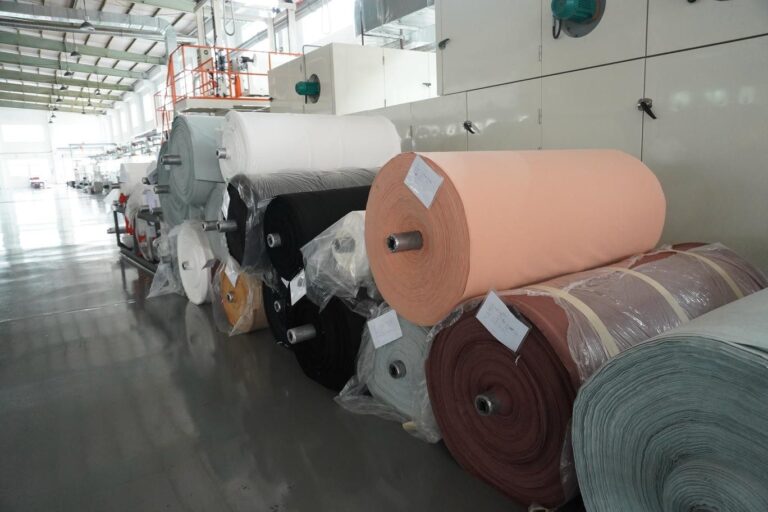
Roll stock tells the truth about a plant. Labels carry batch, gauge, and date.
Gauge and Substrate: Where the Price Really Sits
The first trap is the unit. Some quotes price per linear meter, others per square meter. At a 1.4 meter width, a $1.20 per square meter roll costs about $1.68 per linear meter. Compare a linear price against an area price and one supplier looks 15% cheaper for no reason at all. Fix the unit first. Then check usable width, because edge trim varies between 1.37 and 1.42 meters across mills. Narrow rolls mean more seams and more waste in your cutting room.
The second trap is the base. Two 1.0 mm PU sheets can differ by 25% in price because the substrates differ. A 80 g/m² knitted base costs less than a 150 g/m² woven base, and it also tears sooner at staples and seams. Gauge without substrate weight is half a specification. Insist on both numbers, and weigh a cut square yourself on arrival. A pocket scale catches substitution faster than any lab.
Here is how that 47% spread from our opening decodes. The low quote ran 0.8 mm over a light knit, with a foam layer and no abrasion data. The high quote ran 1.2 mm over woven cloth, with a solid coating and a Martindale report attached. Both matched the swatch in a photo. Only one would have survived a three-year warranty on a rental sofa fleet.

Same look, different base. The substrate line explains most quote gaps.
Coating structure is the third lever. Foam-layer PU whips air into the coating, which cuts resin use and softens the hand at a friendly price. Solid-coating PU spends more resin per meter, but it resists creasing and edge wear far better. Neither is wrong. A decorative accent cushion can run foam happily. A hotel lobby lounge cannot. Match the structure to the chair, and the price gap stops feeling arbitrary.
The Test Lines That Separate Grades
Test lines are where a quote shows its confidence. Benchmark minimums are public knowledge now. Abrasion should clear 20,000 Martindale cycles for seating use. Tensile strength should reach 35 MPa or better, with elongation at break above 400% for durable applications. Chemical compliance should reference REACH or OEKO-TEX Standard 100 for EU and North American programs. A quote that lists the test name without a threshold has told you nothing. A quote that lists the threshold without a method has told you even less.
Demand four details on every test line: the standard and version, the method, the measured value, and the batch number it applies to. A pass stamp without a number cannot be defended in a dispute. Also settle who pays for testing. Third-party reports cost real money, and suppliers build them into price one way or another. A supplier that already runs per-order SGS checks has simply made that cost visible and honest. For buyers weighing material families against each other, our silicone vs PU comparison explains where the two chemistries separate on test results.

A lab that runs its own tests writes braver thresholds into quotes.
Who ran the test matters as much as what it says. An in-house report shows capability, but a third-party report travels better in disputes. The strongest pattern is both: mill data on every batch, plus one independent certificate per order. Ask to see an unredacted report from a recent shipment before you commit. A mill that guards its lab paperwork is guarding something, and it is not your risk.
Two quieter lines deserve attention as well. Hydrolysis resistance predicts how the coating ages in humid climates, and it is the number behind most year-three peeling complaints. Light fastness predicts what sunlight does to a window-side armrest. Both belong in the quote for any seating or marine program. Skip them, and you have bought a material that passes the showroom and fails the season.
MOQ, Lead Time, and the Fine Print
Commercial lines carry their own traps. Many mills set MOQ at 1,000 meters per color, with delivery 15 to 30 days after deposit and sample approval. Others quote a lower headline MOQ but apply it per style, which multiplies quickly across a color range. Ask whether the MOQ survives on re-orders, because repeat production often carries a different floor. Lead time deserves the same skepticism. Market quotes commonly run 30 to 60 days, and sourcing guides advise treating 40 days or less as the healthy band for standard orders.
Then read the freight basis. FOB and CIF prices differ by sea freight, insurance, and who clears export documents. A CIF number that looks 8% higher can actually be cheaper once destination charges land. Deposit terms matter too. A 30% deposit with balance against the bill of lading is standard. Anything beyond 50% up front should come with a reason you accept, not just accept. Our applications overview shows which end uses justify tighter terms.

Sample cards and production rolls are cousins, not twins. Approve both.
Verification beats deduction when the stakes rise. For programs above container volume, schedule a factory visit or a third-party audit before the deposit. Walk the coating line, open the lab door, and check whether roll labels carry batch and gauge. An afternoon on site answers questions that twenty emails cannot. Buyers who audit rarely need the warranty clause. Buyers who skip audits read it often.
Keep every decoded quote on file, even the ones you reject. Prices move in cycles, and the supplier who lost on resin in March may win on service in September. A filed quote is a benchmark. A deleted quote is a rumor. Your future negotiation starts from the paper you kept.
When a PU Leather Supplier Price Is Too Low
Low prices are information once you know where to look. The usual cuts arrive in a fixed order: thinner substrate, lighter topcoat, skipped retardant, and fewer tests. A quote 20% under the field usually means at least two of those have happened. None of them show on a photo. All of them show in year two of ownership, when surface cracking starts a warranty conversation you did not plan for.
The counter is procedural, not emotional. Ask the low bidder to state what changed to reach that price. Honest mills answer in one sentence. If the answer is that everything is the same, request a paid comparative sample against your incumbent roll and test both. That small spend converts a suspicion into a document. For heavy-use programs where lowball PU keeps failing, our silicone microfiber leather line is the upgrade path we quote most often.
The Five-Step Action List Before You Wire a Deposit
Condense this guide into the sequence we use on our own desk:
- Normalize every quote to price per square meter at equal gauge and width.
- Require substrate weight in g/m² alongside thickness in millimeters.
- Attach thresholds to every test name, with methods and batch numbers.
- Confirm MOQ behavior on re-orders, per color and per style.
- Approve a production-run sample, not just a lab card, before balance payment.
Budget for the process itself. Comparative samples, third-party tests, and an audit day cost a fraction of one failed container. Spread across a program, that spend is rounding error. Skipped, it becomes the most expensive saving you ever made. Treat verification as a line item in the project budget, not as an optional extra when time allows.
Sampling closes the last gap between paper and product. Our samples center ships cut panels at your target gauge, substrate, and color. For a quote review against your current RFQ, contact our export desk and we will annotate the comparison ourselves.
One habit ties the whole method together. Put every decoded number back into the RFQ and send it to all bidders. When everyone quotes against the same line items, the spread between them shrinks to honest differences in cost and capability. That is the moment a PU leather supplier comparison becomes fair, and fair comparisons are the only ones worth running.
A PU leather supplier earns trust through lines, not through charm. Gauge, substrate, tests, MOQ, and terms each carry a number. When all five numbers appear in writing, the 47% spread stops being a mystery and becomes a choice you can defend. That is the standard behind every pu leather supplier quote we issue, and it is the standard we suggest you demand from the next one you receive.
Durability comparison footage: why test thresholds belong in the quote itself.