A protected leather couch sounds like a straightforward product category — until you’re the one specifying 5,000 meters of it for a production run. The term “protected” covers everything from lightly pigmented semi-aniline to heavily coated corrected grain, and the gap between those endpoints determines whether your finished sofas pass QC or come back as warranty claims. If you source upholstery for furniture applications at volume, understanding what “protected” actually means in manufacturing terms will save you from costly specification mistakes.

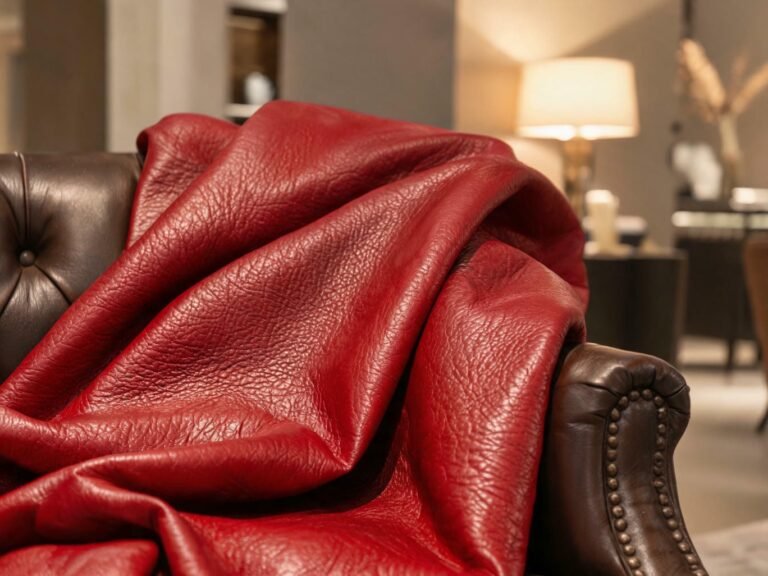
Protected leather swatches shown in various pigment loads and finish types
What Exactly Is a Protected Leather Couch?
In manufacturing terminology, a protected leather couch uses hides that have received a surface coating — typically a pigmented polymer layer — applied over the leather substrate. This coating serves as the primary barrier against stains, abrasion, and UV degradation. Unlike aniline leather couches that show the hide’s natural surface unprotected, protected leather masks imperfections and creates a more uniform appearance across production batches.
The term “protected” doesn’t specify a single coating chemistry. It encompasses several finish types: full-pigment topcoats, semi-aniline finishes with light pigment, and polyurethane-enhanced coatings. Each type carries different performance characteristics. A heavily pigmented corrected grain hide might deliver 25,000+ Martindale cycles but feel plasticky, while a semi-aniline finish offers better tactile quality at the cost of stain resistance. This trade-off is the central decision in protected leather sourcing — and it’s why “what is protected leather couch” remains one of the most searched queries in furniture procurement.

Factory swatch wall showing protected leather in multiple pigment loads and colors
Protected Leather Couch Performance: Coating Types and Test Data
Protected leather couch durability depends almost entirely on the coating system. In our testing lab, we’ve evaluated dozens of protected leather samples across three coating categories, and the performance spread is wider than most buyers expect. The key variables are pigment volume concentration (PVC), crosslinker type, and topcoat thickness — measured in grams per square meter.
A standard abrasion test per ASTM D3884 (Martindale method) reveals how coating type drives wear performance. Here’s how the three main protected leather categories compare:
| Coating Type | Martindale Cycles | Stain Resistance | Typical Use |
|---|---|---|---|
| Full-pigment topcoat | 25,000+ | High | Commercial / hospitality |
| Semi-aniline finish | 15,000–20,000 | Medium | Residential premium |
| PU-enhanced coating | 20,000–30,000 | High | Contract / high-traffic |
One furniture manufacturer we worked with specified protected leather at 0.9mm with a medium-pigment semi-aniline finish for a hotel lobby project. After 18 months of daily commercial use, the coating showed micro-cracking at seam stress points — a classic failure mode when pigment load is too low for the traffic level. The lesson: match coating type to the end-use environment, not just to the aesthetic brief.

Martindale abrasion tester used to evaluate protected leather coating wear performance
Hand Feel Control: Where Protected Leather Wins or Loses
Here’s the manufacturing challenge that doesn’t show up in spec sheets: as coating thickness increases, stain resistance improves — but hand feel degrades. Thick pigment layers mask the leather’s natural grain, creating a surface that feels closer to vinyl than to animal hide. This is the core tension in protected leather couch pros and cons discussions, and it’s where supplier expertise matters most.
Experienced tanneries control hand feel through several techniques:
- Multi-layer coating — applying thin pigment layers with intermediate bonding agents rather than a single thick coat preserves tactility while maintaining coverage
- Embossing after coating — re-embossing the grain pattern into the coated surface restores natural texture that thick pigment flattens
- Selective pigment loading — using lighter pigment on visible areas (seat cushions) and heavier coating on high-wear zones (armrests, headrests)
Key insight: Hand feel is subjective, but it can be quantified. Professional graders use a 1–5 softness scale where 1 equals rigid plastic and 5 equals full-aniline butter. Most protected leather couch materials fall between 2.5 and 3.5 — and buyers who don’t specify a target range get whatever the tannery defaults to.

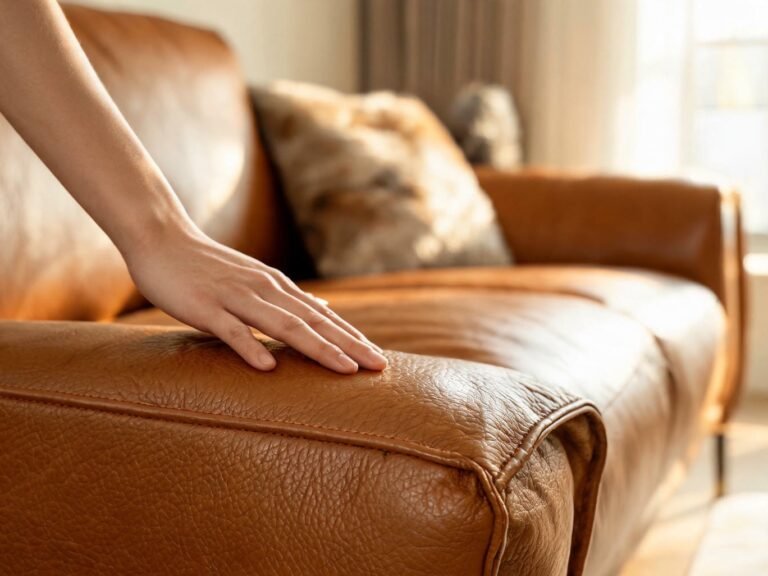
Warm-tone leather swatches demonstrating the tactile range achievable with different coating approaches
Bulk Roll Purchasing: 5 Specs That Prevent Cost Overruns
When sourcing protected leather for sofa production, vague specifications are the single biggest source of cost overruns. Buyers who write “brown protected leather, 1.0mm” on a PO are leaving pricing, quality, and yield entirely to the supplier’s discretion. The best protected leather for sofa manufacturing comes from POs that specify these five parameters:
- Coating weight (g/m²) — 15–25 g/m² for residential, 25–40 g/m² for commercial. This single spec eliminates 80% of quality disputes.
- Hide origin and grade — specify cowhide vs. buffalo, and whether top-grain or corrected grain substrate is required. Grade determines yield: a B-grade hide yields 15–20% less usable area than A-grade.
- Defect tolerance (%) — acceptable surface defect area per hide. Industry standard is 5% for visible panels, 15% for hidden areas like dust covers.
- Color consistency (ΔE value) — specify a Delta E tolerance of ≤2.0 between rolls. Without this, batch-to-batch color drift will haunt your assembly line.
- Roll dimensions and yield — standard rolls are 1.4m wide × 30–50m length. Confirm minimum usable area after trimming defects, not just gross roll length.
Sourcing teams that lock down these five specs typically cut material waste by 15–20% and eliminate the “surprise” regrades that suppliers apply when specifications are ambiguous. For leather sofa upholstery materials at production scale, this level of specification precision is non-negotiable.

Physical testing lab where protected leather samples undergo abrasion, flex, and color fastness verification
Talk to Our Sourcing Engineers
Protected Leather Couch vs Silicone Leather: A Practical Comparison
Protected leather couch materials face a fundamental limitation: the protective coating that provides stain resistance is itself a wear surface. Over time, coatings degrade through flexing, cleaning, and UV exposure — leading to cracking, peeling, and the need for refinishing. This is the core issue in any protected leather vs unprotected leather couch comparison, and it’s where silicone leather offers a structurally different solution.
Unlike protected leather’s surface coating, silicone leather integrates the protective polymer into the material itself — there’s no separate topcoat to degrade. The comparison below shows how this structural difference plays out across key performance metrics:
| Performance Metric | Protected Leather | Silicone Leather | Advantage |
|---|---|---|---|
| Abrasion (Martindale) | 15,000–30,000 | 50,000+ | Silicone |
| Coating degradation | Yes (cracks over time) | No (integrated polymer) | Silicone |
| VOC emissions | Moderate (coating solvents) | Zero-VOC certified | Silicone |
| Cleanability | Good (while coating intact) | Excellent (permanent) | Silicone |
For buyers weighing protected leather against silicone vs PU alternatives, the decisive factor is lifecycle cost. Protected leather may have a lower upfront price per meter, but coating maintenance and eventual replacement push the total cost of ownership higher — especially in commercial settings where the cleaning and maintenance cycle is frequent.

Close-up of leather surface texture showing the protective coating layer visible under magnification
See how silicone leather eliminates the coating degradation cycle that plagues protected leather couches
Frequently Asked Questions
Does a protected leather couch require conditioning?
Yes, but less frequently than unprotected aniline leather. The protective coating reduces moisture loss from the hide, so conditioning every 6–12 months is typically sufficient for residential use. Commercial environments may require quarterly conditioning. Use water-based conditioners — solvent-based products can degrade the polymer coating over time.
Can protected leather be repaired if the coating cracks?
Minor coating cracks can be repaired with pigmented fillers and re-topcoating, but the repair area will be visible under close inspection. Extensive cracking usually requires panel replacement. This is a key lifecycle cost factor — once the coating fails, the material’s stain resistance is gone, and the underlying hide is vulnerable to liquid penetration.
The Bottom Line on Protected Leather Couch Sourcing
Protected leather remains a workhorse material for couch and sofa manufacturing — it delivers solid stain resistance, reasonable durability, and a cost-effective price point for mid-range furniture. But its Achilles’ heel is the coating itself: the very layer that provides protection is also the first component to fail. Sourcing teams who understand coating types, specify hand feel targets, and lock down bulk roll specifications will get the best performance from this material. Those who don’t will discover the difference between a 5-year sofa and a 15-year sofa the hard way — through warranty claims and customer complaints about the protected leather couch they specified.
Request Protected Leather Couch Samples
About TOPSUN
TOPSUN manufactures silicone leather upholstery materials for sofa and furniture producers who need protected-leather-level stain resistance without the coating degradation cycle. Our materials serve residential, hospitality, and contract furniture applications worldwide.
Our materials deliver abrasion resistance exceeding 50,000 Martindale cycles, zero-VOC certification under REACH, customizable hand feel from 0.6mm to 1.8mm thickness, and full OEM/ODM roll production with color consistency verified to Delta E ≤2.0.