You’ve seen the label a hundred times: “Top Grain Cowhide Leather.” It’s on furniture, wallets, car seats, handbags, belts — pretty much anything leather-adjacent. And here’s the problem: half the products carrying that label aren’t actually top-grain, and a surprising number aren’t even cowhide. The leather grading system is notoriously confusing for buyers, and “top grain” is one of the most abused terms in the industry.
Let’s be honest: you shouldn’t need a materials science degree to buy a leather sofa or a quality bag. But the reality is that the grading system — full-grain, top-grain, genuine leather, split leather, bonded leather — was designed for tanneries and upholsterers, not for end users. In this guide, we break down what top grain cowhide leather actually is, how it compares to other grades, and six practical checks you can do right now to tell if a product is really what the label says.
What Is Top Grain Cowhide Leather, Exactly?
Top grain cowhide leather comes from the top layer of a cow’s hide — the same layer as full-grain leather. The difference is that top-grain has been sanded or “corrected” on the surface to remove natural imperfections like scars, bites, and wrinkles, then finished with a protective coating and an embossed grain pattern.
Think of it like this: full-grain leather is the hide as nature made it — beautiful in its own way, but with marks and variations. Top-grain leather is the same hide, but “photoshopped” — smoothed out, made uniform, and given a protective finish. It’s still real leather from the top layer of the hide, but it’s been refined for a more consistent look and better stain resistance.

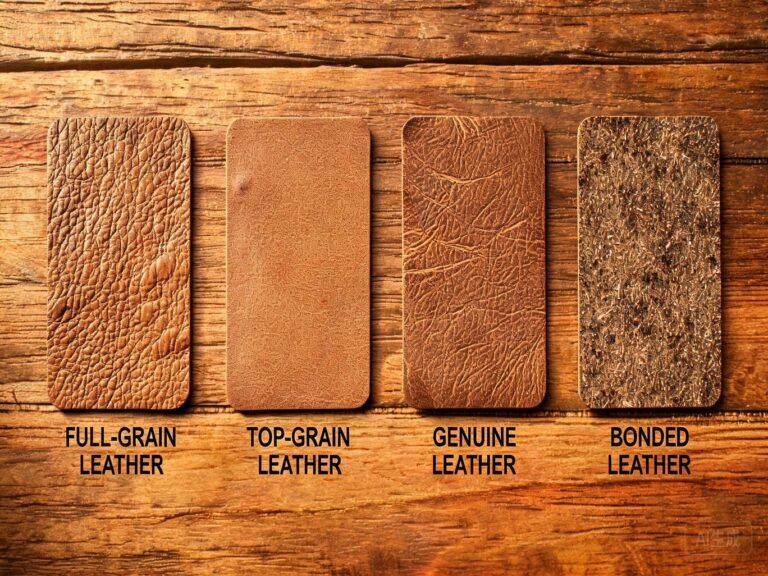
Top grain leather has a uniform, refined grain pattern — the result of sanding the hide surface and embossing a consistent texture.
Here’s where it sits in the leather quality hierarchy:
| Grade | What It Is | Durability | Typical Cost |
|---|---|---|---|
| Full-Grain | Top layer, completely natural, no sanding | Highest (15–25+ yrs) | $$$ |
| Top-Grain | Top layer, sanded + finished coat | Very high (10–15 yrs) | $$ |
| Genuine (Split) | Lower layer of the hide, coated and embossed | Fair (3–7 yrs) | $ |
| Bonded | Leather scraps + PU binder | Low (1–3 yrs) | $ |
Top-grain is the sweet spot for most people — it has the strength and durability of the top hide layer (unlike split or bonded leather), but it’s more affordable and more stain-resistant than full-grain. It’s no wonder it’s the most common grade used in mid-to-premium furniture, automotive interiors, and fashion accessories.
Key takeaway: Top-grain leather is real leather from the top layer of the hide — but it’s been sanded smooth and coated for uniformity and stain resistance.
6 Checks to Verify Top Grain Cowhide Leather
You don’t need a lab to spot the difference between real top-grain cowhide and the cheaper alternatives. Here are six practical checks you can do with just your eyes, your hands, and a little common sense.
1. Look at the grain pattern
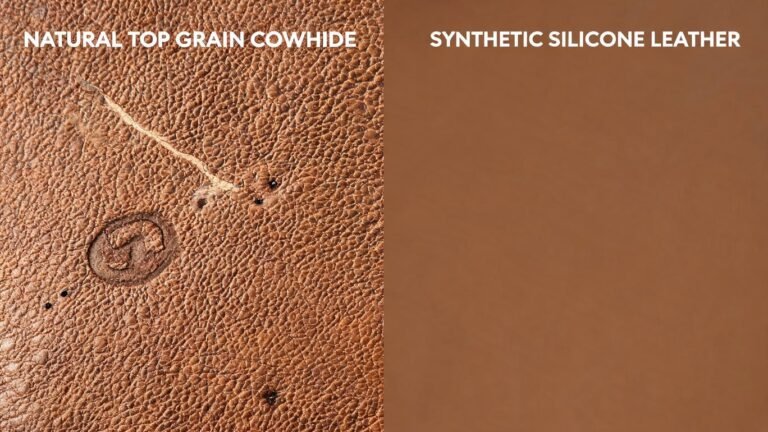
Real top-grain leather has grain variation — the pattern changes slightly across the surface. It might have a consistent overall texture, but if you look closely, the pores and grain lines aren’t perfectly identical everywhere. Fake grain (on split leather or PU) is embossed with a roller, so the pattern repeats exactly like wallpaper. If you can find the exact same grain “motif” repeated across the surface, it’s not top-grain.

Comparing grain patterns across samples — real top-grain has natural variation; synthetic grain repeats like wallpaper.
2. Feel the texture and temperature
Genuine top-grain cowhide feels warm to the touch — it doesn’t stay cold like plastic. When you press into it, it gives slightly and shows fine wrinkles under your finger, then bounces back. PU and other synthetics feel cooler, smoother, and more plastic-y. They don’t wrinkle when pressed — they just indent and pop back like rubber.
3. Check the edges and the back
The edges of top-grain leather will show the hide’s cross-section — you’ll see the dense fiber structure. The back (or “flesh side”) should look and feel like suede — fuzzy, fibrous, clearly animal hide. If the back is smooth, fabric-like, or you can’t see it at all (because it’s fully lined), be suspicious. Real leather products usually show at least some of the raw hide on the inside.
4. Smell it
Real leather has a distinctive, organic smell — like a saddle or a baseball glove. It’s hard to describe but instantly recognizable once you’ve experienced it. PU and synthetic leather smell like chemicals or plastic — especially when new. If you’re not sure, find a product you know is genuine leather and compare the smell side by side. The difference is unmistakable.
5. Do the water test (if you can)
Drop a small amount of water on an inconspicuous spot. Real top-grain leather — even with a finish coat — will absorb a small amount of water and darken slightly at the spot. Fully synthetic materials will bead up and stay on the surface, with no darkening at all. Note: heavily treated or coated leather may not absorb much water, so this test works best in combination with others, not by itself.
6. Consider the price point
A real top-grain cowhide sofa costs real money. If you see a “top grain leather” sofa for $500, it’s not top-grain — it might be split leather with a “top grain” label, or it might have top-grain only on the seating surfaces and vinyl everywhere else. The same goes for bags, belts, and car seats. Top-grain leather costs roughly 2–3x more per square meter than split leather or PU. If the price seems too good to be true, it usually is.
Read Our Full Genuine Leather Guide

Top grain cowhide leather furniture — the most popular premium upholstery choice for its balance of durability, comfort, and affordability.
See how different leather grades hold up to real-world wear — and where silicone-coated materials fit into the durability picture.
Is Top Grain Cowhide Leather Actually Good for Your Use Case?
Top-grain is a great all-around leather grade — but it’s not always the best choice for every application. Let’s break down where it shines and where you might want to go with something else.
Where top-grain is the best choice:
- Furniture upholstery — For living room sofas and chairs that get daily use, top-grain is the sweet spot. It’s durable enough for 10+ years of family use, easier to clean than full-grain (thanks to the protective coating), and looks more premium than split leather.
- Mid-range automotive interiors — Top-grain is the standard for premium trim levels. It has a luxury feel, resists UV better than aniline leather (because of the coating), and costs less than full-grain Nappa.
- Handbags and wallets — Top-grain gives you that “real leather” feel and durability without the full-grain price tag. The protective coating helps resist scratches and stains from daily use.
- Uniformity matters — If you need matching pieces (like a set of dining chairs or multiple sofas in a hotel lobby), top-grain’s consistent color and grain are a big advantage. Full-grain varies too much from hide to hide.
Where you might want something different:
- Heirloom-quality products — If you want something that develops a beautiful patina and gets better with age (like a briefcase, a quality belt, or a classic armchair), go with full-grain. Top-grain’s protective coating prevents the natural patina that makes full-grain so desirable.
- High-stain, high-UV environments — If the material will be in direct sunlight every day or exposed to heavy staining (restaurant booths, outdoor furniture, boats), even top-grain’s protective coating will eventually break down. For these applications, silicone-coated materials are increasingly the better choice — they’re completely stain-proof and UV-stable. Check out marine and outdoor applications for more.
- Budget is tight — If you’re working with a limited budget, good quality PU leather will outperform cheap “genuine leather” (which is usually split leather with a thin coating). Don’t pay a “genuine leather” premium for bottom-grade material.
Practical truth: A well-made top-grain leather product will outlast a poorly made full-grain one every time. Construction, stitching, and finishing matter as much as the hide grade.
Caring for Top Grain Cowhide Leather to Make It Last
The good news about top-grain leather is that it’s relatively low-maintenance — much easier than full-grain aniline leather, which needs regular conditioning and is prone to staining. But it’s not maintenance-free. Here’s what you need to do to keep it looking great for 10+ years.
Clean spills immediately. The protective coating on top-grain gives you a window of a few minutes before a spill sets in. Blot (don’t rub) with a clean, dry cloth. For tougher stains, use a damp cloth with mild soap — but always test on an inconspicuous spot first.
Keep it out of direct sun. UV light will fade and dry out the leather over time. Position sofas away from windows, or use curtains or blinds during peak sun hours. In cars, use a windshield sunshade. For items that have to be in the sun (like patio furniture or boat seats), genuine leather — even top-grain — probably isn’t the best choice. Consider a silicone-coated outdoor material instead.
Condition once or twice a year. While top-grain doesn’t need conditioning as often as full-grain, it still benefits from a light application of leather conditioner every 6–12 months to keep the coating flexible and prevent cracking. Use a conditioner specifically designed for protected or finished leather — not the heavy stuff made for saddle leather.
Avoid harsh cleaners. Bleach, ammonia, rubbing alcohol, and disinfectant wipes will damage the protective coating and dry out the leather. Stick to pH-balanced leather cleaners. And if you’re in a setting where you need frequent disinfecting — like medical offices or restaurants — you might want to look at disinfectable materials like silicone leather instead. Our medical healthcare applications page has more on this.
Frequently Asked Questions
Does top grain leather peel or crack?
Not if it’s real top-grain and well cared for. The peeling and cracking you see on cheap “leather” products is almost always split leather (where the coating separates from the weaker lower hide layer) or bonded leather (where the leather flake/PU mixture delaminates). Real top-grain leather has the strong fiber structure of the top hide layer beneath the coating, so it doesn’t peel — it wears through gradually, like a well-worn pair of jeans. That said, a top-grain leather product that’s never conditioned and sits in direct sun for years can eventually develop cracks in the finish coating — but that’s a maintenance issue, not a material defect.
Is top grain leather better than genuine leather?
Yes — and it’s not even close. The term “genuine leather” is misleading because it sounds like it means “real, high-quality leather,” but it actually refers to the lower grades of real leather (split leather from the lower layers of the hide). Top-grain leather comes from the top layer of the hide, which is much stronger and more durable. In terms of quality: full-grain > top-grain > genuine (split) > bonded. If you’re choosing between a product labeled “top grain” and one labeled “genuine leather,” the top-grain one is the higher quality — assuming both labels are accurate.
The Bottom Line on Top Grain Cowhide Leather
Top grain cowhide leather is popular for a reason. It strikes the best balance of durability, appearance, and price in the leather quality hierarchy. It’s real leather from the strongest part of the hide, it’s more uniform and stain-resistant than full-grain, and it’s significantly more durable than split or “genuine” leather.
But “top grain” is also one of the most misused labels in the industry. The next time you’re evaluating a leather product, don’t just trust the tag — do the checks. Look at the grain pattern. Feel the texture. Smell it. Consider the price. With a little practice, you’ll be able to spot the real thing in seconds — and you’ll avoid paying top-grain prices for second-grade material.
Get Help Choosing the Right Leather Grade
About TOPSUN
TOPSUN produces silicone-coated leather alternatives that give buyers the premium look and feel of top-grain cowhide leather with better stain resistance, UV durability, and zero-VOC performance for demanding environments.
We offer 100+ grain patterns and color options, A4 sample kits for hands-on evaluation, and custom texture matching to replicate your existing top-grain specifications with upgraded performance.