Picture a hotel lobby three years after renovation. The protected leather lobby seating looked flawless on day one — uniform color, smooth finish, no natural blemishes. Now, the armrests show hairline cracks, the seat cushions have dulled under skylight UV, and the once-pristine surface absorbs coffee spills instead of repelling them. The polymer topcoat that defined this as “protected leather” is failing, and the replacement cost runs into five figures.
This scenario plays out across hospitality, automotive, and furniture sectors every day. Protected leather — the pigmented, polymer-coated category that dominates commercial upholstery — promises durability through a surface barrier. But that barrier has a finite lifespan, and most procurement specs never test it before signing multi-year contracts. Here’s the thing: five standard stress tests can predict coating failure before a single meter is purchased.
What Makes Protected Leather “Protected” — and Where It Breaks Down
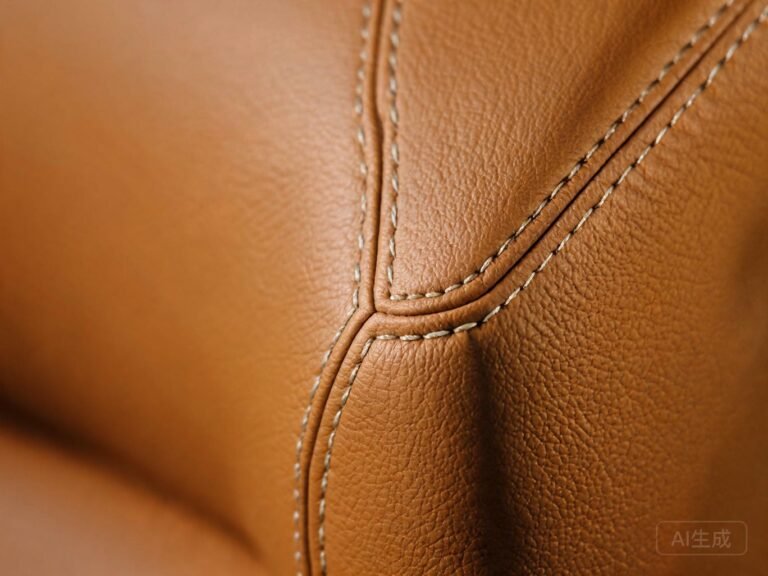
Protected leather earns its name from a polymer topcoat — typically polyurethane or acrylic-based — applied over a pigmented surface. The coating creates a physical barrier against liquids, stains, and minor abrasion. In our lab, we’ve dissected failed samples from commercial furniture projects and found the same pattern: the polymer layer delaminates from the substrate after 18-36 months of UV exposure and repeated flexing. The leather itself is intact; it’s the protective coating that fails.

Martindale abrasion tester simulating years of daily seating wear on protected leather surfaces.
The problem isn’t that protected leather furniture durability is inherently bad — it’s that buyers conflate coating performance with substrate performance. A well-tanned hide underneath a failing coating still looks worn because the visible surface is the coating, not the leather. When sourcing silicone vs PU coated materials, this distinction matters: silicone’s protection is intrinsic to the polymer matrix, not a separate layer that can peel.
5 Stress Tests That Predict Protected Leather Coating Failure
If you’re evaluating protected leather for a multi-year commercial project, these five tests — all standardized and laboratory-accessible — will tell you more than any supplier datasheet. We run all five on every batch because coating failure modes are unpredictable without empirical data.
- UV exposure (ISO 105-B06): Standard accelerated weathering. PU-based protected leather coatings show visible cracking at 1,000+ hours; silicone-based alternatives show zero degradation at the same threshold. Durability testing protocols matter here — ask for the actual cycle count, not just “UV resistant.”
- Martindale abrasion (ISO 12947-2): Measures surface wear under circular rubbing. Conventional protected leather typically reaches 20,000-50,000 cycles before coating breakdown. Silicone leather surfaces we’ve tested exceed 200,000 cycles with no coating loss — because there’s no separate coating to lose.
- Flex resistance (ISO 5402): Repeated bending simulates seat cushion compression. PU topcoats develop micro-cracks at 50,000-100,000 flex cycles; these cracks widen into visible crazing patterns within 6-12 months of real-world use.
- Color fastness (ISO 105-X12): Rubbing fastness reveals pigment migration. Low-grade protected leather transfers color onto clothing and adjacent surfaces — a liability in light-colored hospitality applications.
- Hydrolysis resistance (ISO 11507): Moisture-plus-temperature cycling. PU coatings absorb water vapor, swell, and lose adhesion. This is the #1 failure mode in humid-climate projects — and the least tested in procurement specs.

Color fastness testing reveals whether pigmented coatings will transfer dye onto adjacent materials.
The Real Cost of Coating Failure in Commercial Projects
One of our hospitality clients replaced 200 protected leather lobby chairs after 3.5 years — not because the leather failed, but because the polymer coating cracked, stained, and couldn’t be restored. The replacement cost exceeded $45,000. The original material passed all supplier certifications, but nobody had requested hydrolysis or flex testing data before purchase.

Commercial furniture using protected leather coatings often requires full replacement when the topcoat degrades.
The ISO 12947-2 Martindale standard defines abrasion testing, but many suppliers only report a pass/fail result without disclosing cycle counts. When a supplier says “abrasion resistant,” ask for the exact Martindale number. If they can’t produce it, that’s a red flag — not because the material is necessarily bad, but because they haven’t verified it.
Why Intrinsic Protection Outperforms Applied Coatings
The fundamental difference between traditional protected leather and silicone-based alternatives is where the protection lives. Conventional protected leather applies protection as a separate layer — a coating sitting on top of the substrate. Silicone leather’s protection is built into the polymer matrix itself: the entire material is the barrier, not just the top 0.05mm.
This means there’s nothing to delaminate, nothing to peel, nothing to wear through. Our UV resistance testing confirms 1,000+ hours with no fading or yellowing. Temperature range spans -40°C to 250°C with no cracking. The material is hydrolysis-proof by chemistry, not by coating. For a range of commercial applications from automotive interiors to healthcare seating, intrinsic protection eliminates the failure mode that plagues conventional protected leather.
Before You Sign: Coating Performance Checklist
Before committing to any protected leather specification for a multi-year project, request these data points from your supplier — and walk away if they can’t provide them:
- Martindale cycle count — not “pass,” the actual number. Target: 50,000+ for light commercial, 100,000+ for heavy-use environments.
- UV exposure hours with documented ISO 105-B06 results. Target: 500+ hours minimum for interior applications.
- Flex resistance cycle count per ISO 5402. Target: 50,000+ cycles with no visible cracking.
- Hydrolysis test data — if the supplier has never tested this, assume the coating will fail in humid environments within 3 years.
- Coating adhesion test method — how was bond strength between coating and substrate verified?
- Real-world case references with project age 3+ years. Lab data without field validation is incomplete.
Protected leather isn’t the problem — untested protected leather is. The difference between a 3-year coating and a 10-year material comes down to whether someone ran the stress tests before you signed the purchase order. Demand the data, or expect the delamination.
About TOPSUN
TOPSUN manufactures silicone leather that eliminates the coating failure modes inherent in conventional protected leather, serving automotive, furniture, and commercial upholstery sectors worldwide.
With 200,000+ Martindale cycles, 1,000+ hour UV stability, and intrinsic hydrolysis resistance verified across 10+ automated production lines, our material provides protection that can’t peel — because it isn’t a coating.