Roughly 80% of all leather produced worldwide goes through chrome tanning — a process that transforms raw hides into durable material in as little as 48 hours. But speed comes at a cost: each kilogram of raw hide consumes 50 to 70 liters of water, and the FAO estimates that tanneries add at least 300 kg of chemicals per ton of hides. When we audit the production of leather for B2B clients, the environmental and compliance footprint rarely matches supplier claims. Here is how the traditional process works, where the regulatory pressure is building, and how solvent-free silicone coating changes the math.
Production of Leather: The Traditional 7-Step Process
The conventional production of leather — how leather is made from raw hide — follows seven stages that have changed little in a century. Each step adds cost, water, and chemical load:
- Soaking — Rehydrating salt-preserved hides in water pits to restore moisture and remove preserving salt.
- Dehairing and liming — Dissolving hair and epidermis using lime (calcium hydroxide) and sodium sulfide. This is where most wastewater chemical load originates.
- Fleshing — Mechanically removing subcutaneous fat and connective tissue from the flesh side.
- Tanning — The core chemical step. Chrome tanning uses basic chromium sulfate to permanently alter collagen structure. Vegetable tanning uses tannins from tree bark.
- Splitting and shaving — Cutting the tanned hide into grain and drop splits, then shaving to uniform thickness.
- Dyeing and retanning — Adding color, fatliquors, and secondary tanning agents for softness and shade.
- Finishing — Applying surface coatings, embossing grain patterns, and adding protective layers.

Calendering rollers in a TOPSUN silicone leather line — the coating step that replaces chrome tanning entirely.
Why Chrome Tanning Dominates — and What It Costs
Chrome tanning accounts for 80–85% of global leather output because it processes a hide in 1–3 days, compared to 30–60 days for vegetable tanning. For high-volume industrial production, that speed advantage is decisive. But the trade-offs are significant, especially when comparing chrome tanned vs vegetable tanned leather cost against environmental exposure:
- Water consumption — 50–70 liters per kilogram of raw hide, depending on the method and recycling rate.
- Chemical load — At least 300 kg of lime, salt, chromium sulfate, and auxiliary chemicals per ton of hides, per FAO data.
- Chromium VI risk — Under certain conditions, trivalent chromium used in tanning can oxidize to hexavalent chromium (CrVI), a regulated carcinogen. EU REACH limits CrVI to 3 mg/kg in leather articles.
- Wastewater — Tannery effluent contains high BOD, suspended solids, sulfides, and chromium residues. The World Bank EHS guidelines identify tannery wastewater as a priority environmental concern.
One ton of raw hide produces roughly 200 kg of finished leather — and 800 kg of solid waste, sludge, and wastewater by-product.

Coating rollers applying silicone compound to base fabric — no chrome, no tanning, no wastewater discharge.
How Silicone Leather Production Skips the Problem
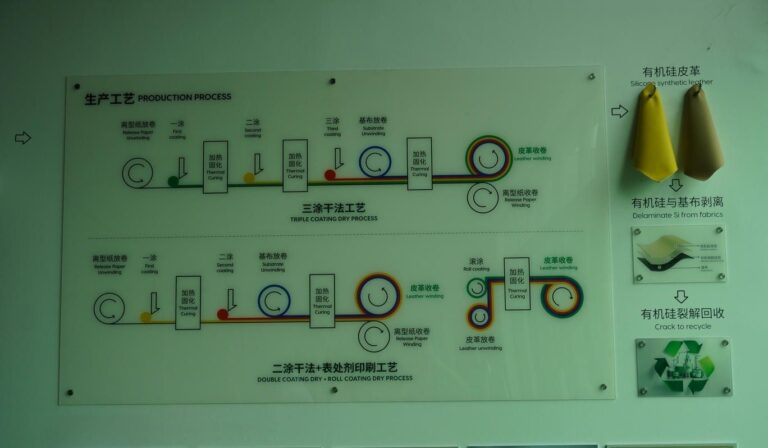
Silicone leather manufacturing replaces the entire tanning paradigm with a solvent-free dry coating process. Instead of chemically altering animal collagen, silicone compound is coated onto a fabric substrate — polyester, nylon, or cotton — and cured through heat. No hides, no chrome, no liming pits. Here is how the two processes compare on the metrics B2B buyers need to track:
| Process Step | Traditional Leather | Silicone Leather | Environmental Impact |
|---|---|---|---|
| Raw material | Animal hides | Fabric substrate | No animal by-product |
| Primary chemical | Chromium sulfate | Silicone polymer | No heavy metals |
| Water per kg | 50–70 L | <5 L | 90%+ reduction |
| VOC emissions | Solvent-based | Zero / near-zero | No air pollution |
| End of life | Non-recyclable | 100% recyclable | Circular economy ready |
In our facility, the silicone leather manufacturing process — solvent-free coating and curing — runs on 10+ automated lines with a daily output of 16,000 meters. The eco-friendly silicone leather produced this way meets REACH, PAHs, and FDA 21 CFR 177.2600 without additional chemical treatment.

High-temperature drying oven — the curing step that bonds silicone to fabric without solvents or water discharge.
Production of Leather: Regulatory Pressure Points
For B2B buyers, the environmental impact of leather production — chromium wastewater and chemical discharge — is no longer just an ESG checkbox. It is a direct compliance risk with financial consequences:
- EU REACH — Annex XVII restricts chromium VI in leather to 3 mg/kg. Non-compliant products face market withdrawal and fines.
- ZDHC (Zero Discharge of Hazardous Chemicals) — Major brands require tannery compliance with restricted substance lists. Non-compliant suppliers lose contracts.
- LWG certification — The Leather Working Group has certified 2,200+ suppliers across 60+ countries. Non-certified tanneries face growing exclusion from brand supply chains.
- California Prop 65 — Chromium VI and certain phthalates in leather products trigger labeling requirements and litigation risk for products sold in California.
- EPR (Extended Producer Responsibility) — EU regulations make manufacturers financially responsible for end-of-life disposal. Non-recyclable leather carries growing disposal costs.

Water-based PU production line — an improvement over solvent-based methods, but still fundamentally different from solvent-free silicone coating.
Frequently Asked Questions
What is the most environmentally damaging step in leather production?
Tanning — specifically chrome tanning — generates the highest concentration of hazardous wastewater. The dehairing and liming step also produces significant chemical load. Together, these two steps account for the majority of the 300+ kg of chemicals added per ton of hides. Silicone leather production eliminates both steps entirely by replacing the tanning paradigm with a dry coating process.
Can silicone leather be produced without any solvents?
Yes. TOPSUN’s production of leather uses a 100% solvent-free dry coating process verified by SGS. The silicone compound is applied to fabric substrate and cured through heat — no DMF, no toluene, no ethyl acetate. VOC emissions test at zero or near-zero per ISO 16000-6. This is fundamentally different from both chrome tanning and solvent-based PU coating.
The Bottom Line on Leather Production
The production of leather is at an inflection point. Chrome tanning still dominates because of speed and cost, but regulatory pressure on chromium, wastewater, and disposal is tightening across every major market. For B2B buyers, the question is not whether traditional leather production will face stricter rules — it is whether your supplier can adapt before those rules take effect. Silicone leather sidesteps the issue entirely. No chrome, no wastewater, no solvents — and a product that lasts 10+ years. That is not an incremental improvement. It is a different production paradigm.
About TOPSUN
TOPSUN operates a 60,000+ m² silicone leather manufacturing facility using a solvent-free dry coating process that eliminates chrome tanning, reduces water consumption by 90%+, and produces zero VOC emissions.
Monthly capacity: 500,000+ meters across 10+ automated lines · SGS-verified compliance to REACH, PAHs, FDA 21 CFR 177.2600 · 100% recyclable · Free A4 swatches shipped worldwide