Standard leather looks great in a climate-controlled showroom. But expose it to desert sun, marine salt spray, or Arctic freeze, and it cracks, fades, or delaminates within months. That is where performance leather technology comes in. Engineered for extreme conditions, these advanced materials use modified polymer structures, reinforced backings, and specialized coatings to deliver durability that traditional hides and basic synthetics cannot match. This article explains the science behind high-performance leather and how to specify it for your next demanding application.
Explore High-Performance Collections
What Separates Performance Leather from Standard Grades?
The difference is not just marketing. Performance leather is built from the molecular level up. While conventional PU leather uses a simple polyurethane coating on a woven or knit base, high-performance variants incorporate:
- Cross-linked polymer networks. These create stronger chemical bonds within the coating layer, improving resistance to hydrolysis, abrasion, and UV breakdown.
- Reinforced base fabrics. Aramid, fiberglass, or high-tenacity polyester backings prevent tearing under mechanical stress and maintain dimensional stability across temperature swings.
- Specialized topcoat formulations. Fluorocarbon or ceramic-infused finishes repel water, oil, and stains while preserving breathability.
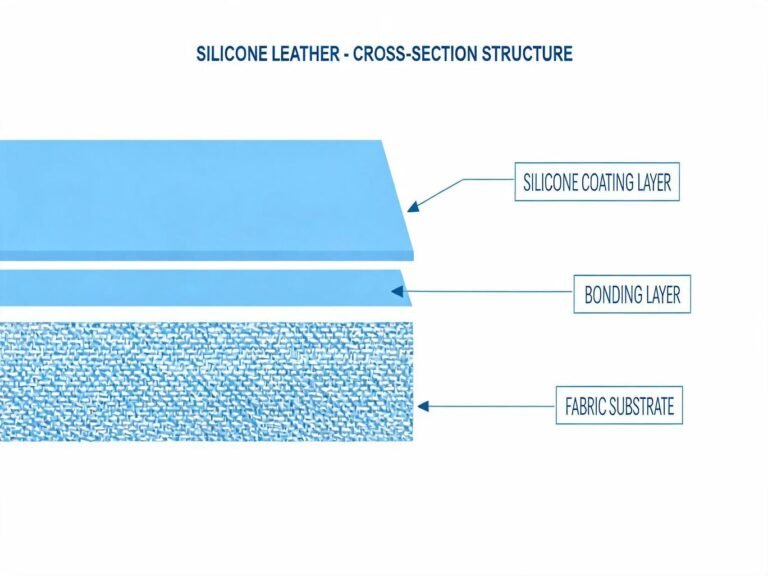
- Silicone-modified chemistry. Silicone leather replaces conventional PU/PVC coatings entirely with stable Si-O backbones that resist thermal degradation and chemical attack.
The result is a material that survives conditions that destroy standard upholstery in under a year. For marine and outdoor applications, this translates to 5+ years of colorfastness and structural integrity without protective covers.
Engineering for Specific Extremes
Not all extreme environments are the same. A material optimized for desert heat may fail in polar cold. Performance leather technology tailors formulations to the specific stressors:
| Environment | Primary Threat | Engineering Solution |
|---|---|---|
| High UV / Desert | Photodegradation, fading, embrittlement | UV absorbers + hindered amine light stabilizers (HALS) in topcoat |
| Saltwater / Marine | Corrosion, mold, osmotic blistering | Anti-mildew additives + hydrophobic silicone chemistry |
| Sub-zero / Arctic | Cold crack, loss of flexibility | Plasticizer-free formulation with low glass-transition temperature |
| High abrasion / Industrial | Surface wear, coating erosion | Ceramic micro-particle reinforcement + increased coating density |
| Chemical exposure | Swelling, dissolution, discoloration | Chemically inert silicone backbone resistant to acids, bases, solvents |

The Role of Silicone Chemistry in Performance Leather
Among performance leather options, silicone-based materials represent the most significant leap in durability. The Si-O bond in silicone polymers is fundamentally more stable than the C-C and C-O bonds in polyurethane. What does this mean in practice?
Heat resistance jumps from roughly 80°C for standard PU to over 200°C for silicone leather. UV stability extends from months to years without significant color shift. Hydrolysis resistance means the material does not break down in humid or wet environments where PU would soften and peel.
Real-world data point: In accelerated aging tests (85°C / 85% RH for 1,000 hours), silicone leather retained 95% of tensile strength and showed zero surface cracking. Comparable PU samples lost 40% strength and developed visible fissures.
For automotive seating and dashboard applications, this thermal stability eliminates the sticky-dash phenomenon common in vehicles parked under direct sun. For aviation interiors, it satisfies the stringent fire-smoke-toxicity requirements without the weight penalty of traditional leather or the fragility of PVC.
Specifying Performance Leather: A Buyer Checklist
When you are ready to source performance leather, generic claims like “heavy duty” are not enough. Use this specification framework to ensure you get what you pay for:
- Define the environmental envelope. State maximum and minimum operating temperatures, expected UV exposure hours per year, and any chemical contact (cleaning agents, fuels, bodily fluids).
- Request test data, not promises. Ask for第三方 lab reports against relevant standards: ISO 105 for color fastness, ISO 12947 for abrasion, ASTM D4329 for UV aging.
- Specify acceptable degradation limits. After accelerated aging, what percentage of original tensile strength, elongation, and color Delta-E is still acceptable?
- Confirm backing compatibility. The coating is only as good as the substrate it adheres to. Match backing type to the mechanical loads (stretch, shear, puncture) in your application.
- Validate flame requirements early. If FMVSS 302, CAL 117, or aviation FAR 25.853 applies, test at the prototype stage. Flame-retardant additives can alter hand feel and color matching.


The Future of Engineered Leather Materials
The next generation of performance leather technology is already emerging. Self-healing topcoats that recover from minor scratches within hours. Conductive leather for integrated heating and sensor applications. Bio-based silicone precursors that reduce petroleum dependence without sacrificing performance.
What does not change is the core principle: performance leather is specified by data, not by appearance alone. Buyers who understand the engineering behind the material make better choices, negotiate from strength, and deliver products that outlast the competition.
Request Extreme-Condition Samples
About TOPSUN
TOPSUN develops advanced silicone leather solutions for extreme-environment applications including automotive, aviation, marine, and industrial sectors. Our R&D team works directly with OEM engineers to tailor material specifications.
Specialties: Flame-retardant grades, UV-stable formulations, hydrolysis-resistant coatings, low-temperature flexibility | Certifications: REACH, RoHS, ISO 10993