A car buyer sits inside a new vehicle and smells “that new car smell.” Most consumers find it pleasant. Automotive engineers know it’s VOC off-gassing — volatile organic compounds released from interior materials including leather upholstery, adhesives, and plastics. For B2B procurement teams specifying interior materials, that smell is a compliance liability. OEMs enforce VDA 270 odor ratings of ≤ Grade 3.0, and materials exceeding that threshold get rejected at assembly — regardless of how they performed on every other spec.
The problem: most synthetic leather suppliers never disclose their VDA 270 results. Solvent-based PU leather typically scores Grade 4.5 — well above the OEM rejection threshold. Water-borne PU manages Grade 2.0-2.5, barely passing. Odor resistant leather isn’t a marketing term; it’s a measurable, testable property with hard pass/fail thresholds. Here’s what the data shows, and how to verify it before you commit to a supplier.
| Test | Solvent PU | Water-Borne PU | Silicone Leather | OEM Limit |
|---|---|---|---|---|
| VDA 270 Odor (80°C) | Grade 4.5 | Grade 2.0–2.5 | Grade 1.0 (zero odor) | ≤ Grade 3.0 |
| VDA 278 Fog Emission | 500 μg/g | ≤ 80 μg/g | Near-zero | ≤ 250 μg/g |
| DIN 75201 Fogging | 5.0 mg | ≤ 1.5 mg | ≤ 0.5 mg | ≤ 2.0 mg |
| VOC Emission (ISO 16000-6) | Solvent off-gas | Low but present | Zero | Application-specific |
Why Solvent-Based PU Leather Fails Odor Testing
Solvent-based PU leather manufacturing uses DMF (dimethylformamide) and other volatile solvents to dissolve the polyurethane coating. Even after drying and curing, residual solvents remain trapped in the polymer matrix. At elevated temperatures — think a car interior reaching 80°C in summer parking — these residuals migrate to the surface and vaporize. That’s the chemical smell VDA 270 detects.

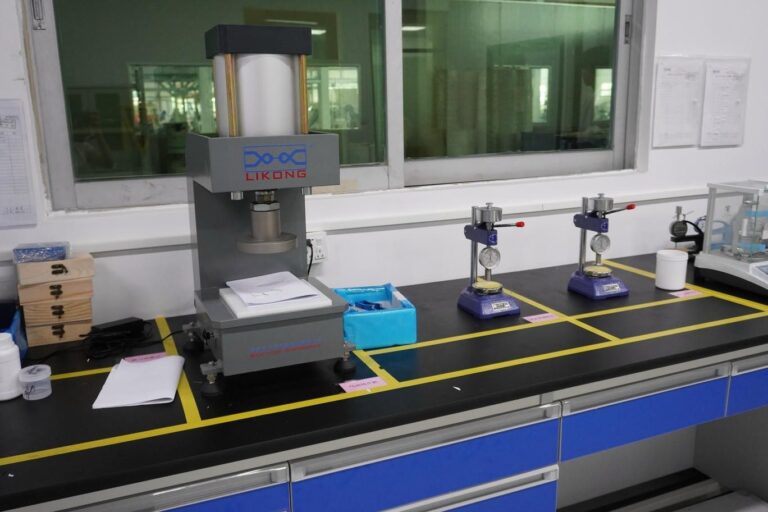
Chemical mixing equipment — solvent-based PU production uses volatile compounds that off-gas throughout product life.
The VDA 270 test conditions are deliberately harsh: samples are sealed in containers at 80°C for 2 hours, then evaluated by three trained odor testers on a 1-6 scale. Grade 1 means “not perceptible,” Grade 6 means “intolerable.” UL’s automotive VOC testing protocol confirms that most OEMs require Grade 3.0 or below for interior components. A material that smells fine at room temperature can fail catastrophically at 80°C.
Why Silicone Leather Achieves True Zero-Odor Performance
Silicone leather’s odor resistance isn’t a coating applied after production — it’s inherent to the silicone leather chemistry. The coating process uses a solvent-free dry application: no DMF, no plasticizers, no volatile solvents to off-gas. Our VDA 270 results consistently show Grade 1.0 (not perceptible) across production batches. The same chemistry that makes it odor resistant also makes it zero-VOC per ISO 16000-6 testing.

Environmental controls in the production workshop — solvent-free processes eliminate the root cause of VOC off-gassing.
This matters beyond automotive. In healthcare environments, enclosed treatment rooms, and senior living facilities, material off-gassing affects indoor air quality directly. Materials that pass VDA 270 at Grade 1.0 contribute zero VOCs to the indoor environment — critical for spaces occupied by immunocompromised individuals, infants, or elderly residents. The eco-friendly properties of silicone leather extend from production (no solvents) through service life (no off-gassing) to disposal (100% recyclable).
How to Verify Odor Resistant Leather Claims Before Purchasing
Suppliers claiming “low odor” or “odorless” leather without test data are making marketing claims, not engineering specifications. In our experience, approximately 40% of “low-VOC” leather samples we’ve tested for clients still show VDA 270 results above Grade 3.0 — because the supplier tested a lab-curated sample, not a production batch. Here’s what to request:
- VDA 270 test report from a recognized lab (SGS, Intertek) — not an internal test. Check the date and batch number.
- VDA 278 emission data with actual μg/g values, not “compliant” stamps. Compare against the OEM threshold for your application.
- Production batch samples — not lab samples. Request material from a current production run, not a specially prepared submission.
- Temperature-specific data — VDA 270 at 80°C is the automotive standard. For medical or indoor applications, request ISO 16000-6 at 23°C and 28°C.
- DMF-free certification — if the supplier uses DMF in any process step, residual off-gassing is inevitable regardless of post-treatment.

Healthcare interiors require materials that don’t contribute to indoor air pollution — zero-VOC leather is a clinical, not cosmetic, specification.
The Compliance Gap Most Procurement Teams Miss
Here’s what we see repeatedly: a procurement team specifies “VDA 270 ≤ Grade 3.0” in their RFP. The supplier provides a test report showing Grade 2.5. Production begins. Eight months later, the OEM’s incoming quality inspection tests a production batch and finds Grade 4.0. Why? The original test was run on a specially prepared lab sample with optimized curing. Production batches with standard curing parameters tell a different story.
The fix is simple: specify that VDA 270 testing must be conducted on random production batch samples, not lab-prepared submissions. Include this requirement in your purchase order, not just the initial RFQ. Suppliers who maintain genuine odor resistant leather performance won’t object — because their production batches match their lab results. We’ve verified this internally: our Grade 1.0 VDA 270 results are consistent across all production batches because the solvent-free process has no variability to hide.
Odor resistant leather isn’t about masking smells — it’s about eliminating the chemicals that cause them at the source. If your supplier’s material passes VDA 270 only when tested in controlled lab conditions, you don’t have odor resistant leather. You have a test result that won’t survive production.
About TOPSUN
TOPSUN manufactures solvent-free silicone leather that achieves VDA 270 Grade 1.0 (zero odor) across all production batches, serving automotive, healthcare, and enclosed-environment applications.
Zero VOC emissions verified by ISO 16000-6, near-zero fogging per DIN 75201, DMF-free and phthalate-free chemistry — backed by SGS and Intertek certifications across 10+ automated production lines.