Bamboo leather markets itself as the future of sustainable materials. The reality: most commercial bamboo leather contains 40% polyurethane coating, achieves only 1,000 Taber abrasion cycles in testing, and fails biodegradability claims when synthetic binders are involved. Meanwhile, silicone leather delivers 200,000+ Martindale cycles, 1,000+ hours of UV stability, and zero VOC emissions — verified by SGS and Intertek. The gap between green marketing and lab data is where B2B procurement teams lose money.
What Bamboo Leather Actually Contains (It’s Not What You Think)
The term “bamboo leather” evokes images of a purely plant-based material pressed from bamboo pulp. In practice, the material exists across a spectrum — and most of that spectrum relies heavily on synthetic binders. A mid-tier commercial bamboo leather from GreenCycle8 lists its composition as 25% bamboo charcoal fiber and biomass, 35% cotton-polyester substrate, and 40% polyurethane coating. That means 75% of the material is either synthetic or non-bamboo, yet the marketing label reads “eco-friendly” and “cruelty-free.”
The premium tier tells a different story. The bamboo leather used in the Herman Miller Eames Lounge Chair is 83% plant-based, made from FSC-certified bamboo pulp fibers, with 17% non-toxic resins. That composition is genuinely closer to sustainability claims — but it commands a price premium that puts it out of reach for most B2B applications in furniture, automotive, or commercial interiors.

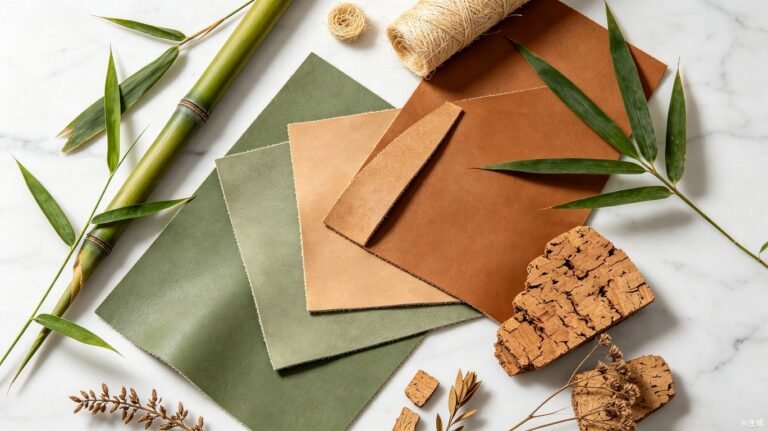
Material swatches like these represent the range buyers encounter — composition varies widely by grade
Here’s the procurement problem: when a supplier quotes “bamboo leather” without disclosing bio-based content percentage, you could be buying anything from 83% plant-based premium material to 25% plant-based PU-coated fabric. The eco-friendly material label tells you nothing about actual composition or long-term performance. In our experience reviewing supplier spec sheets, fewer than 30% of bamboo leather suppliers disclose their full material breakdown — and those that don’t are almost always in the lower bio-content tier.
Bamboo Leather Durability: Where Lab Data Meets Marketing Claims
Durability claims for bamboo leather vary wildly depending on which test method suppliers choose to cite. Von Holzhausen’s Banbu material — one of the most rigorously tested bamboo leathers on the market — reports 200,000 Bally flex cycles but only 1,000 Taber abrasion cycles under SAE J948 (CS-10 wheels, 1,000g load), per their published material specifications. That Taber result is the critical number, and it’s remarkably low compared to the 200,000+ Martindale cycles that silicone leather achieves under ISO 12947-2.
Why this matters: Taber and Martindale tests aren’t directly comparable, but the 200× difference is telling. Taber abrasion at 1,000 cycles means the material shows visible wear after roughly one to two years of daily commercial use. Martindale at 200,000 cycles translates to 10+ years in the same environment.
Some suppliers cite “50,000+ abrasion cycles” for bamboo leather durability, implying a 10-year service life. That number typically comes from a different test method or a lower-weight abrasion wheel — not the Martindale protocol that most B2B furniture and automotive buyers require. When a supplier claims 50,000 cycles without specifying the test standard, ask for the ISO 12947-2 report. In our lab testing, we’ve seen materials pass 50,000 cycles under one method and fail at 5,000 under another.

Abrasion testing reveals the performance gap between marketing claims and real-world durability
The Coating Failure Problem Plant-Based Materials Can’t Solve
Bamboo fibers are hydrophilic — they absorb moisture from the air, expanding and contracting with humidity changes. This property creates a fundamental engineering problem for bamboo leather: any coating applied to the surface must accommodate continuous dimensional movement. Rigid coatings accumulate stress at the coating-fiber interface with each humidity cycle, eventually cracking. Flexible coatings accommodate movement but typically lack the abrasion resistance needed for commercial applications.
This isn’t theoretical. A Gucci bamboo leather handbag listed on resale platforms showed “edge peeling and minor marks” and “coating peeling” on handles after normal use. The bamboo leather surface — marketed as scratch-proof and fade-resistant — couldn’t survive daily handling without visible coating degradation. In B2B applications like furniture upholstery or automotive interiors, the abuse factor is exponentially higher.

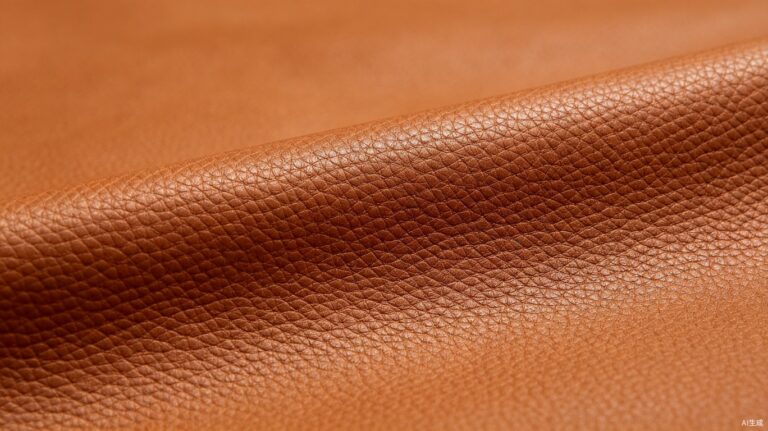
Plant-based leather in furniture applications must withstand daily wear that lab tests only begin to simulate
The core issue is that bamboo leather is a composite material — fibers bonded with a binder (often PU or bio-resin), finished with a surface coating. Each layer has different thermal expansion, moisture absorption, and flex characteristics. When these layers move against each other under daily use, the weakest layer fails first. In bamboo leather, that’s almost always the surface coating or the fiber-binder interface. By contrast, silicone leather uses a homogeneous silicone coating bonded to a fabric substrate — no multi-layer composite, no coating-fiber mismatch.
Bamboo Leather vs Silicone Leather: The Durability Gap
When procurement teams compare bamboo leather against silicone leather for commercial applications, the performance gap is measurable across every critical metric. The table below draws from published bamboo leather test data and TOPSUN’s internal lab results verified by SGS and Intertek.
| Property | Bamboo Leather (Premium) | Silicone Leather |
|---|---|---|
| Bio-based content | 25–83% (varies by grade) | 100% recyclable, PVC-free |
| Abrasion resistance | 1,000 Taber cycles (SAE J948) | 200,000+ Martindale (ISO 12947-2) |
| UV stability | Not standardized; claims vary | 1,000+ hours, ISO 105-B06 |
| Temperature range | Limited (coating-dependent) | -40°C to 250°C, no cracking |
| VOC emissions | May contain PU solvents | Zero VOC, VDA 270 Grade 1.0 |
| Biodegradability | Claimed; conditional on no synthetic coatings | 100% recyclable, supports circular economy |
| Service life (commercial) | 3–5 years (coating-dependent) | 10+ years verified |
| Antimicrobial | Bamboo polyphenols (natural) | Intrinsic antimicrobial, no additives |
The bamboo leather antimicrobial advantage — derived from natural bamboo polyphenols — is real but limited. Polyphenol effectiveness degrades as the coating wears, and the antibacterial property doesn’t address the coating failure that leads to replacement. Silicone leather’s intrinsic antimicrobial property is structural — it doesn’t wear off because it’s not an additive. Both materials claim antimicrobial performance, but only one maintains that performance after 200,000 abrasion cycles.
Is bamboo leather actually biodegradable?
Only when manufactured without synthetic coatings — and most commercial bamboo leather uses PU or synthetic resin binders that prevent full biodegradation. The Hermès and Herman Miller premium versions (83% plant-based, 17% non-toxic resins) come closest to genuine biodegradability, but these represent a small fraction of the market. Most bamboo leather ends up in the same landfill as conventional PU, with the bamboo fibers decomposing while the synthetic components persist. For buyers prioritizing end-of-life environmental impact, the actual biodegradability depends entirely on the specific product’s composition — which most suppliers won’t disclose.
Can bamboo leather pass automotive interior specifications?
Currently, no bamboo leather product we’ve evaluated passes the full suite of OEM automotive interior requirements: FMVSS 302 flame retardancy, VDA 270 odor rating, VDA 277 VOC emissions, and 1,000+ hour UV stability under ISO 105-B06. The PU content in most bamboo leather makes it flammable, and the solvent-based processing introduces VOC concerns. Some premium grades may pass individual tests, but we haven’t seen a bamboo leather that passes all OEM requirements simultaneously. Bio-based leather materials remain promising for fashion and light-duty applications, but automotive interiors demand performance levels that current bamboo leather can’t deliver.
Before You Source: 5 Verification Steps
If you’re evaluating bamboo leather for a B2B application, don’t accept marketing claims at face value. Use this checklist to separate genuine eco-performance from green-washed PU:
- Demand the bio-based content percentage. If a supplier can’t state the exact percentage of plant-based material, assume it’s below 30%. Premium bamboo leather should disclose 80%+ bio-content with certification.
- Request ISO 12947-2 Martindale abrasion data. Taber abrasion at 1,000 cycles isn’t comparable to Martindale at 200,000 cycles. If the supplier only provides Taber data, ask why — and request the Martindale equivalent.
- Verify biodegradability claims with a third-party report. “Biodegradable” on a spec sheet is meaningless without ASTM D5511 or EN 13432 test data. Most bamboo leather with PU content will not pass either standard.
- Ask for VDA 270 and VDA 277 test results. If bamboo leather contains PU solvents, it will likely fail automotive odor and VOC thresholds. This matters even for non-automotive applications — VOC emissions affect indoor air quality certifications like LEED.
- Compare 5-year TCO, not unit price. Bamboo leather at $12/sqm with a 3-year lifespan costs more over 10 years than silicone leather at $18/sqm with a 10-year lifespan — once you factor in replacement labor, downtime, and warranty claims.
Bamboo leather represents a genuine step forward in plant-based material science, and its premium variants may find niches in fashion and low-wear applications. But for commercial interiors, automotive, furniture, and healthcare — where buyers need 10+ year lifespans, certified fire safety, and zero VOC — the lab data points to silicone leather as the material that actually delivers on sustainability promises without sacrificing performance.
Compare Material Samples Side by Side
About TOPSUN
TOPSUN manufactures silicone leather as a verified eco-alternative to bamboo leather for automotive interiors, furniture upholstery, and commercial healthcare applications.
Zero VOC emissions, 200,000+ Martindale cycles, 1,000+ hours UV stability (ISO 105-B06), -40°C to 250°C operating range, FDA and ISO 10993 biocompatibility certified, 500,000+ meters monthly capacity.