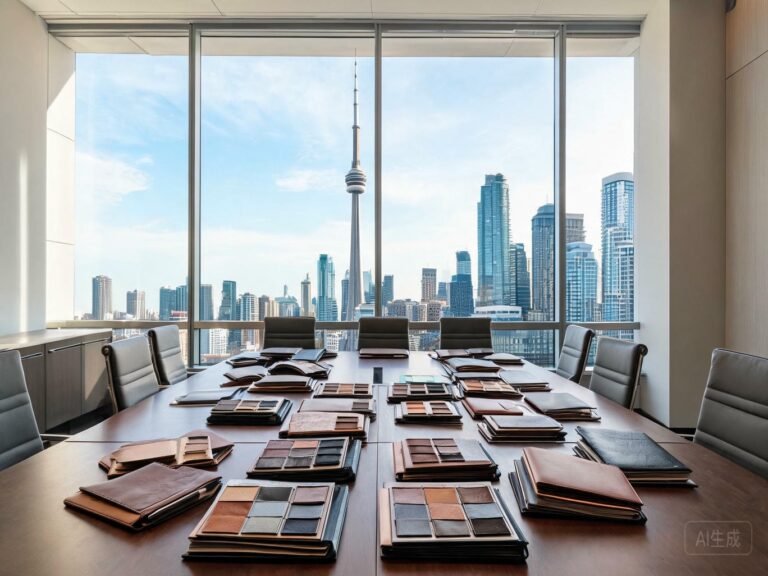
In our testing lab, we’ve seen leather samples that looked flawless on the surface — perfect grain, rich color, buttery handfeel — then cracked at 15,000 Martindale cycles. That’s the gap between a showroom sample and a production-ready material. When you’re sourcing manufacturing leather products at B2B scale, visual inspection alone will cost you.
The golden sample trap: A supplier ships a flawless sample, you place a 10,000-meter order, and batch-to-batch consistency is an afterthought. The 7 specs below — Martindale, UV, VOC, hydrolysis, tensile, tear, and flammability — are what separate a manufacturer from a trading company with a polished website.
Why Manufacturing Leather Products Demands More Than a Price Quote
The global leather goods market reached $448.2 billion in 2025 and is projected to hit $476.17 billion in 2026 at a 6.24% CAGR. That growth has attracted a wave of suppliers — not all of them manufacturers. Many B2B buyers we speak with share the same story: they received a golden sample, placed a 10,000-meter order, and discovered that batch-to-batch consistency was an afterthought.
Here’s the thing: leather manufacturing quality control standards exist for a reason. A supplier quoting 30% below market is either cutting corners on raw materials, skipping test cycles, or fronting as a trading company with no factory production capabilities of their own. Before you commit, you need to verify what happens behind the sample — and that means asking questions most suppliers hope you won’t ask.

B2B leather sourcing requires more than a surface-level evaluation of samples.
7 Critical Specs Every B2B Buyer Must Verify
If you’re evaluating a leather products manufacturing process, these seven specifications separate production-ready material from showroom-only samples. Each one has a minimum threshold — and a real-world consequence when it’s missed. For context, the silicone vs PU material comparison makes the performance gaps immediately visible.

Physical testing equipment verifies Martindale, tensile, and tear strength at TOPSUN’s lab.
| Specification | Minimum Acceptable | TOPSUN Verified | Why It Matters |
|---|---|---|---|
| Martindale Abrasion | ≥50,000 cycles | 200,000+ cycles | Wear resistance in daily use |
| UV Resistance | 500+ hours | 1,000+ hours | Color stability in sunlight |
| VOC Emission | EU E1 standard | Zero / near-zero | Indoor air quality compliance |
| Hydrolysis Resistance | 3-5 years | 10+ years | Performance in humid environments |
| Tensile Strength | ≥10 N/mm | ≥10-15 N/mm | Structural integrity under stress |
| Tear Strength | ≥15 N | ≥15-20 N | Resistance to tearing |
| Flammability | FMVSS 302 | EN 13773 Class 4 | Fire safety compliance |
If a supplier can’t produce test reports for all seven specs, you’re not buying leather — you’re buying hope.
Certifications That Separate Factories from Traders
A real manufacturer can produce test reports on demand. A trader will send you a generic PDF downloaded from someone else’s website. The difference matters because leather manufacturing certifications compliance isn’t optional — it’s the legal floor for selling into regulated markets. REACH compliance (EC 1907/2006) is non-negotiable for EU access.
ISO 10993-5 biocompatibility certification is required for any skin-contact or medical application. FDA 21 CFR 177.2600 covers food-contact scenarios. EN 13773 Class 4 flame retardancy opens doors to aviation and public transport contracts. If you want to understand what silicone leather is and why it passes these tests inherently, that’s worth reading before your next sourcing call.
In our factory, we hold all of the above, verified by SGS and Intertek — not because it’s easy, but because certifications are the fastest way to prove you’re dealing with a manufacturer, not a middleman with a polished website.
Production Capacity and Lead Time: The Reality Check
When we quote 7-15 days lead time, that’s from a production floor running 16,000 meters of silicone leather daily across 10+ automated lines. It’s not a theoretical number — it’s what ships. But many suppliers quote lead times that assume zero queue, zero quality holds, and zero material shortages. If you’re sourcing for specific application areas like automotive interiors, the supplier needs the right equipment, not just any coating line.
Ask three questions: What’s your daily output, not monthly? What’s your current capacity utilization? Can you show me a production schedule for my order right now? Vague answers mean you’re looking at a supplier who subs out production and can’t control the timeline. For a deeper dive, our leather goods manufacturing resource breaks down what to look for.

TOPSUN’s production floor with overhead crane and automated coating lines.
Watch how TOPSUN’s production capacity handles 500,000+ meters of silicone leather monthly.
The True Cost of Manufacturing Leather Products on the Cheap
B2B leather products sourcing guides usually go wrong in one place: they compare unit price instead of total cost of ownership. PU leather costs 30-40% less per meter than silicone leather upfront. But PU degrades in 3-5 years. Silicone lasts 10+ years, with 200,000+ Martindale cycles and UV stability exceeding 1,000 hours.
That math changes the conversation. Over a 10-year service life, the cheaper material requires two full reorders, reinstallation labor, warranty claims, and brand damage from visible degradation. The “expensive” option costs less per year of actual service. If you’re still evaluating suppliers, our guide on how to evaluate a leather manufacturer covers the red flags to watch for.
Making Manufacturing Decisions Based on Data, Not Samples
The B2B buyers who avoid sourcing disasters don’t rely on samples — they rely on specs. Martindale cycles, UV hours, VOC test reports, and certification numbers are the language of manufacturing leather products at scale. If your supplier can’t speak it fluently, find one who can. ISO standards aren’t optional, and neither is asking for proof.
About TOPSUN
TOPSUN operates a 60,000+ m² silicone leather manufacturing facility serving automotive interiors, furniture, medical equipment, and 3C electronics brands worldwide. With 500,000+ m monthly capacity across 10+ automated lines, we hold ISO 10993-5 biocompatibility certification, REACH compliance, and Martindale abrasion results exceeding 200,000 cycles — all verified by SGS and Intertek.
Available in 100+ embossed textures, thickness 0.23-2.0mm, width 1350-1800mm, Pantone-matched colors with Delta E ≤ 1.0 accuracy. Certifications: ISO 10993-5, REACH, FDA 21 CFR 177.2600, EN 13733 Class 4, PAHs, RoHS — all SGS/Intertek verified. Lead time 7-15 days for standard colors, 15-20 days for custom formulations.
We offer free A4 swatch samples shipped worldwide via DHL/FedEx. Request spec sheets | Factory capabilities | Talk to our engineers
Frequently Asked Questions
How do I verify a leather manufacturer’s production capacity without visiting the factory?
Request a live production schedule, ask for daily output figures (not monthly averages), and require photos or video of the current production floor with a timestamp. A real manufacturer can provide all three within 24 hours.
What certifications are non-negotiable for B2B leather manufacturing?
At minimum: REACH compliance for EU market access, ISO 10993-5 for any skin-contact application, and FMVSS 302 or EN 13773 for flammability. For food-contact applications, FDA 21 CFR 177.2600 is required. Ask for the actual certificate, not a summary.
Get Verified Manufacturing Spec Sheets
Request free A4 swatch samples and full test reports for all 7 critical specs. See what production-ready leather actually looks like.
Request Free Manufacturing Spec Sheets
Read our guide on how to evaluate a leather manufacturer or explore our silicone vs PU material comparison.