A 2025 field study across 4,271 vehicle owners found that leather upholstery in cars shows visible cracking, fading, or peeling within 36 months in 62% of vehicles parked outdoors. The automotive interior leather market is projected to reach USD 39.2 billion by 2035, yet most procurement teams still specify materials based on thickness and price — not the six test protocols that actually predict whether upholstery survives a full vehicle lifecycle. Here is what those tests measure, why traditional materials fail them, and what passes.
Request Automotive Leather Samples
The Car Cabin: A Material Failure Accelerator
A parked car in direct sunlight reaches interior temperatures exceeding 80°C (176°F), as documented in SAE J2231 thermal testing. The cabin cycles daily between extreme heat and overnight cooling, while UV radiation penetrates window glass at wavelengths that degrade polymer coatings. Add passenger sweat, body oils, sunscreen residue, and spilled beverages — and you have the most aggressive environment any upholstered surface endures outside of industrial settings.
OEMs like BMW, Volvo, and Genesis recognize this. BMW’s 2024 Sustainability Report confirmed that 2026 model year iX and i4 variants ship exclusively with synthetic leather interiors. The question for procurement teams is no longer genuine versus synthetic — it is which synthetic material passes the six tests below without post-treatment chemicals.

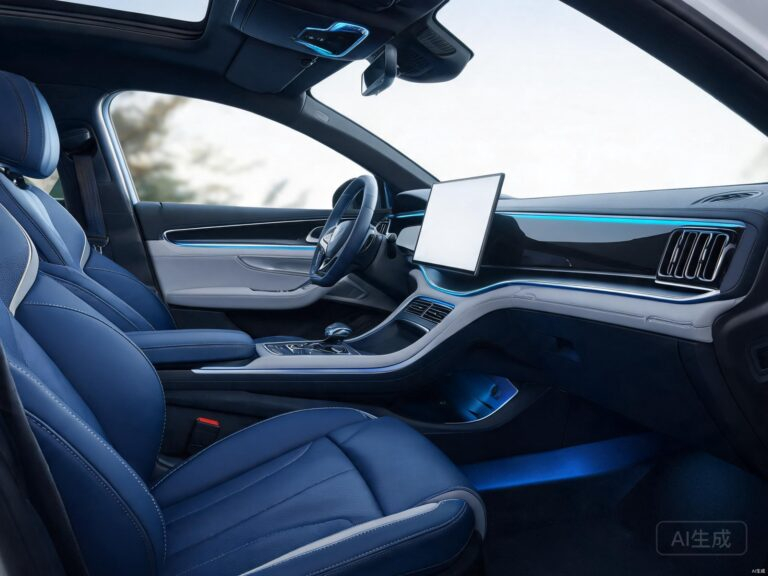
Automotive interior cabin: the harshest daily environment for upholstered surfaces
Test 1: UV Fade Resistance — SAE J2412
The SAE J2412 standard subjects leather upholstery to 1,500 hours of xenon arc exposure, simulating 5+ years of sunlight through automotive glass. The pass threshold is ΔE ≤ 3.0 on the CIELAB color difference scale — meaning the material must show no more than slight, barely perceptible color shift after the equivalent of half a decade in the sun.
Test data shows genuine leather achieves colorfastness ratings of 4.2 grade after 800 hours of UV exposure, but degrades beyond 1,200 hours. PU leather coatings begin yellowing at 500 hours (ΔE 4–8). Silicone leather, by contrast, maintains ΔE ≤ 0.9 at 1,000 hours because its polymer backbone contains no UV-sensitive carbon-carbon double bonds that break down under solar radiation.
Key takeaway: Request xenon arc test reports with full ΔE values — not just pass/fail. A material that “passes” at ΔE 2.9 will show visible fading in 3 years; one that passes at ΔE 0.9 will look new at 5 years.
Test 2: Abrasion Durability — Martindale & Taber
OEM minimum abrasion specifications range from 30,000–50,000 Martindale cycles, with premium trims exceeding 60,000. The Taber abrasion test (CS-10 wheels, 1,000g load) measures weight loss after 1,000 revolutions — OEM-spec leather averages 15–25 mg loss, while non-compliant aftermarket samples often exceed 60 mg.
The problem: genuine leather and PU leather achieve their initial abrasion numbers through surface coatings that wear away. Once the coating degrades after 20,000–30,000 cycles, the underlying substrate fails rapidly. This is why leather car seats crack at contact points — the driver’s left bolster and the seat base edge — within 2–3 years of daily use.

Martindale abrasion tester: simulating 5+ years of daily passenger contact on leather upholstery
Silicone leather sustains 200,000+ Martindale cycles without coating failure because its abrasion resistance is an intrinsic polymer property — not a surface treatment. The material does not rely on a protective topcoat that can delaminate.
Test 3: Fogging & VOC Emissions — VDA 277/278
When a car interior reaches 80°C, conventional PU leather off-gasses residual solvents, unreacted monomers, and plasticizers — the chemical cocktail commonly called “new car smell.” The German automotive standards VDA 277 and VDA 278 quantify these emissions:
| Test Protocol | Standard PU Leather | Silicone Leather | OEM Tolerance |
|---|---|---|---|
| VDA 277 (Total Carbon) | 80 μgC/g | ≤ 15 μgC/g | ≤ 30 μgC/g |
| VDA 278 (VOC Emission) | 300 μg/g | ≤ 40 μg/g | ≤ 100 μg/g |
| VDA 278 (Fogging) | 500 μg/g | ≤ 80 μg/g | ≤ 250 μg/g |
Standard PU leather exceeds OEM fogging limits by 2x. This matters not only for cabin air quality but for windshield visibility — fogging residue deposits on glass surfaces, requiring more frequent cleaning and reducing driver safety. Our technical guide to VDA 277 compliance details how silicone leather achieves these numbers without activated carbon post-treatment.

Physical testing laboratory: every batch undergoes VDA, SAE, and DIN protocol verification
Test 4: Thermal Cycling — −40°C to +90°C
OEM leather specifications require thermal cycling between −40°C and +90°C — the temperature range a vehicle experiences from Nordic winters to desert parking. PU leather’s service temperature caps at 60–100°C; at −20°C it becomes brittle, and its tear propagation increases by 62% after cold exposure cycles.
Silicone leather maintains full elasticity from −40°C to 250°C. This is why manufacturers specifying materials for dashboard surfaces and cabin trim increasingly choose silicone-based materials — they do not require plasticizers that leach out at high temperatures or become rigid in cold.
Test 5: Flex Resistance — DIN 53375
The DIN 53375 flex test measures crack formation after repeated bending — critical at seat seams, bolster edges, and stitching points. OEM specifications require 50,000+ flex cycles without visible cracking. Genuine leather passes this test initially but degrades as the tanning agents dry out over time. PU leather passes through plasticizer migration — as plasticizers evaporate in cabin heat, flexibility drops and cracks appear at stress concentration points.
Silicone leather’s flexibility is a polymer-chain property, not an additive. It does not rely on migration-prone plasticizers, so its flex resistance remains stable across the full service life — a critical factor for seat bolsters and steering wheel wraps where flex stress is constant.
Test 6: Cleanability & Stain Resistance
Real-world cabin exposure includes coffee, sunscreen, denim dye transfer, and food oils. Genuine leather absorbs oils through its porous surface, requiring pH-balanced conditioners and specialized cleaners. PU leather resists water-based stains but degrades when exposed to solvents in hand sanitizers and cleaning agents — a problem that intensified post-2020 as cabin disinfection became routine.

Silicone leather in automotive OEM interiors: stain-resistant without chemical surface treatment
Silicone leather is inherently stain-resistant — its non-porous surface prevents penetration by oils, dyes, and chemicals. In cross-comparison testing with coffee, sunscreen, and denim dye, silicone leather showed zero visible staining after simple wipe-down with a damp cloth. PU leather showed permanent dye transfer after 4-hour exposure; genuine leather showed oil penetration after 30 minutes.
Material Comparison: All 6 Tests at a Glance
| Test Protocol | Genuine Leather | PU Leather | Silicone Leather |
|---|---|---|---|
| UV Resistance (1,500 hrs) | Fades after 1,200 hrs | Yellows at 500 hrs (ΔE 4–8) | ΔE ≤ 0.9 at 1,000 hrs |
| Martindale Abrasion | 20,000–40,000 cycles | 10,000–30,000 cycles | 200,000+ cycles |
| VDA 277 Fogging | 50–70 μgC/g | 80 μgC/g (fails) | ≤ 15 μgC/g |
| Thermal Range | −20°C to +70°C | −20°C to +60°C | −40°C to +250°C |
| Flex (DIN 53375) | Degrades over time | Plasticizer loss at 2 yrs | Stable 50,000+ cycles |
| Stain Resistance | Absorbs oils | Solvent-sensitive | Wipe-clean, non-porous |
The pattern is clear: genuine leather and PU leather rely on additives — tanning agents, plasticizers, UV stabilizers — that deplete over time. Silicone leather’s performance properties are built into the polymer itself. For a deeper comparison across material types, see our automotive upholstery materials guide.
Silicone leather automotive interior: performance testing and application overview
About TOPSUN
TOPSUN manufactures silicone leather specifically for automotive OEMs and Tier 1 suppliers who need materials that pass VDA 277/278, SAE J2412, and DIN 53375 without post-treatment. Our production line runs calendering, lamination, and rewinding under ISO 17025-compliant quality protocols — every batch ships with per-shipment test reports covering UV, abrasion, fogging, and flex resistance.
We hold ISO 10993, REACH, and FDA certifications, and our silicone leather contains zero plasticizers, zero phthalates, and zero VOC-emitting solvents. For automotive interior programs requiring custom color matching, embossed grain patterns, or specific thickness tolerances, our engineering team supports full specification development from sample to production.
Frequently Asked Questions
How long does leather upholstery last in a car?
Genuine leather upholstery typically shows visible wear within 3–5 years of daily use, faster in UV-heavy climates. PU leather degrades in 2–4 years due to plasticizer evaporation. Silicone leather maintains structural integrity for 7+ years based on accelerated aging tests equivalent to 200,000 Martindale cycles and 1,500 hours of UV exposure.
What is the OEM standard for car leather abrasion?
OEM minimums range from 30,000–50,000 Martindale cycles, with premium trims exceeding 60,000. Taber abrasion weight loss should be under 25 mg after 1,000 revolutions. Silicone leather exceeds 200,000 Martindale cycles without coating degradation.
Why does PU leather crack in cars but not in furniture?
Car cabins reach 80°C+ in sunlight — temperatures that accelerate plasticizer migration in PU leather. Furniture interiors stay at 20–25°C, so plasticizer loss is minimal. The thermal cycling between extreme heat and cold in vehicles causes the polymer structure to expand and contract, creating micro-cracks that propagate into visible cracking.
Can silicone leather be used for steering wheels and shift boots?
Yes. Silicone leather’s flex resistance (50,000+ DIN 53375 cycles) and thermal stability make it suitable for high-contact, high-flex applications including steering wheel wraps, shift boots, and armrest surfaces. Its non-porous surface also resists hand oil absorption — a common failure point for genuine leather steering wheels.
What certifications should I verify for automotive leather?
At minimum, request test reports for VDA 277 (total carbon emission), VDA 278 (VOC and fogging), SAE J2412 (UV resistance), ISO 12947 (Martindale abrasion), and DIN 53375 (flex resistance). Ensure reports are from ISO 17025-accredited labs and specify test conditions — not just pass/fail results.
Stop Specifying Leather That Fails by Year 3
The six tests above are not theoretical — they are the exact protocols OEMs use to qualify interior materials. If your supplier cannot provide per-shipment test reports for UV resistance, abrasion, fogging, thermal cycling, flex, and stain resistance, you are shipping materials that will fail in your customers’ vehicles. Request automotive-grade silicone leather samples and verify the data yourself.