Every year the world buys more than $22 billion of upholstery fabric, and fabrics home buyers account for 67.8% of it. Yet the average sofa survives only 7 to 15 years, and budget models give up in as little as three. The fabric rarely wears out evenly.
It fails where life actually happens: the juice that soaks in, the claw that snags, the sun that bleaches. The fourth killer works even quieter: the disinfectant wipe that dries out the coating. Most home fabrics are specified against a single abrasion number. That number explains less than half of what really ends a sofa. Here are the four killers, and the test data that intercepts each one.
| Failure Driver | How It Destroys the Fabric | Residential Benchmark | The Number That Intercepts It |
|---|---|---|---|
| Soaked-in spills | Liquids wick through porous weaves into the foam, where stains and odors set permanently | Permanent stains are a top replacement trigger | Level 5 stain resistance; liquids bead and wipe off |
| Pet claws | Loops snag, coatings puncture, seat covers pill at the edges | 30,000+ double rubs advised for pet households | 200,000+ Martindale cycles (ISO 12947) |
| UV sunlight | Dyes bleach and fibers embrittle on the window side of the room | Cotton and linen sofas fade within 5-10 years | 1,500+ hours of UV exposure with no fading |
| Disinfectants | Alcohol and quats craze PU coatings and accelerate hydrolysis | PU upholstery typically fails in 3-5 years | Alcohol-safe surface; no hydrolysis after 14 weeks at 85°C / 85% RH |
Why Fabrics Home Buyers Replace: The Cycle Nobody Budgets For
Start with the scale. The global upholstery fabric market reached $22.5 billion in 2025. Projections put it at $32.08 billion by 2032, a 5.2% CAGR. Residential buyers dominate with a 67.8% share, and synthetic fibers carry 60.1% of all material volume. In other words, the biggest single buyer of upholstery fabric is not a hotel chain or an airline. It is the household, replacing furniture one living room at a time.
If you have ever asked how long a sofa should last, the honest answer is a spread, not a number. Budget pieces wear out in 3 to 7 years. Mid-range sofas manage 7 to 10. Well-built premium frames can push past 15. What surprises buyers is how often the fabric, not the frame, ends the relationship. Sagging cushions can be re-filled. A torn or permanently stained cover usually cannot be rescued, so the whole sofa goes.
In our abrasion laboratory, fabrics almost never die from rubbing alone. We see samples pass 50,000 cycles and still fail a real living room, because the laboratory only simulates one of the four killers. A residential furniture specification that quotes a single rub count is answering one question out of four.
Spills and Stains: Where Most Home Fabrics Fail First
Liquid is the fastest path from “new sofa” to “replacement sofa.” A woven fabric is a bundle of capillaries. Juice, coffee, and pet accidents wick along the yarns into the foam core. There they set into permanent stains and feed the bacteria behind lingering odors. Industry replacement guides list persistent odors and permanent stains among the clearest signs that a sofa is finished. By then, no surface cleaning recovers it.
This is why stain resistant fabric for sofas has become such a crowded claim. Most performance fabrics fight liquid with a surface treatment, a fluorocarbon or wax finish applied after weaving. Those treatments work well on day one. They also wear away with abrasion and laundering, which is exactly what a family room delivers daily. The protection is a coating of promises on top of an absorbent structure.
We test the difference with a dropper, not a brochure. On silicone-coated material, water, coffee, and soy sauce sit on the surface as beads that wipe away with a dry cloth. The hydrophobic chemistry runs through the entire coating rather than sitting on it. Spilled milk on a visit to our testing bench still wiped clean after an hour. For the care routine that keeps any fabric at Level 5 stain performance, see our cleaning and maintenance guide.

Liquid beading on the coating surface: stains stay where a cloth can reach them.
Watch the sofa stain challenge: common household spills wiped away without a trace.
Talk to Our Team About Stain-Proof Home Fabrics
Pet Claws and Kids: The Rub Count Reality Check
Abrasion numbers deserve scrutiny too, because the two industry tests do not translate. Wyzenbeek double rubs (the North American method) and Martindale cycles (the European method) measure similar abuse, but a 30,000 double-rub rating is not a 30,000 Martindale rating. Benchmarks help. Light-duty living rooms suit 15,000 to 25,000 rubs. Family rooms need 25,000 to 30,000, and homes with pets or kids should start at 30,000 and climb. Some heavy-use guides push 40,000 and beyond for households that treat a sofa like playground equipment.
Ask what the best fabric for sofa with pets really is. Most retail guides point to leather or performance weave. Both answers carry fine print. Genuine leather handles hair well but punctures at claw points and costs a premium. Tight performance weaves resist snagging, yet the same tightness can feel stiff, and pile or loop textures are explicitly advised against for pet homes. The claw is a point load, not a rub. The honest specification needs puncture and tear data alongside the rub count.
Our High Performance line is specified at 200,000+ Martindale cycles, verified on our own ISO 12947 testers, and tear strength starts at 20+ N. A pet products brand we supply runs dog-bed covers through claw-and-rub cycling before every production release. Two years into the market, their fabric-damage return rate has stayed under 1%. For that application we recommended our PET-base silicone leather, which pairs the abrasion figure with a snag-resistant surface.

Scratch testing simulates the point loads claws deliver, which rub counts never measure.
Sunlight and Disinfectant: The Two Killers That Work Quietly
The last two killers do their damage in slow motion. UV light bleaches dyes unevenly. The window-side seat fades while the far side stays dark, so the sofa looks old long before it is structurally worn. Faded fabric from UV damage is another listed replacement sign. Natural-fiber covers are the most exposed: cotton and linen sofas typically serve 5 to 10 years, and sunroom placements cut that sharply.
Disinfectant is the newer threat. Since 2020, households wipe armrests with alcohol-based cleaners several times a week. Alcohol swells and crazes PU coatings. Plasticizers migrate out, the surface cracks, and hydrolysis finishes the job. That chemistry is why PU seating lives 3 to 5 years in real homes. Silicone chemistry takes a different path. Our samples came through 1,500+ hours of UV exposure with no fading. They survived 14 weeks in an 85°C / 85% RH hydrolysis chamber with no delamination. They also tolerate alcohol-safe disinfection at Level 5 stain performance. Wipe the armrest as often as you like.

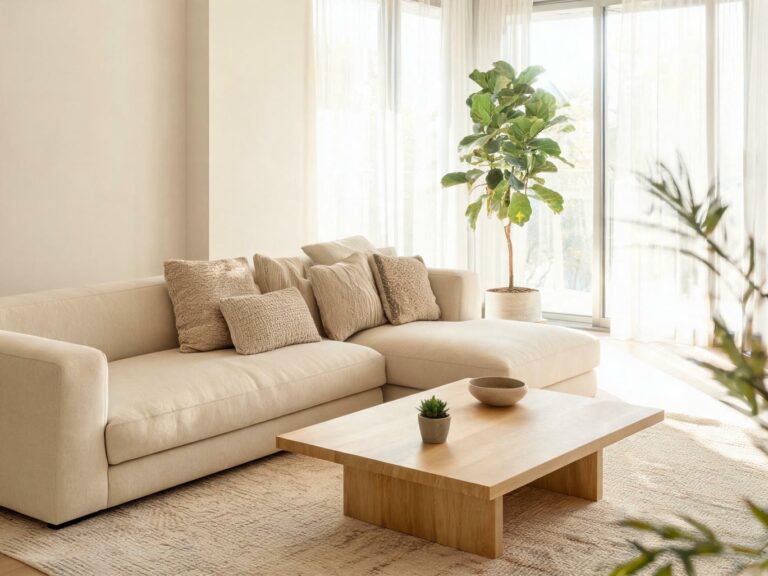
A living-room build specified against all four killers, not just abrasion.
Lab Numbers That Actually Predict Fabrics Home Survival
Test reports are where marketing meets evidence, and four numbers matter for a living room. Martindale (ISO 12947) covers mechanical wear. Ask for the cycle count at first visible thread break, not at the tester’s stopping point. Color fastness under ISO 105-B02 covers sunlight. Grade 4-5 means a summer of window light leaves the dye where it started. VOC, measured in the ISO 16000-6 chamber, covers the air your family breathes. “Non-detect” is the only answer worth framing.
The fourth number is the one catalogs skip: hydrolysis hours. Coated fabrics age from the inside out in humid rooms, so we run samples for 14 weeks at 85°C and 85% relative humidity. Afterward we check for delamination, strength loss, and surface degradation. Add flame behavior for sofas that sit near fireplaces and radiators: EN 13773 Class 4 is the top rating for interior textiles. A supplier who volunteers all four numbers has nothing to hide. A supplier who quotes only the rub count is hiding three.
The Four-Killer Test: How to Specify Fabrics That Last
The lesson from thousands of replaced sofas is simple. Home fabrics fail on the dimension nobody tested, so specify against all four killers before your next residential order:
- Demand Martindale data, not just double rubs: 40,000+ cycles for family rooms with kids or pets.
- Pour water on the sample: if it wicks in instead of beading, spills will reach the foam.
- Ask for UV hours, not “fade resistant”: under 1,000 hours means visible fading within a few summers near a window.
- Wipe the swatch with 75% alcohol: a coating that crazes in your hand will crack on the armrest.
- Request hydrolysis records: any 10-15 year service-life claim needs chamber data behind it.
A sofa that survives all four killers is not a lucky purchase. It is a specification. Choose home fabrics with numbers for every killer, and the 7-to-15-year replacement cycle becomes a floor instead of an average.
Request Home Upholstery Samples with Full Test Reports
References
- https://pmarketresearch.com/hc/furniture-uphols… — upholstery fabric market $22.5B in 2025 to $32.08B by 2032; residential 67.8%; synthetics 60.1%
- https://www.wayfair.com/sca/ideas-and-advice/ro… — sofa lifespan 7-15 years; cotton and linen 5-10; 30,000+ double rubs for homes with pets
- https://www.testextextile.com/abrasion-resistan… — Martindale rub count tiers: 30,000+ cycles for a home sofa, 50,000+ for commercial use