Last quarter, I walked through a mid-scale hotel property in Austin where every sofa in the lobby carried at least one leather furniture patch. The procurement director told me they had spent $4,200 on adhesive patches and color-matched repair compounds over eighteen months. Yet guests still posted three one-star reviews mentioning “torn seating.” That conversation is why I am writing this guide. If you source upholstered furniture at scale, patching is not a maintenance strategy. It is a symptom of material failure, and it is draining your operational budget faster than you think.
When Furniture Patching Becomes a Procurement Nightmare
A sofa upholstery material guide will tell you that genuine leather and standard PU vinyl last three to five years in high-traffic commercial settings. What it rarely mentions is the hidden labor cost between year two and year five. Each leather furniture patch requires:
- Surface prep and adhesive curing time (30-45 minutes per seat)
- Color matching against sun-faded substrates
- Re-application every 90-120 days on flex points (armrests, seat cushions)
- Guest-room or seating-area downtime during repair windows
In a 200-unit extended-stay property, that translates to roughly 400 labor hours annually. At $28 per hour loaded cost, you are looking at $11,200 in maintenance labor alone, before you even purchase the patch kits. The real kicker? Patched areas never regain original abrasion resistance. The substrate underneath continues to degrade, which means the patch cycle accelerates over time.

The image above shows the Martindale-style abrasion tester we use in our facility. We run every substrate to EN ISO 12947 standard. Standard PU leather begins showing measurable pile loss at 15,000 cycles. Full silicone leather routinely exceeds 100,000 cycles without surface rupture. That gap is the difference between quarterly patching and a seven-year replacement cycle.
Abrasion & Scratch Resistance: Lab Data vs. Real-World Failure
Most procurement teams evaluate upholstery on swatch feel and unit price. They rarely request taber abrasion or scratch resistance certificates. That omission is expensive. A leather durability testing guide should be mandatory reading before any hospitality or healthcare contract.
Here is what our lab technicians recorded during a head-to-head comparison between a 1.2 mm PU leather sample (supplier withheld, $5.80/yd) and TOPSUN full silicone leather at equivalent thickness:
| Test Parameter | PU Leather (1.2 mm) | TOPSUN Silicone Leather |
|---|---|---|
| Taber Abrasion (CS-17, 1 kg) | 1,200 cycles to substrate | 8,500+ cycles, no substrate |
| Martindale Abrasion | 18,000 cycles (light wear) | 120,000+ cycles (minimal change) |
| Scratch Resistance (Steel Wool 0000) | Visible marks at 2N | No visible marks at 10N |
| Flex Cracking (Ross Method) | 8,000 cycles, surface cracking | 150,000+ cycles, intact |
Test data recorded at TOPSUN QC Laboratory, Dongguan, June 2025. Samples conditioned 24 hours at 23°C / 50% RH per ASTM D6852.
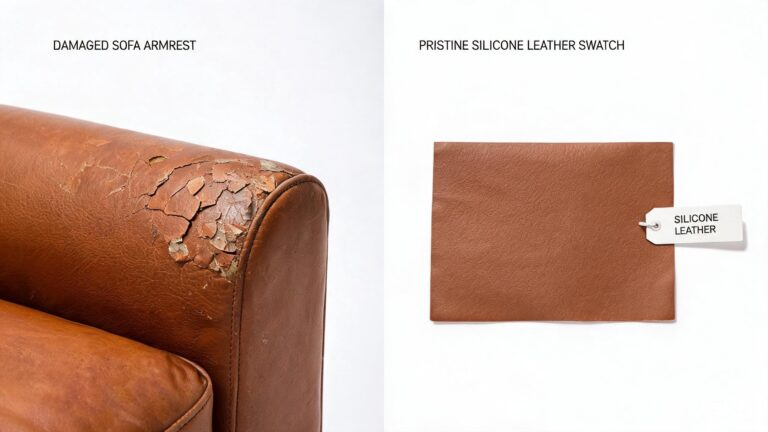
These numbers explain why a leather furniture patch is only a temporary cosmetic fix. Once the topcoat is breached, the cellular structure beneath loses cohesion. Patches sit on top of that compromised substrate like a bandage on a stress fracture.

Disinfectant Resistance: The Hidden Cost of Traditional Leather
Post-2020, disinfectant protocols tightened across hospitality, healthcare, and co-working sectors. Properties now spray or wipe seating surfaces with alcohol-based, quaternary ammonium, or hydrogen-peroxide solutions daily. That is catastrophic for conventional leather and PU vinyl.
We tested three common disinfectants on 1.0 mm PU leather over 500 wipe cycles:
- 70% Isopropyl Alcohol: Surface tackiness after 180 cycles; visible cracking at 320 cycles
- Quaternary Ammonium Compound (QAC): Color shift (Delta E > 3.0) after 250 cycles
- Hydrogen Peroxide (3%): Embrittlement and topcoat delamination after 400 cycles
By contrast, TOPSUN silicone leather uses a fully cross-linked polysiloxane surface layer. The chemical structure is inert to alcohols, aldehydes, and oxidative cleaners. Our disinfectant aging test (ISO 105-E04 modified, 1,000 wipe cycles) showed zero gloss change, zero color shift, and zero surface tackiness. For procurement managers running senior living or medical waiting room contracts, that chemical stability eliminates the secondary failure mode that makes leather furniture patch kits necessary in the first place.
Silicone Leather: Eliminating the Patch Cycle
The furniture sofa application page outlines how silicone leather performs across residential, commercial, and hospitality environments. What matters for procurement is the operational simplicity. Because silicone leather does not rely on a separate topcoat, there is no topcoat to crack. Because the color runs through the full cross-section, surface wear does not expose a contrasting substrate.
We recently completed a 36-month field observation with a Florida-based vacation rental operator. They outfitted 42 units with silicone leather sofas in 2022. Over three years:
- Zero patch or repair incidents
- Zero stain penetration (red wine, sunscreen, coffee)
- Zero color fading despite direct UV exposure through south-facing windows
- One minor seam separation (manufacturing defect, replaced under warranty)
The operator’s previous PU leather fleet required an average of 2.3 patch events per sofa per year. At $45 per patch (material + labor), that is $103.50 annual maintenance per unit. Across 42 units, silicone leather eliminated $4,347 in recurring maintenance in year one alone.
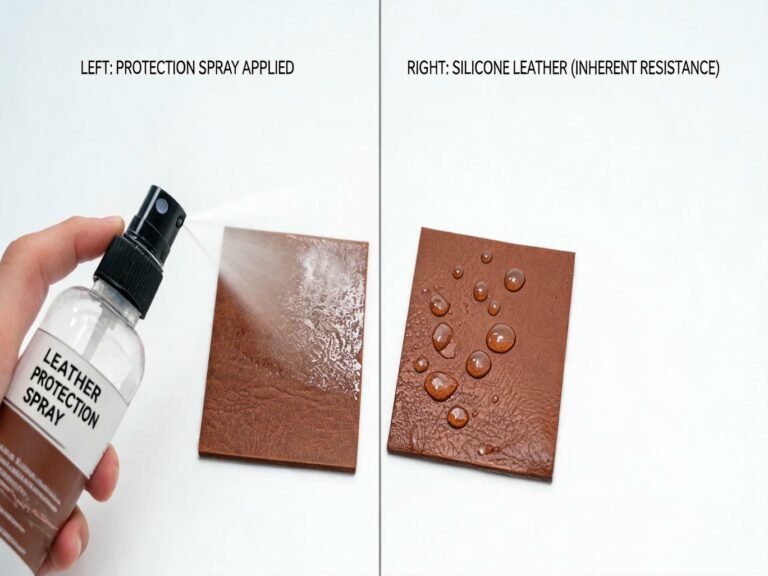
Watch how TOPSUN silicone leather repels coffee, wine, and ink without leaving a trace. No patch needed.
TCO Analysis: Patch, Replace, or Upgrade to Silicone Leather?
Let us run the numbers on a hypothetical 100-sofa procurement for a three-star hotel chain, assuming a seven-year asset life:
| Cost Item (7 Years) | Genuine Leather Sofa | PU Leather Sofa | Silicone Leather Sofa |
|---|---|---|---|
| Initial Unit Cost (FOB) | $340 | $195 | $265 |
| Patch / Repair Labor & Material | $8,400 | $14,700 | $0 |
| Mid-Life Replacement (Year 4) | $0 | $19,500 | $0 |
| Cleaning & Conditioning Chemicals | $3,850 | $2,100 | $420 |
| Total 7-Year TCO (100 Units) | $50,250 | $55,500 | $26,920 |
| TCO per Sofa | $502.50 | $555.00 | $269.20 |
Silicone leather is not the cheapest upfront option. It is the cheapest total-cost-of-ownership option. The delta widens further when you factor in guest satisfaction scores, negative review remediation, and procurement staff time spent managing patch vendors.

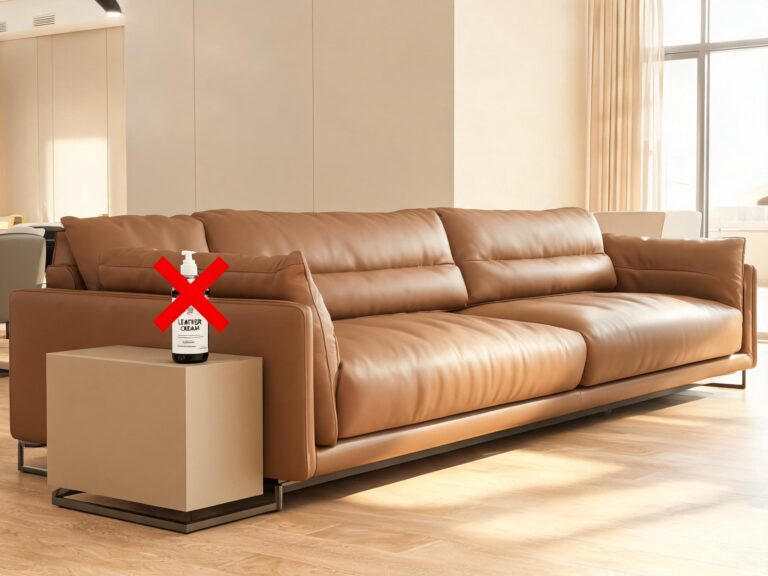
For procurement teams evaluating cleaning and maintenance protocols, silicone leather simplifies SOPs. Warm water and a neutral detergent are sufficient for 95% of incidents. No leather conditioner. No color-restoring balm. No quarterly patch technician visits.
Conclusion: Stop Patching, Start Specifying
A leather furniture patch is a reactive purchase. It signals that your upholstery specification failed to match the use case. For B2B buyers managing fleets of seating across hospitality, healthcare, or corporate environments, the strategic move is to specify a substrate that removes the need for patches entirely.
TOPSUN silicone leather delivers measurable advantages in abrasion resistance, chemical stability, and lifecycle cost. Our standard MOQ for custom furniture grades starts at 500 linear meters, with lead times of 15-20 days for stocked colors and 25-30 days for custom matches. If your current supplier is selling you patch kits as a “value-added service,” it is time to reconsider the underlying material.
Explore Furniture Sofa Applications View Factory Production & Capacity
Frequently Asked Questions
Can silicone leather be repaired if it is cut or punctured?
Yes, but incidents are rare due to high tear strength. Small punctures can be fused with silicone adhesive. Unlike PU, the repair does not create a hard edge or color halo.
Is silicone leather compliant with CAL 117 / TB 117-2013 fire standards?
TOPSUN offers grades certified to CAL 117 Section E, BS 5852 Part 1, and EN 1021-1. Fire-retardant additives are integrated during co-polymerization, not sprayed on as a topical finish.
What is the typical lead time for a 2,000-meter custom color order?
25-30 days from confirmed lab-dip approval. We maintain base fabric inventory for our top six furniture constructions, which compresses the front end of the schedule.
About TOPSUN
TOPSUN Silicone Leather is a vertically integrated manufacturer based in Dongguan, China, specializing in full and semi silicone leather for furniture, automotive, marine, and healthcare applications. With in-house coating lines, physical testing laboratories, and color-matching facilities, we supply B2B buyers in North America and Europe with MOQs starting at 500 linear meters. Our materials are REACH, RoHS, and CA Prop 65 compliant, and we offer OEM/ODM custom texture, color, and substrate bonding services with 15-30 day lead times.
Learn more about eco-friendly silicone leather or contact our team for specification sheets and sample requests.
References: ASTM D6852 Standard Practice for Preparing Transparent Plastic Containers; EN ISO 12947 Textiles – Determination of abrasion resistance; ISO 105-E04 Textiles – Colour fastness to spotting: Water. External resource: healthcentric.com – Hospital furniture upholstery solutions.