B2B buyers who need 500 to 2,000 meters of custom leather face a structural problem: traditional tanneries quote 3,000+ meter minimums, 6 to 8 week lead times, and per-color setup fees that make small projects economically unfeasible. The gap between what designers need and what tanneries will produce forces compromises — either over-order and warehouse excess material, or abandon the custom specification entirely. Leather small batch production at a 500-meter MOQ with 7 to 15 day lead times eliminates that compromise. This article breaks down how it works and what to verify before ordering.
| Factor | Traditional Tannery | PU/PVC Factory | Silicone Leather (TOPSUN) |
|---|---|---|---|
| Minimum order | 3,000+ m | 1,000–2,000 m | 500 m |
| Lead time | 6–8 weeks | 3–4 weeks | 7–15 days |
| Custom color setup | $500–$2,000/dye lot | $200–$800/lot | Included (Pantone match) |
| Custom texture lead time | 4–6 weeks | 2–3 weeks | 7–10 days |
| Color accuracy | Delta E 2–3 (hide variation) | Delta E 1.5–2.5 | Delta E ≤1.0 |
Why Leather Small Batch Production Demands a Premium
The economics of leather small batch production follow a basic principle: setup cost divided by order volume equals per-unit cost. When a tannery spends 8 hours changing dye formulations, cleaning equipment, and calibrating a new embossing roller, that fixed cost gets distributed across every meter produced. At 3,000 meters, the setup cost adds $0.50/m. At 500 meters, the same setup adds $3.00/m — unless the production line is engineered for rapid changeover. This principle is documented in ISO manufacturing standards and applies universally across material production industries.

Automated coating line — rapid changeover capability is what makes small batch leather production economically viable.
Traditional tanneries can’t offer small batch production efficiently because their processes — hide sorting, drum tanning, air drying — are inherently batch-oriented with long changeover times. A chrome tanning drum takes 24 to 48 hours per batch, and switching colors requires complete cleaning of the drum, pipes, and drying tunnels. The 3,000-meter MOQ isn’t arbitrary — it’s the minimum volume that makes the setup cost palatable. Vertically integrated production solves this by replacing batch processes with continuous-line manufacturing, where color changes take hours instead of days.
Traditional Leather vs Silicone: Small Batch Production Compared
The structural advantage of silicone leather in small batch production comes from its coating process. Rather than tanning animal hides — a biological process with inherent variability — silicone leather applies a controlled silicone elastomer to a fabric substrate using a continuous coating line. The chemistry is programmable: color, texture, thickness, and finish are determined by line parameters, not hide variation. This means a 500-meter custom order achieves the same consistency as a 50,000-meter run.
In our experience producing custom leather specifications for boutique furniture brands, a typical project looks like this: the client requests 800 meters of a specific Pantone color with a custom lychee texture for a limited-edition sofa line. Traditional tannery quote: $14/sq ft, 6 week lead time, 3,000m MOQ. Silicone leather production: $4.50/sq ft, 10 day lead time, 500m MOQ, Delta E ≤1.0 color accuracy. The client gets exactly the material they specified without warehousing 2,200 meters of excess inventory.

Release film roller system — continuous-line coating enables rapid color and texture changes for small batch production.
What 500m MOQ Means for Your Custom Project
A 500-meter minimum opens doors for projects that traditional tannery MOQs shut. A custom automotive interior prototype needing 200 meters of a specific color. A boutique hotel refurbishment requiring 350 meters of a unique texture. A limited-edition furniture line using 600 meters across 50 units. Each of these projects is viable at 500m MOQ and impossible at 3,000m MOQ without warehousing costs that erode profitability.
The practical implications extend beyond the order size itself. At 500m MOQ with 7 to 15 day lead time, a designer can order a 50m pilot run, validate the material in real-world conditions, then place the production order — all within a 3-week window. Traditional leather production would still be in the dye drum at week 3. This acceleration lets brands test-and-launch faster, reducing the risk of committing to a full production run on an unvalidated specification.
How Custom Embossing Works in 7-10 Days
Custom texture is where leather small batch production typically stalls. Creating a new embossing pattern on traditional equipment means machining a new roller — a 4 to 6 week process at most factories. For a small batch project, the roller cost alone can exceed the material cost.
TOPSUN’s approach compresses this to 7 to 10 days using in-house embossing roller design and CNC machining. The process: you provide a physical sample, digital file, or concept sketch. Our engineers scan and digitize the pattern, machine a custom embossing roller, and run a 10-meter validation sample — typically within 5 working days. Once approved, full production runs at 16,000 meters per day capacity. The 100+ texture library also allows pattern matching from existing rollers when custom design isn’t required, reducing lead time to the standard 7 to 15 day production window.

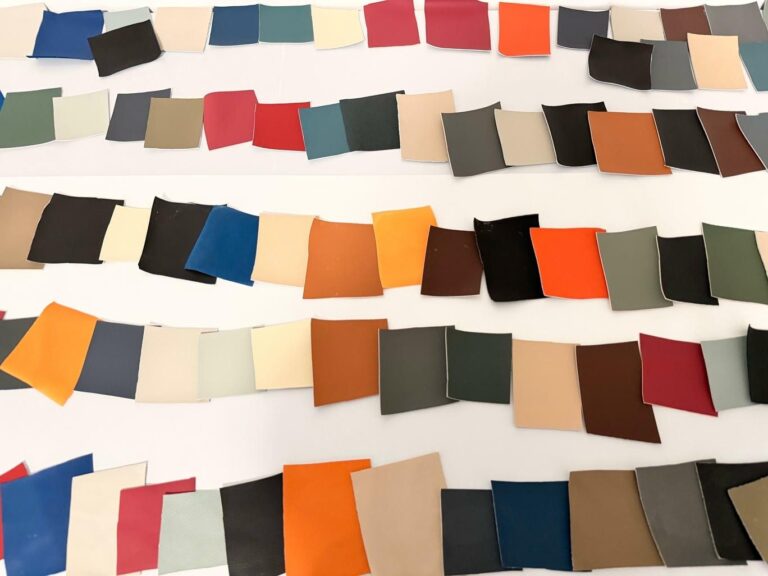
Custom texture samples — rapid prototyping within 7 days lets designers validate tactile and visual properties before committing to production volume.
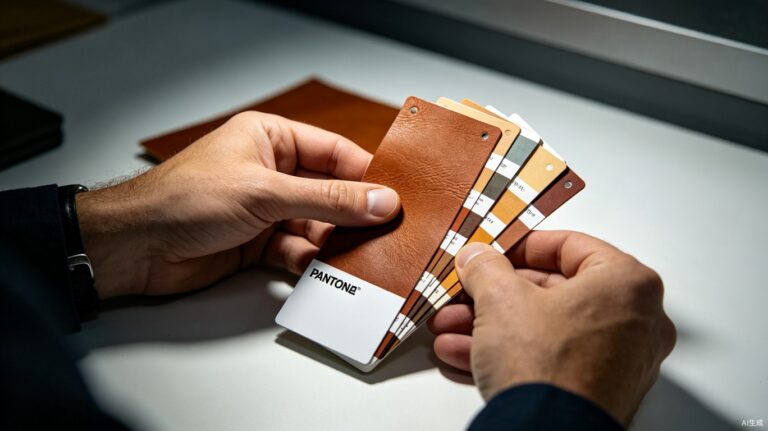
For Pantone color matching, the process is equally streamlined. Rather than dyeing hides in a color drum — which produces natural variation across the batch — silicone leather achieves color integration through the coating formulation itself. The target Pantone reference is measured against a spectrophotometer, the silicone formulation is adjusted, and a 1-meter validation swatch is produced within 48 hours. Batch-to-batch consistency holds at Delta E ≤1.0, which means the 500th meter looks identical to the 1st. Choosing the right supplier means verifying that this color-matching protocol exists, not just accepting a Pantone promise on a quote sheet.
Verification checklist for small batch leather production: (1) Is the stated MOQ for custom colors/textures, or only for stock items? (2) Does the lead time include sample production and approval? (3) Is Pantone matching included or charged separately? (4) Can they provide a 10-meter pilot run before full production? (5) What is the color accuracy guarantee (Delta E value)?
Leather small batch production at 500-meter MOQ with 7-day custom embossing represents a structural shift in what B2B buyers can specify. Projects that were forced into compromise — using stock colors, over-ordering material, or extending timelines — can now execute exactly as designed. The technology exists; the question is whether your supplier has invested in the rapid-changeover infrastructure that makes it possible.
About TOPSUN
TOPSUN enables leather small batch production with 500m MOQ, 7-day custom embossing, and Pantone-accurate color matching for automotive, furniture, and design applications.
10+ automated lines · 16,000 m/day capacity · 100+ texture library · Delta E ≤1.0 · Custom rollers in 7–10 days · 500m MOQ · 7–15 day lead time · Free A4 swatches worldwide