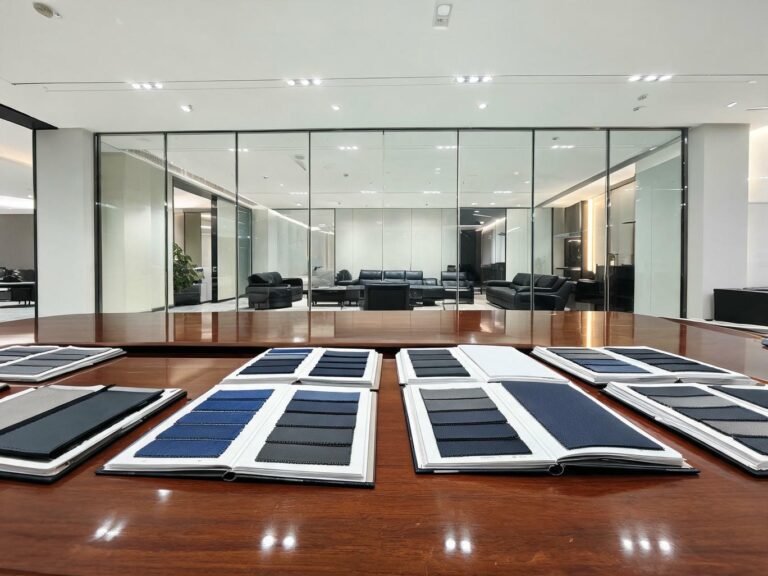
The supplier’s website shows a spotless factory, ISO certifications in a carousel, and a MOQ that fits your budget. But when the third-party auditor shows up unannounced, half the machines are idle and the “factory” is a 200-square-meter trading office subcontracting to whoever is cheapest that week. Finding a genuine leather product manufacturer — one that actually controls its production line — is the single most important decision in your sourcing pipeline. Here’s what to verify before you wire a deposit.
Trading Company vs Real Leather Product Manufacturer
Roughly 70% of suppliers on B2B marketplaces that present themselves as factories are actually trading companies. They don’t own production equipment, don’t control quality at the line level, and can’t guarantee batch-to-batch consistency. The difference matters because a trading company adds a markup without adding quality control — and when a defect appears, they blame the factory they can’t even name.
A real leather product manufacturer owns its coating lines, maintains in-house testing equipment, and can walk you through the production process step by step. When you request a factory production tour, you should see raw material storage, active coating lines, a quality lab with calibrated equipment, and finished goods with batch numbers — not a showroom with samples and a sales team.

A real manufacturer’s finished goods warehouse — batch-traceable and audit-ready
7 Critical Specs Every Leather Product Manufacturer Must Prove
A spec sheet tells you what a material should do. A test certificate tells you what it actually did. Here are the seven specifications a credible leather product manufacturer must provide with verifiable test data — not marketing language. Understanding the fundamental properties of silicone leather gives you the baseline to evaluate whether a supplier’s claims are credible.
- Martindale abrasion cycles — Minimum 100,000 for commercial applications. Premium silicone leather tests at 200,000+. Ask for the test report number and lab name.
- Hydrolysis resistance — Measured in hours. PU typically fails under 500 hours. Silicone leather should pass 1,000+ hours with zero degradation.
- VOC emissions — Demand actual emissions data, not just “low VOC.” Solvent-free silicone production registers zero VOC. PU processes emit DMF and other solvents.
- Color consistency (ΔE) — Batch-to-batch ΔE ≤ 2.0 measured by spectrophotometer. If the supplier can’t show you the equipment, they can’t guarantee the spec.
- Tear and tensile strength — Minimum tear strength of 25 N/cm for upholstery. Request ISO 3376 test data.
- Fire resistance rating — For automotive, furniture, and public spaces. Require specific standard references (e.g., FMVSS 302, EN 1021).
- Flex resistance — Minimum 100,000 flex cycles (Bally flexometer). Critical for seating applications where the material creases repeatedly.

Modern production floor — the kind of facility a real manufacturer welcomes you to audit
The Certification Stack: What to Demand and How to Verify
Certifications are only as trustworthy as the verification behind them. A supplier that emails you a PDF certificate and says “trust us” is not the same as one that gives you the certificate number, the issuing body, and a valid expiration date. The Leather Working Group audit standard — the industry’s flagship environmental, social, and governance assessment — requires on-site audits conducted by impartial certification bodies. A credible eco-friendly leather manufacturer should hold or be working toward comparable third-party verification.
For silicone leather specifically, the non-negotiable certification stack includes REACH compliance (EU chemical safety), OEKO-TEX Standard 100 (consumer safety), and ISO 10993 for medical-grade applications. For food-contact products, FDA compliance is mandatory. Ask for certificate numbers and verify them directly with the issuing body — SGS, Intertek, or TÜV. If the certificate is expired, missing a number, or issued by a body you’ve never heard of, that’s your answer.

Quality inspection in progress — the process that separates verified manufacturers from the rest
Production Capacity Audit: Reading Past the Spec Sheet
A spec sheet says the factory can produce 500,000 meters per month. The spec sheet doesn’t tell you that 60% of that capacity is committed to other clients, or that the line is down for maintenance every other Tuesday. Production capacity is a function of available lines, current utilization, and raw material lead time — three numbers most suppliers won’t volunteer.
In our factory, every production batch undergoes in-line Martindale testing before it leaves the line. We’ve seen firsthand what happens when a buyer skips capacity verification — the supplier accepts the order, then subcontracted production delivers inconsistent quality across batches because three different factories are running the same SKU. For guidance on choosing the right silicone leather factory, the factory audit checklist covers the questions that separate real capacity from a PowerPoint slide.
| Audit Area | Real Manufacturer | Trading Company | How to Verify |
|---|---|---|---|
| Equipment Ownership | Owns coating lines, calenders, test lab | Showroom only; no production floor | Request unedited factory video walk-through |
| Batch Traceability | Every roll has batch number + test data | No batch system; generic lot numbers | Ask for a random batch number and its full record |
| Quality Lab | In-house Martindale, spectrophotometer | Outsources all testing | Request live video of test equipment in operation |
| Third-Party Audits | Welcomes SGS, BV, TÜV unannounced | Only “staged” audits with advance notice | Send your own auditor or request raw audit reports |

In-house fabric inspection area — the kind of quality control infrastructure trading companies lack
5 Red Flags That Should End the Conversation
Some warning signs are subtle. These five are not. If you encounter any of them during your supplier evaluation, walk away — no matter how attractive the price seems. For a deeper dive into what to look for during leather quality inspection, the inspection protocol covers every checkpoint from raw material to finished goods.
- No in-house testing equipment — If the supplier can’t show you a Martindale tester or spectrophotometer on-site, they’re outsourcing quality control to whoever is cheapest. That’s not a manufacturer.
- Certificates without numbers — A PDF that says “REACH compliant” without a certificate number, issuing body, or expiration date is worthless. Real manufacturers provide all three.
- Refusal to allow third-party audits — A factory that only allows “staged” visits with two weeks of notice is hiding something. SGS, BV, and TÜV audits should be welcome at any time.
- Inconsistent batch samples — If the three sample rolls you receive have visibly different textures or colors, the factory has no color management system. Production will be worse.
- Price 30%+ below market — Silicone leather has a real cost floor determined by raw materials and process. If the price seems too good, you’re getting PU labeled as silicone, or recycled material labeled as virgin.
Inside TOPSUN’s quality control system — see what a real manufacturer’s audit process looks like
Verification Over Promises
The difference between a sourcing disaster and a successful partnership almost always comes down to verification. A real leather product manufacturer doesn’t just claim certifications — it hands you the certificate numbers. It doesn’t just promise capacity — it shows you the production schedule. And it doesn’t just talk about quality — it lets you walk the floor and watch the tests run. The seven specs, the certification stack, and the red flags in this guide exist because too many B2B buyers have learned these lessons the expensive way. Don’t be the next case study.
About TOPSUN
TOPSUN operates a 60,000-square-meter silicone leather production network where B2B buyers can verify every claim — from raw material sourcing to finished goods inspection.
With 10+ automated production lines, in-line Martindale testing, spectrophotometric color management, and third-party audit readiness for SGS, BV, and TÜV, our factory gives procurement teams the evidence they need to approve a supplier with confidence.