Last spring I sent one tote bag specification to three factories. The quotes came back at $18.50, $24.10, and $31 per unit. Same dimensions, same lining, nearly identical hardware. I almost signed with the cheapest supplier. Six months of production later, the highest quote looked like the real bargain. Most guides list questions to ask leather handbag manufacturers. Few explain why the numbers differ so much. Here is what I learned by reading three quotes line by line.
Why Leather Handbag Manufacturers Quote Different Prices
A quote is a set of assumptions. One factory planned 12 hides per bag, another planned 14. One priced rack-plated brass hardware, one priced barrel-plated zinc. One included the logo mold fee, and two buried it in the unit price. A quotation that arrives 20 minutes after your tech pack is a guess. Real costing takes days, because the purchasing team must calculate material yield, hardware cost, labor minutes, and logistics.
The stakes justify the effort. Fortune Business Insights values the global handbag market at $68.86 billion in 2026, headed for $120.43 billion by 2034. On that volume, a $3 unit-price gap is not rounding error. It is either your margin, or a defect you discover after delivery.
Talk to a Manufacturer Who Shows the Math

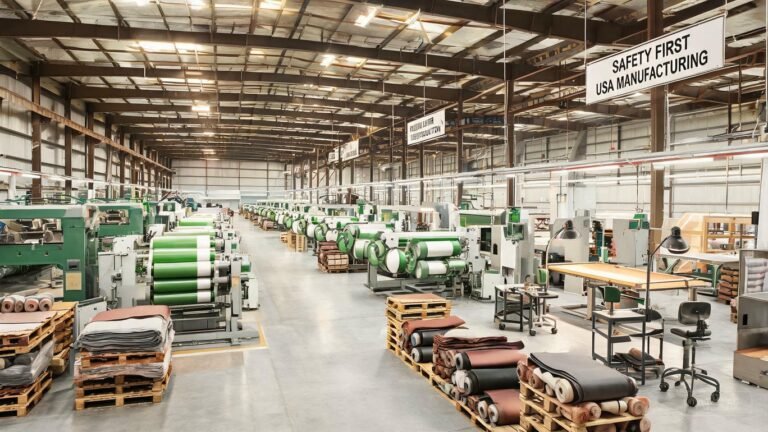
Material yield assumptions start here: every meter of coated leather is planned before a single panel is cut.
What an MOQ Really Covers
Startup brands want a minimum order of 50 pieces. Factories want 1,000. Both sides have a reason. A tannery does not fire up a dyeing drum for 20 meters of leather, so a suspiciously low MOQ usually means deadstock material you can never reorder. Industry practice sits in between. Simple designs using stock leather can start around 200 pieces, while custom dyes, exclusive hardware plating, or printed packaging push the number higher.
Ask what the minimum actually binds. One workable model is a 300-piece style minimum split across three colors from a tannery partner’s stock range. The details of the factory production process explain that flexibility better than any headline MOQ.
The Sample-to-Bulk Gap
The costliest failures happen after approval. Bulk orders arrive with softer bodies, lighter clasps, uneven edge paint, and handles set at slightly different angles. Sales teams call it normal variation. Your customers notice anyway, usually in a public review. A manufacturer worth signing will name the risks up front: leather thickness tolerance, hardware finish consistency, edge paint adhesion, and carton-level color control.
How Serious Leather Handbag Manufacturers Close the Color Gap
Our worst reorder taught the clearest lesson. The second run of 800 units came back a shade warmer than the approved sample, and photography was already scheduled. Better factories prevent this with a simple system: master color swatches held by both sides, incoming inspection against that master, and a spectrophotometer reading that keeps Delta E under 1.5 between batches. Color fastness should be tested and documented too, with grade 4 or 5 as the passing bar.

Rub-test rigs confirm grade 4-5 color fastness before bulk leather is released to the cutting table.
That discipline matters for handbags and other fashion and sports goods, where one off-color batch can end a retail relationship. For structured bag programs, silicone microfiber leather adds batch stability on top of abrasion resistance.

Master swatches and Pantone-referenced matching keep reorders aligned with the approved sample.
Watch how an OEM/ODM bag program moves from tech pack to approved bulk production.
Key takeaway: a quote is only as good as its assumptions. Demand material yield, hardware specs, mold fees, and color-control methods in writing before you compare prices.
Pick the Manufacturer Who Shows the Math
The price gap between leather handbag manufacturers is really an information gap. The cheap quote was cheap because it hid assumptions I paid for later. Choose the partner who documents materials, names production risks, and can reproduce the approved sample in bulk. Ask for the math before you ask for the discount.
References
1. https://www.fortunebusinessinsights.com/handbag… — Handbag market $68.86B (2026) to $120.43B by 2034, CAGR 7.24%; $64.41B in 2025
2. https://szoneierleather.com/how-to-choose-a-lea… — MOQ from ~200 pieces for simple projects; sample-to-bulk inconsistency risks (2026)
3. https://www.bagsrain.com/blog/premium-handbag-m… — MOQ 50 vs 1,000 logic; 20-minute quote rule; tannery dye-lot constraints (2026)