Walk into the All China Leather Exhibition in Shanghai and the scale registers first. Seven halls, 80,500 square metres, roughly 1,000 exhibitors from 27 countries. Then a quieter detail appears. Between the national pavilions stand county pavilions named Haining, Xinji, Wuji and Susong. Each sign marks a local cluster of leather manufacturers in China, and each cluster does a different job. The fair’s floor plan is the industry map drawn in aisle form.
Read that map before you shortlist anyone. A rank-order list flattens a continent-sized industry into ten interchangeable names. A region-first route does the opposite. It tells you which provinces can build your product at the price band, lead time and compliance depth your plan assumes.
Leather Manufacturers in China: The Map Behind the Export Machine
Start with the macro numbers, because they explain why the map matters now. According to the China Leather Industry Association’s H1 2026 report, key enterprises recorded sales of nearly RMB 330 billion, down 5.0% year on year. Industry exports reached US$40.9 billion, down 5.4%. Light leather output fell 6.5% to 140 million square metres. Leather footwear output slipped 7.6% to 970 million pairs.
The headline contraction hides divergence. Leather garment sales rose 25.5% in the same half, while travel goods and luggage fell 5.3%. Segments did not move together, and neither do regions. Guangdong builds premium OEM goods. Zhejiang runs the synthetic engine. Hebei tans the raw material. Fujian owns speed for sportswear. The four routes compare below.
| Region | Core Cities | Specialization | FOB Band* | Lead Time |
|---|---|---|---|---|
| Guangdong | Guangzhou, Dongguan, Shenzhen | Premium OEM/ODM handbags, footwear, small goods | $28.50-42.00 | 45-60 days |
| Zhejiang | Haining, Jiaxing, Wenzhou | Synthetic PU/PVC at volume, mid-market goods | $22.00-32.50 | 35-45 days |
| Hebei | Shijiazhuang, Baoding, Anxin | Raw hide tanning, semi-finished leather, entry-level goods | $16.00-24.00 | 30-40 days |
| Fujian | Quanzhou, Jinjiang | Sports footwear, eco-certified lines | $30.00-48.00+ | 50-70 days |
*FOB reference: genuine leather handbag, 1,000-unit MOQ, audited supplier data (SourcifyChina, Q3 2026).
Province lines matter because they bundle capabilities. A cluster concentrates base fabric mills, coating lines, finishing workshops, hardware suppliers and port logistics within a short drive. That density compresses quoting time and makes small-batch runs possible. It also explains why a factory tour in one city can mislead. The real supply chain often crosses three county borders.
Export mix adds texture to the picture. All footwear exports ran 4.29 billion pairs worth US$19.83 billion in H1 2026. Leather-upper footwear accounted for 240 million pairs and US$3.28 billion of that. Travel goods and luggage exports still reached US$15.48 billion despite the segment’s sales dip. The volumes are large enough that a one-percent shift between regions reshapes factory order books.

Guangdong: The Premium OEM Belt
Guangdong holds about 35% of leather goods export volume in the SourcifyChina cluster audit. The hub spans Guangzhou’s Huadu district, Dongguan and Shenzhen. It specializes in premium work: handbags, footwear and small leather goods built under full OEM and ODM terms. Proximity to Hong Kong logistics and design talent keeps quality control tight. Audited suppliers here passed third-party AQL 1.0 inspection at a 98% rate, the strongest result on the map.
You pay for that discipline. FOB quotes for the benchmark handbag run $28.50 to $42.00, and lead times stretch to 45-60 days. Roughly 90% of audited suppliers can hand over Leather Working Group scores and cattle-origin data, which matters once EU deforestation rules bind. For branded programs, this is the belt to search first. Our automotive interiors applications page shows where those premium surfaces end up.
Automotive work shows the belt’s depth. Around 20-25% of new vehicles are fitted with leather seating, which the CLIA fair report estimates at 6-7 million units a year. EV programs add interior refresh cycles that reward suppliers able to tool new grain patterns fast. That is precisely the Guangdong design-integration pitch.

Zhejiang: The Synthetic Leather Engine
Zhejiang leads on volume at roughly 40% share. Haining and Jiaxing form the largest synthetic leather cluster in the country, focused on PU and PVC at scale, with growing capacity in water-based and eco-certified coatings. FOB prices for the benchmark handbag run $22.00 to $32.50. Lead times of 35-45 days reflect streamlined production and Ningbo port access.
Two cautions apply. About 75% of Zhejiang suppliers reserve their best pricing for orders of 1,500 units or more, so small programs need negotiating room. Environmental enforcement is also consolidating smaller tanneries, which favors larger compliant factories. For coated synthetics at contract volume, including accessories and electronics cases, this cluster sets the price floor. Our 3C accessories applications page lists the surface specs those programs usually demand.
Wenzhou rounds out the province with a different job. The city earned its Shoe Capital nickname through leather footwear and garment work, and sourcing guides rate it mid-market on price with solid craftsmanship. Factory scale skews smaller there, which suits fashion programs more than bulk contracts. Treat Wenzhou as a specialty route inside Zhejiang rather than a second volume hub.
Hebei and Fujian: Different Ends of the Map
Hebei anchors the low end. Shijiazhuang, Baoding and the Anxin area concentrate raw hide tanning, leather chemicals and entry-level goods. Benchmark prices start near $16.00 and top out around $24.00, with 30-40 day lead times that lead the country. The trade-off is consistency. Audited pass rates run 85% against AQL 2.5, quality varies between lots, and fewer than 30% of suppliers hold verifiable deforestation-free documentation. Treat Hebei as a materials route, not a finished-goods shortcut.

Fujian sits at the performance end. Quanzhou and Jinjiang built integrated supply chains for athletic footwear, serving programs for brands such as Anta and Nike. The cluster holds a modest 7% of volume but leads in speed and eco-certified lines. Expect $30.00 to $48.00 or more per benchmark unit, with 50-70 day lead times, because certification adds work. Sourcing reports credit Fujian suppliers with 95% pass rates and verified ESG paperwork.
What the H1 2026 Data Changes for Buyers
The half-year report carries three signals buyers can act on. Tanning took the sharpest hit, with key-enterprise sales down 12.8%. Raw hide imports rose 7.0% in volume, while imports of semi-finished and finished leather fell. Tanneries are absorbing cheaper raw stock and moving upchain instead of trading mid-materials. That shift favors suppliers who run their own coating lines over resellers who assemble them.
Garments prove the point. Leather garment enterprises grew sales 25.5% while their exports jumped 41.4% in US dollar terms. A segment can buck a national slide when design and niche demand align. Regions follow the same rule, which is why the map beats the average.
Demand is changing shape as well. The report points to growing small-batch, fast-response and customized orders across footwear, bags and garments, alongside a push toward greener production. Independent sourcing data runs the same way: over 60% of export-oriented factories now offer chrome-free tanning or bio-based PU options. Put that question to any leather manufacturers in China shortlist and ask for batch-linked reports in writing. Suppliers who answer with documents belong on the second-round list.
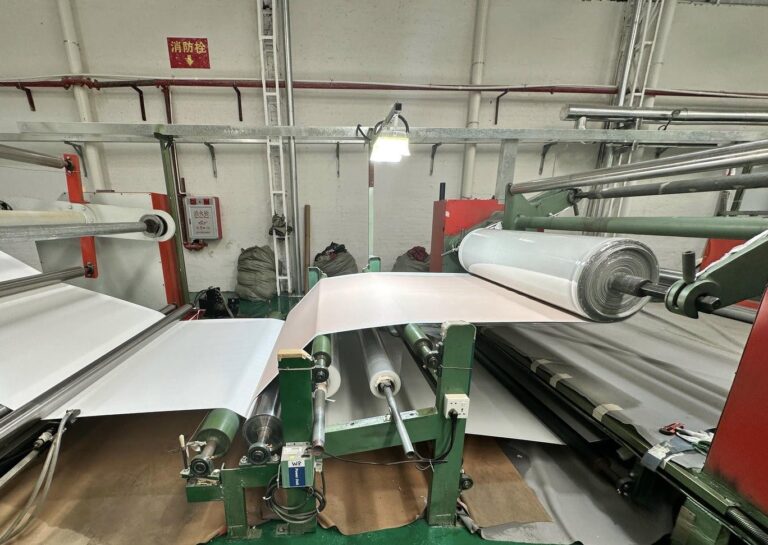
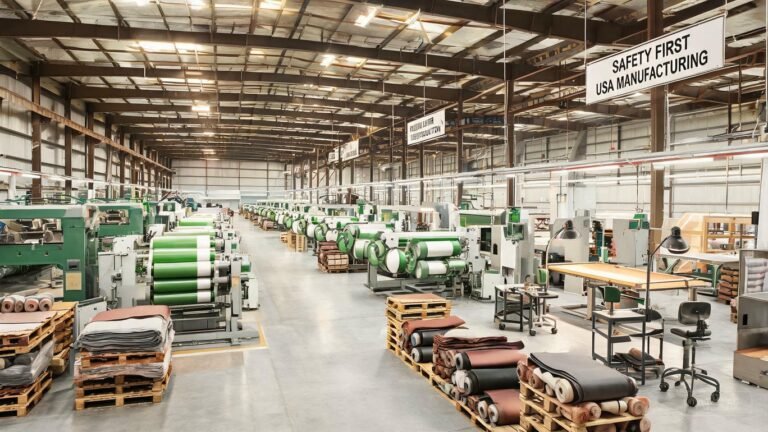
Factory walkthrough: coating lines, QC gates and finished roll storage.
Buyer behavior is shifting too. The ACLE fair drew about 23,500 visitors in 2019 and more than 32,000 by 2025, even as tariffs disrupted planning. Attendance growth during a contraction tells you sourcing teams are rebuilding supplier maps rather than waiting out the cycle. The report also flags rapid growth in cross-border e-commerce and overseas warehousing, which shortens the path from factory floor to end customer.
Route Your RFQ to the Right Leather Manufacturers in China
Routing rules beat rankings. Send premium branded work to Guangdong, where design integration and AQL 1.0 discipline justify the price. Send volume synthetic programs to Zhejiang, then negotiate MOQ terms early. Buy tanned material and semi-finished stock from Hebei, with traceability papers pre-validated. Give speed-critical sportswear and eco-certified lines to Fujian. Each route fixes your price band, lead time and compliance depth before any factory quote arrives.
Paperwork belongs in the routing decision too. Guangdong leads on digital traceability, Zhejiang scales eco-coatings, and Fujian documents ESG claims. Hebei needs the most verification per dollar saved. Ask each region for the same four items: a named test standard, a dated report, a batch number and a signatory. Regions that return three of four justify the next flight.
When the route feels uncertain, buy a pilot. A 500-meter trial run exposes coating consistency, color matching and packaging discipline at low cost. Score the pilot against the same AQL tables you would apply at contract volume. One pilot per shortlisted region settles the choice in weeks instead of quarters.
Frequently asked questions:
- Which region should I choose for synthetic leather? Haining and Jiaxing in Zhejiang form the largest synthetic cluster, with FOB prices from $22.00 and 35-45 day lead times. Confirm MOQ early, since 75% of suppliers reserve best pricing for 1,500-unit orders.
- How large is China’s leather industry? Key enterprises logged nearly RMB 330 billion in H1 2026 sales, down 5.0%. Exports reached US$40.9 billion, and light leather output held at 140 million square metres.
- Do shorter lead times mean lower risk? No. Hebei quotes 30-40 days, the fastest window, yet audited pass rates sit at 85% under AQL 2.5. Fewer than 30% of Hebei suppliers carry deforestation-free papers.
The closing point restates itself: a rank list cannot tell you which province fits, but the map can. We sit on that map too, as a silicone leather manufacturer running solvent-free coating lines with 500,000 meters of monthly capacity and a 500-meter minimum. Use the two routes below to move from map to order.
Match Your Project to the Right Region
References
- https://www.aclechina.com/en/china-leather-indu… — CLIA H1 2026 report: key-enterprise sales near RMB 330 billion (-5.0%), exports US$40.9 billion (-5.4%), light leather output 140 million square metres (-6.5%).
- https://www.fobsourcify.com/leather-company-lis… — Five clusters rated on price, quality and lead time; over 60% of export factories offer chrome-free tanning or bio-based PU options.
- https://www.sourcifychina.com/supplier-of-leath… — Cluster volume shares of 35%, 40%, 18% and 7%, FOB handbag bands from $16.00 to $48.00+, AQL pass rates of 85-98% and lead times of 30-70 days.