How many kinds of leather can you actually name? Most people can list two or three — “real leather” and “fake leather.” The industry recognizes at least seven distinct categories, each with wildly different lifespans, performance profiles, and compliance implications. If you’re specifying materials for furniture, automotive interiors, or commercial upholstery, knowing which kind you’re getting — and how long it actually survives — determines whether your project lasts a decade or ends in warranty claims after eighteen months.
| Kind of Leather | Source | Real-World Lifespan | Martindale | 5-Year TCO |
|---|---|---|---|---|
| Full-Grain | Top hide layer, unsanded | 15–20+ yrs | 50K–80K | High (maintenance) |
| Top-Grain | Sanded top layer | 10–15 yrs | 40K–60K | Medium-High |
| Genuine/Corrected | Lower grain, buffed + coated | 3–7 yrs | 20K–40K | High (replacement) |
| Split | Lower hide layers | 2–5 yrs | 15K–30K | Highest (2+ replacements) |
| Bonded | Leather scraps + binder | 1–2 yrs | <10K | Highest (peeling) |
| PU/PVC Synthetic | Petrochemical fabric coating | 2–3 yrs | 30K–50K | High (UV/hydrolysis failure) |
| Silicone Leather | Silicone-coated fabric | 10+ yrs | 200K+ | Lowest (no replacement) |
The 7 Kinds of Leather Every Buyer Encounters
Walk into any tannery showroom or B2B supplier catalog, and you’ll encounter these seven kinds of leather. The differences between them aren’t subtle — they determine whether your upholstery peels in 18 months or lasts a decade.
Full-grain leather keeps the hide’s complete natural surface, including scars and insect bites. It’s the strongest and most expensive, prized for developing a patina. But that natural beauty comes with vulnerability: without applied coatings, full-grain absorbs water, stains, and UV damage. For B2B performance applications, the “best” kind of leather is often the worst choice.

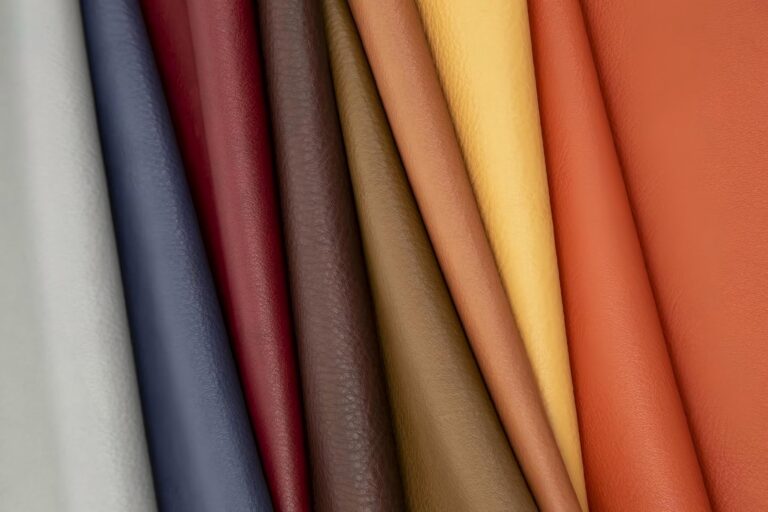
Soft fold display — appearance and feel vary dramatically across kinds of leather, but looks don’t predict durability.
Top-grain leather is sanded to remove imperfections, then finished with a protective coating. It sacrifices some natural character for more uniform appearance — and that coating is where the trouble starts. The polymer layer on top-grain leather typically cracks within 2 to 3 years under UV exposure in automotive and hospitality settings. We’ve seen automotive OEMs reject entire top-grain shipments after accelerated weathering tests revealed coating failure at 500 UV hours — far below the 1,000+ hour threshold for silicone leather.
Genuine or corrected leather is where labeling gets misleading. “Genuine leather” sounds premium but actually refers to a lower-grade hide that’s been buffed, coated, and embossed to mimic higher quality. It typically lasts 3 to 7 years before the coating cracks and the underlying hide degrades. Split leather is cut from beneath the grain layer — less dense, less durable, and often finished with a polyurethane layer (bicast) that separates from the substrate. Bonded leather is the lowest tier: leather scraps ground and mixed with adhesive, pressed into sheets. It starts peeling within 12 to 24 months.
Which Kinds of Leather Actually Survive 10+ Years?
The table above reveals a pattern that surprises most procurement teams: lifespan doesn’t correlate with price. Full-grain leather at $15/sq ft lasts 15 to 20 years — but only with regular conditioning, climate-controlled storage, and protection from UV and moisture. PU synthetic at $3/sq ft lasts 2 to 3 years before UV-driven hydrolysis cracks the surface. Neither delivers the combination of durability, cleanability, and zero-maintenance that modern applications demand.

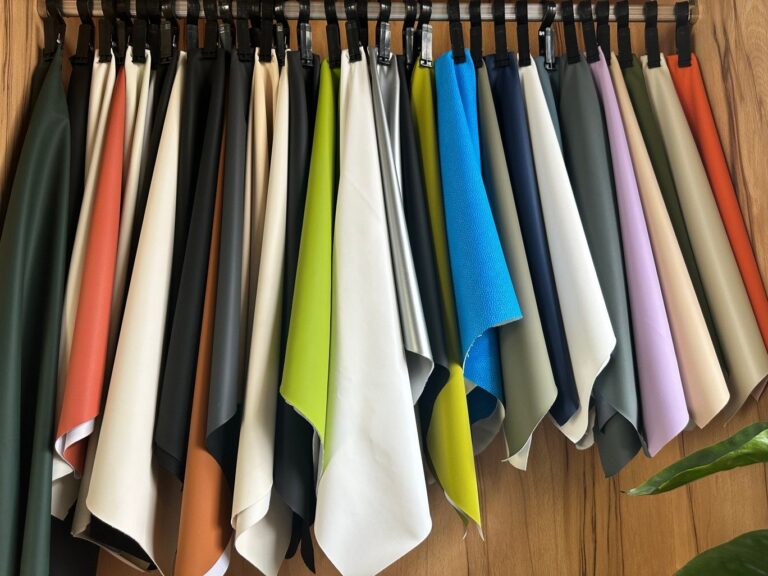
Swatch rack comparison — the visual similarity between kinds of leather masks performance differences that only surface after years of use.
In our lab testing, silicone leather maintained structural integrity past 200,000 Martindale abrasion cycles — more than double the best full-grain leather and six times the durability of PU. The material achieved 1,000+ hours of UV stability per ISO 105-B06 with zero color shift, and survived -40°C to 250°C temperature cycling without cracking. For daily-use environments where the leather gets touched, cleaned, and exposed to sunlight, these metrics translate directly to years of service without replacement.
Kinds of Leather for Furniture: What Daily Use Does to Each
Consider what happens to a sofa in a busy commercial lobby. Over a single year, that furniture endures roughly 2,000 sitting events, 500 spill incidents, 100 UV-exposure days through windows, and 50 professional cleanings with chemical disinfectants. Here’s how each kind of leather responds:
- Full-grain absorbs body oils and liquids without a coating barrier. Spills stain permanently. Professional cleaning with solvents strips natural oils, requiring reconditioning. UV fades unevenly.
- Top-grain coating resists initial spills but micro-cracks develop within 18 months of UV exposure. Once cracked, the coating traps dirt and bacteria in fissures that cannot be cleaned.
- Genuine/corrected coating fails faster, typically within 12 months in commercial settings. The underlying buffed hide then absorbs everything — stains, bacteria, moisture.
- Bonded peeling begins at stress points (seat edges, armrests) within 6 months of daily commercial use. The adhesive binder breaks down under UV and humidity.
- PU/PVC synthetic surface resists liquids initially but hydrolyzes under UV and humidity, developing cracks at flex points within 2 to 3 years. Once cracked, the backing absorbs moisture and harbors bacteria.
- Silicone leather maintains a non-porous surface that repels liquids, resists chemical cleaning (including bleach and alcohol disinfectants), and shows zero UV degradation at 1,000+ hours per ISO 105-B06. No coating to crack, no substrate to absorb moisture.

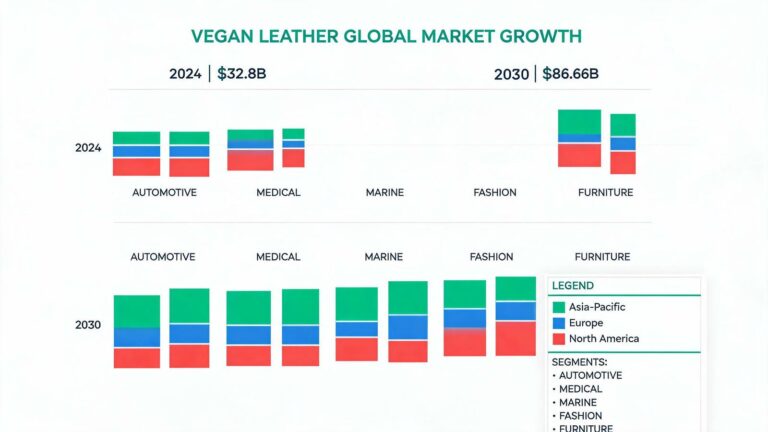
Color palette comparison — modern silicone leather matches the visual range of traditional leather while eliminating the failure modes of every kind above.
The 8th Kind: Silicone Leather and Why It Changes the List
Traditional leather classification — from full-grain to bonded — all shares one limitation: they’re organic materials that degrade. Silicone leather introduces a fundamentally different category. Rather than coating fabric with polyurethane or plasticizing PVC, it applies a 100% silicone elastomer to a textile backing. The silicone chemistry is inherently UV-stable, hydrolysis-proof, and non-porous — properties that PU and PVC achieve only through additives that leach out over time.
For B2B buyers, the practical difference is this: every other kind of leather on this list has a known failure mode that eventually ends its service life. Full-grain dries out and cracks without conditioning. Top-grain coating delaminates. PU hydrolyzes. Bonded peels. Silicone leather‘s failure mode, in lab testing, hasn’t been reached within the parameters of standard industry tests — it exceeds 200,000 Martindale cycles, 1,000+ UV hours, and -40°C to 250°C thermal cycling. When buyers ask which kind of leather is best, the honest answer depends on application — but for performance-driven uses, the data points to the 8th kind.
Kinds of Leather: Which Should You Choose?
| If Your Application Needs… | Choose This Kind | Why |
|---|---|---|
| Patina, natural aging, luxury narrative | Full-grain | Unique aesthetic, 15+ yr lifespan with maintenance |
| Uniform appearance, mid-tier price | Top-grain | Consistent look, 10–15 yr lifespan (coating-limited) |
| Maximum durability, zero maintenance | Silicone leather | 200K+ Martindale, UV-stable, bleach-cleanable, 10+ yr |
| Lowest unit cost, short lifespan acceptable | Split or bonded | Budget option, plan for replacement within 2–5 yrs |
The kinds of leather you choose sets the trajectory for your entire project’s cost, compliance, and customer satisfaction. Knowing the real-world lifespan of each type — not just the marketing label — is the difference between specifying for a decade of service and budgeting for repeated warranty claims.
About TOPSUN
TOPSUN produces silicone leather — the 8th kind — that outperforms all traditional kinds of leather in durability testing for furniture, automotive, marine, and medical applications.
200K+ Martindale cycles per ISO 12947-2 · UV 1,000+ hrs per ISO 105-B06 · -40°C to 250°C range · Zero VOC / DMF-free · FDA 21 CFR 177.2600 · SGS/Intertek certified · 100+ textures · Free A4 swatches worldwide