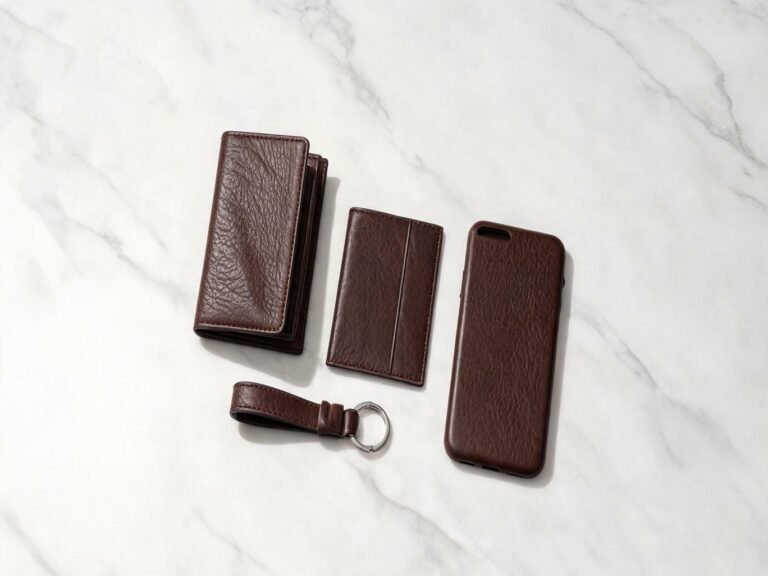
A keychain is the cheapest item in a corporate gift program — and the one most likely to fail. The leather cracks at the rivet hole. The logo debossing fills with pocket lint. The edge paint chips after three months of daily handling. When a keychain leather supplier quotes $0.15 per unit, the buyer sees savings. What they don’t see is the material specification that determines whether the product lasts six months or five years. Evaluating a keychain leather supplier means evaluating the material: thickness, chemistry, logo compatibility, edge quality, and skin safety — not just the unit price.
Material Selection: Genuine, PU, or Silicone for Keychains
Three material categories dominate the keychain market, and each fails differently. Genuine leather (full-grain or top-grain, 1.5–2.5mm) offers maximum durability and develops patina, but requires tanning chemicals that can cause skin sensitization and varies in color between hides — a problem for brand-consistent corporate gifts. PU-coated synthetic (0.8–1.5mm) provides uniform color and lower cost, but the coating hydrolyzes with daily skin contact and humidity, peeling within 6–12 months. Silicone-coated leather (0.23–0.8mm) combines the thinness needed for compact keychain design with hypoallergenic chemistry that tolerates indefinite skin contact without degradation [$TOPSUN](https://leathermingle.shop/blogs/news/best-leather-for-keychains-and-straps).
For promotional programs where the keychain carries a brand logo, material consistency matters more than material cost. A batch of 1,000 keychains with visible color variation between pieces signals poor quality control — regardless of the leather type used. The Designer Collection offers Pantone-matched silicone leather with Delta E ≤ 1.0 batch-to-batch consistency, eliminating the hide-to-hide variation that plagues genuine leather sourcing.

Slitting and rewinding line — precision width control determines die-cutting yield. Material slit to ±1mm tolerance reduces waste when stamping small keychain blanks.
Thickness Matters: Why Thinner Outperforms Thicker for Promotional Goods
Traditional keychain specs call for 2.0–3.0mm leather — thick enough to survive the rivet stress at the ring attachment point. This thickness works for genuine leather, where the fiber structure distributes stress across the full cross-section. It is counterproductive for synthetic materials, where excessive thickness increases stiffness, makes the keychain uncomfortable in a pocket, and does not improve the weak point: the coating-to-substrate bond that fails at the rivet hole regardless of total thickness.
Silicone-coated leather in the 0.5–0.8mm range produces a keychain that is slim enough for pocket comfort, flexible enough to resist crease-induced cracking at the fold line, and structurally sound because the silicone coating bonds to the substrate at the molecular level — no adhesive layer to delaminate under stress. The Ultra Thin Collection (0.23–0.8mm) is engineered specifically for small-goods applications where thinness and durability must coexist.
Logo Methods That Survive Daily Pocket Wear
A keychain lives in a pocket — rubbed against keys, coins, and phone surfaces thousands of times per month. Logo application methods that look perfect on the production line can degrade rapidly in service:
| Material Type | Thickness | Best Logo Method | Edge Quality | Skin Safety | Unit Cost |
|---|---|---|---|---|---|
| Genuine leather | 1.5–2.5mm | Debossing, laser engraving | Edge paint required | Chrome allergy risk | High |
| PU synthetic | 0.8–1.5mm | Foil stamping, screen print | Clean die-cut | Solvent residue risk | Low |
| Silicone-coated | 0.23–0.8mm | Debossing, foil, laser, print | Clean die-cut, no fraying | Hypoallergenic, EN 71 certified | Medium |
Debossing presses the logo into the surface, creating a recessed impression that resists wear because the logo is below the contact plane. Foil stamping applies metallic leaf into the debossed impression — visually striking but susceptible to rubbing off on raised edges. Laser engraving removes the top coating to reveal a contrasting substrate color — permanent but limited to single-color designs. Screen printing applies ink to the surface — fastest and cheapest, but the first to wear off in pocket contact. Silicone leather accepts all four methods; the choice depends on the logo design and expected wear conditions.

Corporate gift packaging — the keychain represents the brand. Material failure within months undermines the entire gift program’s ROI.
Edge Quality and Die-Cutting Precision
Keychain edges are the first point of visible failure. Genuine leather requires edge paint — a lacquer application that chips with impact and wear, exposing the fibrous cross-section. PU-coated synthetic cuts cleanly with steel-rule dies but can delaminate at the cut edge if the coating-substrate bond is weak, creating a visible white line where the fabric backing separates from the coating.
Silicone-coated leather die-cuts with a clean, sealed edge because the silicone coating is thermally bonded to the substrate — there is no adhesive layer to separate. The cut edge shows a uniform cross-section with no fraying, no white line, and no need for edge paint. This eliminates a production step (edge painting) and a failure point (edge paint chipping) simultaneously. Request the sample ordering guide to evaluate edge quality before committing to volume production.
Skin Safety: The Overlooked Specification for Daily-Contact Goods
A keychain is handled daily, often for years. The material is in direct, repeated skin contact — yet most keychain leather suppliers cannot provide biocompatibility documentation. Genuine leather carries chrome tanning residues (chromium VI) that cause contact dermatitis in sensitized individuals. PU-coated synthetics retain solvent residues that off-gas during the first months of use. Neither material carries certification for prolonged skin contact.
TOPSUN supplies ultra-thin silicone leather (0.23–0.8mm) to keychain leather suppliers and promotional product manufacturers who need hypoallergenic, non-toxic material certified to EN 71 toy safety and ISO 10993-5 biocompatibility standards. Silicone chemistry is the same material used in medical-grade tubing and baby bottle nipples — it is chemically inert, hypoallergenic, and safe for indefinite direct skin contact. For corporate gift programs targeting executives, clients, or healthcare professionals, skin safety is not a premium feature — it is a baseline requirement. See the full certification documentation for compliance details.

Finish and color options — metallic sheen, matte, and textured finishes all accept debossing, foil stamping, and laser engraving for custom logo application.
FAQ
What thickness is best for leather keychains?
For genuine leather keychains, 1.8–2.5mm provides sufficient strength at the ring attachment point without excessive bulk. For silicone-coated synthetic leather, 0.5–0.8mm is optimal — the material’s inherent flexibility and coating bond strength provide structural integrity at lower thickness, producing a slimmer keychain that resists crease-induced cracking. The key factor is not total thickness but the material’s ability to survive stress concentration at the rivet hole and repeated flexing at the fold line without coating delamination.
Keychain Leather Supplier: Material Is the Brand
A keychain leather supplier who quotes by unit price without specifying material chemistry, thickness, logo compatibility, edge treatment, and skin safety is selling a commodity — not a brand asset. The keychain that cracks in six months costs more than the one that lasts five years, because the replacement cost includes the brand damage of a failed corporate gift. Silicone-coated leather delivers the thinness, color consistency, edge quality, and skin safety that genuine leather and PU cannot — at a unit cost that fits corporate gift budgets. When the keychain represents the brand, the material specification is the brand specification.