As an equestrian product engineer who has tested saddle materials across competitive riding, endurance racing, and daily training environments, I’ve seen the same failure pattern repeat: a saddle that looks and feels perfect at purchase — vegetable-tanned, 4.3mm, stuffed with waxes — begins to crack at the seat junction within 18 months of daily use. The rider didn’t abuse it. The leather just couldn’t handle the moisture, flex, and friction cycles that equestrian use demands.
Traditional saddle leather — bridle leather and harness leather, made from high-gain cowhide, vegetable-tanned and stuffed with oils and waxes — has been the standard for 200 years. It’s beautiful, develops a rich patina, and when properly maintained, lasts decades. But “properly maintained” means regular conditioning, oiling, and protection from moisture — maintenance that 90% of riders don’t perform consistently. The question for B2B saddle manufacturers is whether synthetic alternatives can match the performance without the maintenance burden.
The performance gap: Traditional saddle leather excels in grip and patina but fails in moisture resistance, maintenance burden, and consistency. Silicone leather excels in moisture resistance, zero maintenance, and batch consistency — but doesn’t develop patina. The right material depends on the rider profile and price point you’re manufacturing for.
Saddle Leather Technical Specifications: The Industry Standard
Before comparing materials, here’s what B2B buyers need to know about traditional saddle leather specifications:
| Specification | Bridle Leather | Harness Leather | Purpose / Impact |
|---|---|---|---|
| Base material | High-gain cowhide | Heavy cowhide | Determines tensile and tear strength |
| Tanning method | Vegetable-tanned | Vegetable-tanned | Chrome tanning rejected — too soft for stress |
| Thickness | 3.5–4.5mm | 4.0–5.5mm | 4.3mm is the saddle sweet spot |
| Stuffing | Waxes & oils (smooth finish) | Heavy tallow/grease (maximum durability) | Affects weather resistance & hand-feel |
| Surface finish | Smooth, direct horse contact | Rougher, for straps & hardware | Bridle for seat, harness for rigging |
| Maintenance | Condition every 3–6 months | Oil annually | Skip maintenance = cracking risk |
| Expected life (maintained) | 10–20+ years | 15–30+ years | With regular conditioning |
| Expected life (unmaintained) | 2–3 years | 3–5 years | Moisture & flex without conditioning = crack |

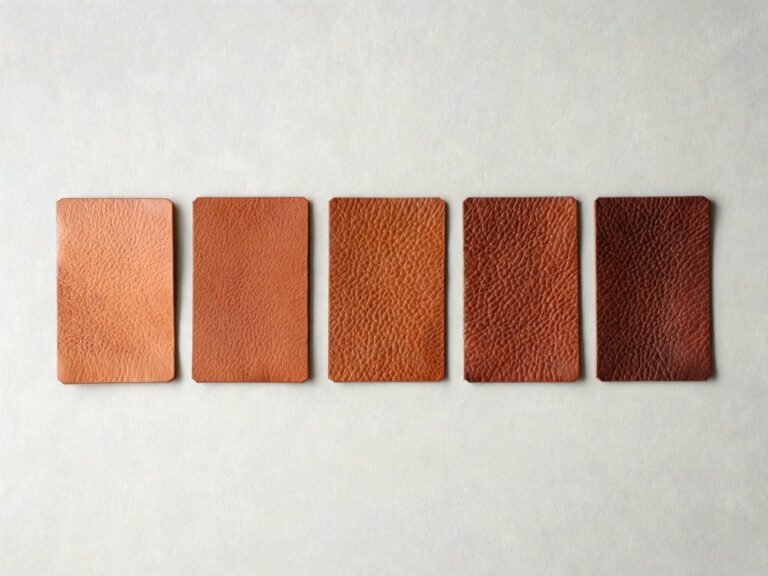
Material swatch variety — the range of colours and textures available for equestrian product manufacturing.
The 3 Failure Modes of Unmaintained Saddle Leather
1. Moisture Ingress & Structural Weakening
Traditional saddle leather is porous. Horse sweat, rain, and stable moisture penetrate the grain and dissolve the stuffing (waxes and oils) that give the leather its flexibility. Once the stuffing migrates out, the leather becomes dry, rigid, and prone to cracking at flex points — the seat junction, stirrup leather attachment, and billet holes. This process takes 2–3 years of unmaintained daily use. Silicone leather’s non-porous surface is inherently moisture-proof — sweat and rain sit on the surface and wipe clean.
2. Flex Fatigue at Stress Points
A saddle flexes at specific points with every ride: the seat (rider weight), the flap (leg contact), and the billet straps (girth tension). Traditional leather at these points undergoes 10,000–30,000 flex cycles before fatigue cracking appears — typically 18–24 months of daily riding. Silicone leather’s flex resistance of 50,000–100,000+ cycles (ISO 5402) means 3–5× longer life at the same stress points.
3. Salt & UV Degradation
Horse sweat is saltier than human sweat, and equestrian use means outdoor UV exposure. Salt crystallizes within leather’s pore structure, creating microscopic abrasion that weakens fibres from within. UV breaks down the vegetable-tanning agents, causing fading and surface embrittlement. Traditional leather shows visible UV damage within 6 months of daily outdoor exposure. Silicone leather’s UV resistance (1,000+ hours, Grade 4–5) and salt-spray resistance (1,000+ hours) make it structurally immune to both degradation modes.
Traditional Saddle Leather vs. Silicone Leather: Head-to-Head
| Performance Factor | Traditional Saddle Leather | Silicone Leather (TOPSUN) | Rider Impact |
|---|---|---|---|
| Grip (dry conditions) | Excellent — natural grain texture | Good — embossed texture provides grip | Traditional has slight edge for competition |
| Grip (wet conditions) | Poor — smooth when wet | Good — non-porous surface maintains friction | Silicone safer in rain |
| Moisture resistance | Poor — porous, absorbs sweat & rain | Excellent — non-porous, hydrolysis-proof | Zero conditioning needed |
| Maintenance required | Condition every 3–6 months | None — wipe with water | Saves $50–100/year in conditioning products |
| Flex resistance | 10,000–30,000 cycles | 50,000–100,000+ cycles | 3–5× longer at stress points |
| UV resistance | 6 months visible fading | 1,000+ hours, no fading | Colour stays true for years |
| Salt-spray resistance | Poor — salt crystallizes in pores | 1,000+ hours (ISO 9227) | Withstands horse sweat contact |
| Temperature range | -10°C to 60°C (stiffens in cold) | -40°C to 250°C | Remains flexible in winter riding |
| Patina development | Yes — ages beautifully | No — maintains original appearance | Traditional wins for aesthetic purists |
| Batch consistency | Variable — natural hide defects | Consistent — ±0.05mm, Delta E ≤1.0 | Predictable production for manufacturers |
| Weight | Heavy (4.3mm cowhide) | Lighter at equivalent thickness | Reduces saddle weight for endurance |

Production-scale leather inventory — consistent rolls enable predictable saddle manufacturing without hide-by-hide grading.
When to Choose Each Material: Saddle Manufacturer’s Guide
Choose Traditional Saddle Leather When:
- Manufacturing for the premium/heritage segment where patina and tradition are selling points.
- The saddle is priced above $2,500 and the buyer expects to maintain it properly.
- Competition regulations specify traditional leather (some FEI disciplines require it).
- The aesthetic of vegetable-tanned leather is a brand differentiator.
Choose Silicone Leather When:
- Manufacturing for the mid-market ($500–1,500) where maintenance burden is a complaint driver.
- Targeting endurance riders, trail riders, and daily-use riders exposed to weather.
- The saddle is marketed as “low-maintenance” or “weatherproof.”
- Producing synthetic/vegan saddles for the growing cruelty-free equestrian market.
- You need consistent material quality across large production batches without hide-by-hide grading.
Market trend: The synthetic saddle market is growing — brands like Wintec (Equi-Fabric, Equi-Suede), Barefoot (DryTex, Biotane), and Lorica are proving that performance-focused riders will adopt synthetic materials. Silicone leather offers a premium alternative to these existing synthetics — with superior durability, UV resistance, and aesthetic flexibility.

Calendering equipment — precision thickness control ensures consistent 4.0–5.0mm saddle leather production.
Silicone leather for sports goods — performance material properties for equestrian and athletic applications.
About TOPSUN
TOPSUN manufactures silicone leather at a 60,000+ m² facility in Dongguan, Yichang, and Xiangyang, China. We produce 500,000+ meters monthly across 10+ automated lines for 100+ brands, including sports and outdoor equipment manufacturers. Our silicone leather is engineered for high-performance applications where moisture resistance, flex durability, and zero maintenance are critical — including equestrian products, sports equipment, and outdoor furniture.
For saddle and equestrian applications, our material offers: thickness up to 2.0mm (suitable for saddle flaps, seat surfaces, and accessory straps), flex resistance 50,000–100,000+ cycles, UV resistance 1,000+ hours, salt-spray resistance 1,000+ hours, non-porous moisture-proof surface, temperature range -40°C to 250°C (remains flexible in winter riding), 100+ embossed textures including cowhide grain for traditional aesthetics, and Pantone-matched colours. The material is PVC-free, solvent-free, zero-VOC, 100% recyclable, and vegan/cruelelty-free — meeting the growing demand for ethical equestrian products. Certifications: ISO 10993-5, REACH, FDA 21 CFR 177.2600, EN 13733 Class 4, PAHs — all SGS/Intertek verified.
Free A4 swatch samples available in saddle-appropriate thicknesses and textures. Sports applications | High Performance Collection | Request equestrian samples
Frequently Asked Questions
Can silicone leather provide the grip that riders need in a saddle?
Yes, through embossed texture patterns. Our 100+ embossing options include cowhide grain, pebbled, and suede-like textures that provide tactile grip comparable to oiled nubuck (the grippiest traditional saddle leather). In wet conditions, silicone leather actually outperforms traditional leather — its non-porous surface maintains friction when wet, while traditional leather becomes slick. For riders who need maximum grip, we recommend our lychee or pebbled texture patterns, which create micro-cavities that channel moisture away from the contact surface.
Is silicone leather suitable for saddle seat surfaces that bear rider weight?
For saddle seat surfaces, we recommend our High Performance Collection at 1.5–2.0mm thickness, laminated to a reinforced substrate for structural support. The silicone leather provides the surface layer (comfort, grip, moisture resistance) while the substrate provides the structural integrity that traditional 4.3mm cowhide offers as a single material. This composite approach is how modern saddle manufacturers like Wintec and Barefoot already engineer synthetic saddles. Our engineering team can provide lamination recommendations and substrate specifications for your saddle design.
How does silicone leather handle the thermal stress of outdoor equestrian use?
Silicone leather’s temperature range of -40°C to 250°C means it remains flexible in winter riding (traditional leather stiffens and can crack in sub-zero temperatures) and doesn’t soften or degrade in summer heat (dark traditional leather can reach 60–70°C in direct sun, causing stuffing migration). The material’s UV resistance of 1,000+ hours means the colour and surface integrity remain unchanged through years of daily outdoor exposure. For dark saddle colours (brown, black) that absorb heat, silicone’s thermal stability is a significant advantage over traditional leather.
Test Silicone Leather for Your Saddle Production
Get free A4 samples in saddle-appropriate thicknesses, textures, and colours — with flex, UV, and salt-spray test data.
Explore our High Performance Collection or see outdoor applications.