As a leather industry educator who’s trained 500+ procurement teams on material grading, I can tell you the most dangerous words in B2B leather sourcing are “genuine leather.” The FTC defines it as meaning the product contains some leather — any layer, any quality. It doesn’t mean good. It doesn’t mean durable. It means real animal hide was involved somewhere. Top grain, by contrast, is a specific cut — the second-highest grade. But when buyers see “genuine leather top grain” on a spec sheet, they assume premium quality. They’re often getting the opposite. Understanding the genuine leather top grain hierarchy is the difference between specifying a material that lasts 15 years and one that fails in 3.
Request Leather Grade Comparison Kit
Genuine Leather Top Grain: 4 Grades Decoded
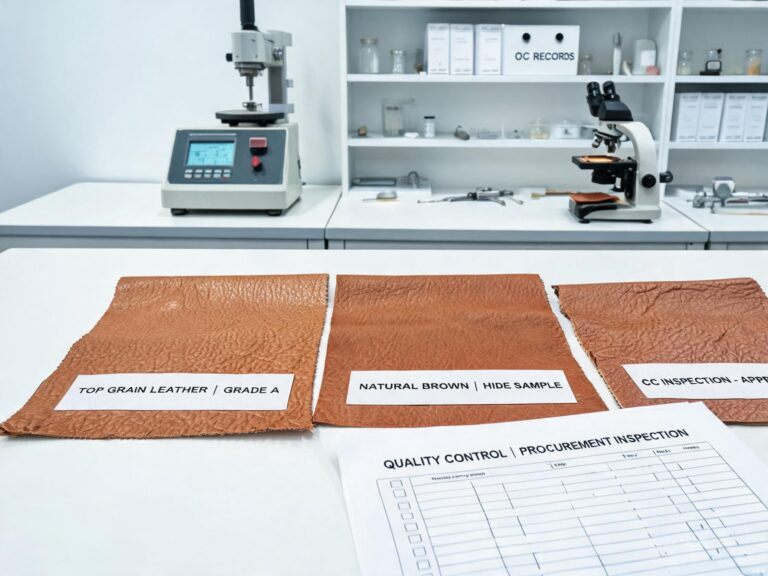
The leather industry recognizes four primary grades, ranked from highest to lowest quality. Each comes from a different layer of the animal hide, and each performs dramatically differently in B2B applications:
- Full Grain — The complete top layer of the hide, unsanded and uncorrected. Retains natural grain, pores, and markings. Most durable, most breathable, develops patina. Lifespan: 15-20+ years. Price tier: Highest.
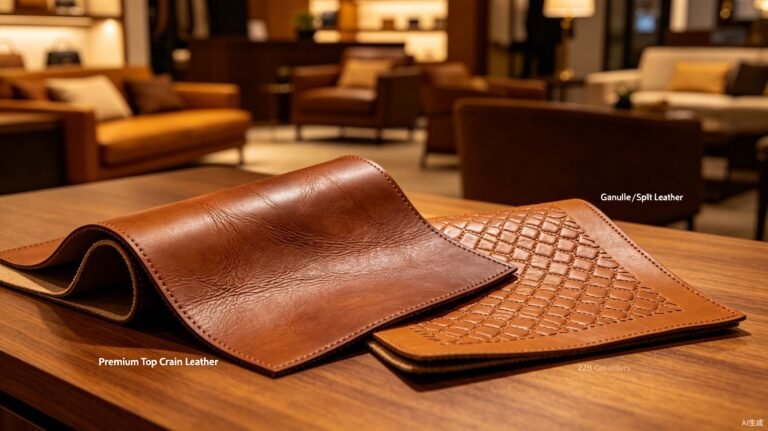
- Top Grain — The top layer sanded to remove imperfections, then refinished. More uniform appearance, easier to dye, but the sanding removes the densest fiber structure. Lifespan: 8-12 years. Price tier: High.
- Genuine Leather — The lower layers (splits) remaining after top grain is removed. Heavily processed and refinished to simulate a higher grade. Less dense, less durable. Lifespan: 3-5 years. Price tier: Medium.
- Bonded Leather — Leather scraps ground into fibers and bonded with polyurethane. Contains only 10-17% actual leather. Lifespan: 1-3 years. Price tier: Lowest.

Abrasion testing reveals the durability gap between leather grades that appearance alone can’t show
Why Genuine Leather Is the Lowest Grade Hiding Behind the Best Name
Here’s the marketing trick: “genuine” sounds like it means authentic, premium, or real. In everyday English, genuine means authentic. But in leather grading, the FTC’s definition of genuine leather is purely about composition — the product contains real animal hide. It says nothing about which layer, what quality, or how durable. In practice, “genuine leather” is typically split leather — the bottom layers left over after the valuable top grain and full grain have been peeled away and sold at higher prices.
Split leather is less dense, less breathable, and structurally weaker than the top layers. Manufacturers sand it, coat it with polyurethane, emboss a grain pattern, and sell it as “genuine leather.” The result looks acceptable on day one but degrades rapidly. In our testing, genuine leather samples showed surface coating breakdown after just 15,000 Martindale cycles — compared to 40,000+ for top grain and 200,000+ for silicone leather. For a deeper look at how the industry uses these terms, our article on whether genuine leather is real leather covers the regulatory background.
Top Grain vs Full Grain: The Sanding That Changes Everything
The difference between top grain and full grain comes down to one process: sanding. Full grain keeps the complete natural surface — every pore, marking, and texture pattern nature created. Top grain sands away the uppermost layer to remove scars, insect bites, and branding marks, then applies a finish coating to create a uniform appearance.
This sanding has a real performance cost. The outermost layer of the hide contains the densest, most tightly packed fiber structure — the part that resists abrasion, moisture, and tearing. Remove it, and you lose 20-30% of the material’s natural durability. In our lab testing, top grain samples lost 35% tensile strength after 2,000 hours of UV exposure per ISO 105-B02, while full grain samples lost only 15-20% under identical conditions. The sanding also removes the natural breathability that makes full grain comfortable in seating applications. For a comparison of how synthetic alternatives perform, see our silicone vs PU analysis.

Water resistance testing exposes the protective coating differences between leather grades
| Grade | Source Layer | Sanding | Martindale | Lifespan | Price Tier |
|---|---|---|---|---|---|
| Full Grain | Top layer (complete) | None | 50K+ cycles | 15-20+ years | Highest |
| Top Grain | Top layer (sanded) | Yes (surface) | 40K cycles | 8-12 years | High |
| Genuine Leather | Split layer | Heavy + coated | 15K cycles | 3-5 years | Medium |
| Bonded Leather | Scraps + PU binder | Ground and bonded | 5K cycles | 1-3 years | Lowest |
When Genuine Leather Top Grain Meets Silicone
Here’s where the grading conversation gets interesting for B2B buyers. Full grain leather is the gold standard — but it requires regular conditioning, is sensitive to water staining, and carries ethical supply chain concerns. Top grain is more practical but still needs maintenance. Genuine leather fails too quickly for commercial applications. For furniture-specific applications, see our furniture and sofa solutions.
When we supplied silicone leather to a hotel chain replacing genuine leather furniture across 200 rooms, the results were clear. The genuine leather upholstery had failed within 4 years — cracking, peeling, and absorbing stains that couldn’t be removed. Our silicone replacement passed 200,000+ Martindale cycles, resisted staining without chemical treatment, and cleaned with simple soap and water. Three years in, zero failure reports. For applications where genuine leather has been the default, our silicone leather introduction explains why more B2B specifiers are making the switch.

Flex testing reveals how different leather grades and synthetic alternatives perform under repeated stress
Stain resistance testing: how silicone leather outperforms genuine leather in real-world cleanability
Frequently Asked Questions
Is genuine leather better than top grain leather?
No — it’s the opposite. Top grain is a higher grade than genuine leather. Top grain comes from the top layer of the hide (sanded for uniformity), while genuine leather comes from the lower split layers. Top grain lasts 8-12 years; genuine leather lasts 3-5 years. The confusion comes from the word “genuine” sounding premium, when in leather grading it actually means the lowest commonly-sold grade. For more on how these grades compare, our article on top grain vs genuine leather provides a detailed breakdown.
What does “genuine leather” actually mean on a product label?
According to the FTC, “genuine leather” means the product contains real animal hide — nothing more. It doesn’t specify which layer of the hide, the quality, or the durability. In practice, products labeled “genuine leather” are typically made from split leather (the lower layers) that’s been sanded, coated with polyurethane, and embossed to look like higher-grade leather. It’s the lowest commonly-sold grade, despite the premium-sounding name.
How long does top grain leather last compared to genuine leather?
Top grain leather typically lasts 8-12 years with proper maintenance, while genuine leather lasts 3-5 years. The difference is structural: top grain retains the dense fiber structure of the hide’s top layer, while genuine leather comes from weaker split layers. In Martindale abrasion testing, top grain resists 40,000+ cycles versus 15,000 for genuine leather. Silicone leather outperforms both, exceeding 200,000 cycles with no maintenance required.
Beyond the Grade
The genuine leather top grain hierarchy exists to help buyers understand what they’re getting — but it also reveals the limitations of animal hide as a B2B material. Even the highest grade (full grain) requires maintenance, carries supply chain complexity, and varies in quality from hide to hide. Synthetic alternatives like silicone leather now deliver full-grain-level durability without the grading ambiguity, maintenance burden, or ethical concerns. When you specify leather for B2B applications, the grade matters — but so does asking whether animal hide is the right material choice at all.
Download Durability Benchmark Report
About TOPSUN
TOPSUN manufactures silicone leather that outperforms genuine leather top grain on every B2B performance metric — durability, cleanability, and compliance — without the grading ambiguity that plagues animal hide sourcing.
200,000+ Martindale cycles · FDA 21 CFR 177.2600 food-contact certified · Zero plasticizers · Solvent-free platinum-cured production · OEKO-TEX Standard 100 certified