Every furniture manufacturer, upholstery workshop, and accessories brand eventually faces the same purchasing decision: buying faux leather by the yard. The process seems straightforward — find a supplier, request samples, negotiate price per yard, place the order. But the gap between what looks identical in a swatch book and what performs differently after 18 months of commercial use is enormous. And it’s measured in warranty claims, reupholstery costs, and customer returns.
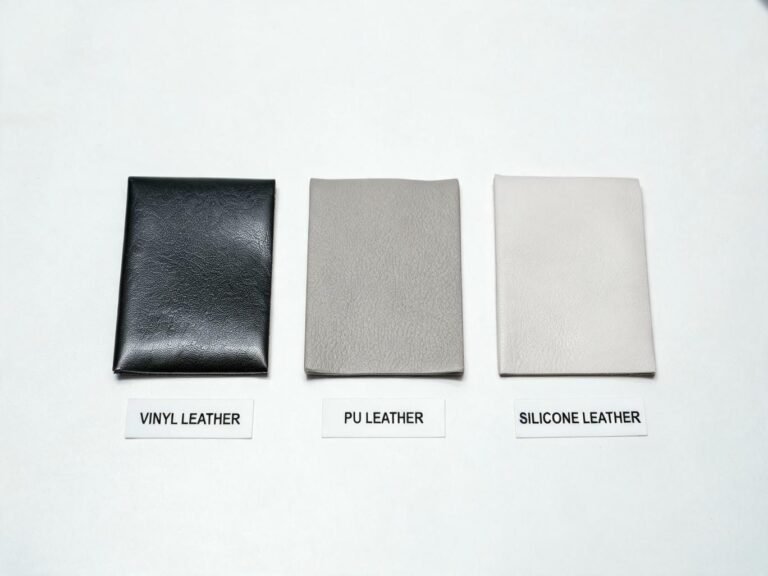
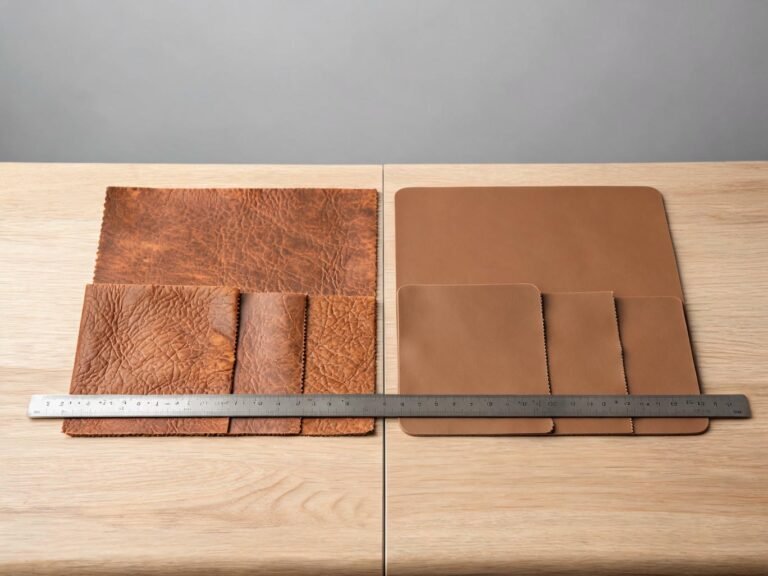
The problem is that “faux leather yard goods” covers a spectrum from $2 PVC vinyl that peels within a year to $15 silicone leather that lasts a decade — and they can look virtually identical in a 4×4 inch swatch. This guide gives procurement teams a specification framework to evaluate faux leather yard goods before committing to bulk orders, including the five quality tiers that separate materials that perform from materials that fail.
Understanding Faux Leather Yard Goods: The Baseline Specs
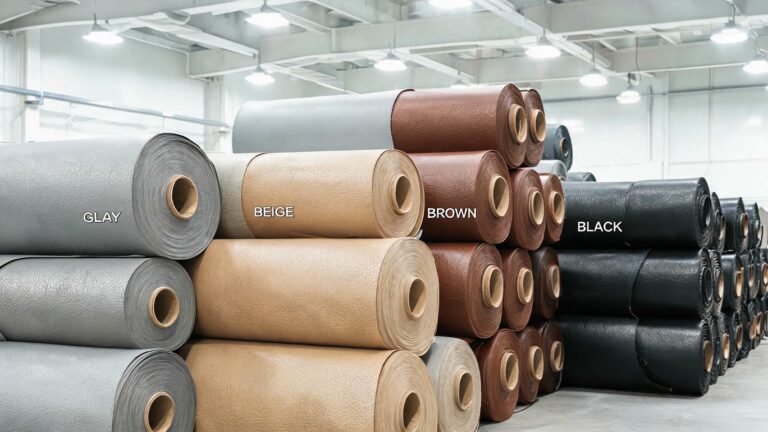
Before evaluating quality, you need to understand the physical parameters that define a yard of faux leather. These are the baseline specifications that every supplier should provide on their quotation:
| Parameter | Standard Range | Tolerance | Why It Matters |
|---|---|---|---|
| Width | 54″, 58″, or 137 cm | ±1 cm | Determines cutting yield per yard — narrower width means more waste on large panels |
| Thickness | 0.6 mm – 2.0 mm | ±0.1 mm | Affects drape, durability, and application suitability — thicker for furniture, thinner for accessories |
| Weight | 200 – 450 g/m² | ±10 g/m² | Higher weight = more coating material = better durability, but also higher shipping cost |
| Backing Fabric Weight | 80 – 150 g/m² | ±5 g/m² | Heavier backing = better tear strength; lighter backing = better drape for curves |
| Roll Length | 30 – 50 yards per roll | +1 yard (over-run) | Shorter rolls = more splices in production; insist on 40+ yard rolls for furniture production |
These are the entry-level specs. Any supplier who can’t provide them isn’t a manufacturer — they’re a trader marking up someone else’s material. For a comprehensive leather yardage supplier audit guide, our audit framework covers the full qualification checklist from factory visit to first bulk order.

The 5-Tier Quality Grading System
Not all faux leather yard goods are created equal. Based on coating chemistry, backing quality, and performance testing, we categorize faux leather into five quality tiers. Understanding which tier your supplier is offering — and which tier your application actually requires — is the most important specification decision in the procurement process.
| Tier | Material | Cost/Yard | Martindale | UV Hours | Commercial Life | Typical Failure |
|---|---|---|---|---|---|---|
| Grade 1 | PVC (vinyl) | $2-5 | 15-25K | 200 | 1-2 years | Cracking, plasticizer migration |
| Grade 2 | Solvent PU | $4-8 | 25-50K | 300-500 | 2-3 years | Peeling, hydrolysis, VOC off-gassing |
| Grade 3 | Water-based PU | $6-10 | 40-60K | 500 | 3-4 years | Hydrolysis in humid environments |
| Grade 4 | Microfiber PU | $10-15 | 60-100K | 500-800 | 4-5 years | UV fading, surface wear |
| Grade 5 | Silicone | $8-15 | 150K | 1,500 | 7-10 years | None expected within service life |
The counterintuitive finding: Grade 5 silicone leather doesn’t cost significantly more per yard than Grade 4 microfiber PU — but it delivers 2-3x the abrasion resistance, 3x the UV stability, and 2x the commercial service life. The per-yard price is the wrong metric; the cost per year of service life is what matters. A Grade 2 material at $6/yard that lasts 2.5 years costs $2.40 per yard-year. A Grade 5 material at $12/yard that lasts 8 years costs $1.50 per yard-year. The “expensive” option is 37% cheaper over its service life. For more on leather fabric quality and custom production, our quality guide covers the full spec sheet framework.

The Hidden Costs of Buying Faux Leather by the Yard
The per-yard quote is the beginning of cost analysis, not the end. Here are the hidden costs that procurement teams consistently underestimate when buying faux leather yard goods:
- Defect rate and yield loss — Low-grade faux leather can have 8-15% defect rates (coating bubbles, backing wrinkles, color streaks). At a 10% defect rate on a 1,000-yard order, you’re paying for 100 yards of unusable material. High-grade silicone leather has 1-3% defect rates, meaning less waste and lower effective cost per usable yard.
- Width variation — A 54″ width with ±1″ tolerance means some rolls are actually 53″ wide. If your cutting pattern assumes 54″, you lose yield on every narrow roll. Always specify width tolerance in your purchase order and verify on receipt.
- Color lot variation — PU leather color can shift between production lots. If you order 500 yards in March and 500 yards in June, the two lots may not match — creating visible color differences across a furniture production run. Specify Delta E ≤ 1.5 for color matching between lots.
- VOC remediation — Solvent-based PU leather off-gasses VOCs for 30-90 days after production. If your product goes from production line to sealed shipping container to retail shelf without adequate airing, customers may detect chemical odor — leading to returns. Water-based PU and silicone leather have ultra-low VOC profiles.
- Compliance documentation — Every lot of PU or PVC faux leather needs REACH, Prop 65, and fire code documentation. Missing or expired certificates can hold up customs clearance or retail onboarding. Silicone leather’s inherent compliance eliminates per-lot testing.
For a full supplier audit checklist covering these and other hidden costs, see our fabric supplier audit checklist — it covers everything from factory capacity to quality management systems.

Yardage Calculation: How Much Faux Leather Do You Actually Need?
One of the most common procurement errors is underestimating yardage requirements. The calculation isn’t just “surface area of the product ÷ area per yard.” You need to account for pattern matching, grain direction, cutting waste, and defect allowance. Here’s a practical framework for a standard 3-seater commercial sofa:
| Calculation Step | Value | Notes |
|---|---|---|
| Total surface area (3-seater sofa) | ~22 m² | Seats, back, arms, piping |
| Usable area per yard (54″ width) | ~1.35 m² | 0.914m × 1.37m, minus 5% edge waste |
| Theoretical yardage | ~16 yards | 22 ÷ 1.35 |
| + Pattern matching allowance (10%) | +1.6 yards | Grain direction and seam placement |
| + Cutting waste (8%) | +1.4 yards | Remnants between cut pieces |
| + Defect allowance (3-10%) | +0.7-2.1 yards | 3% for silicone, 10% for low-grade PU |
| Actual yardage needed | 20-21 yards | Silicone (low defect rate) |
| With low-grade PU | 22-23 yards | Higher defect allowance |
The difference between 20 yards and 23 yards — driven entirely by defect rate — is 15% more material cost. On a 100-unit furniture production run, that’s 300 additional yards. At $8/yard, the hidden cost of low-grade material’s defect rate adds $2,400 to the order. For more on faux fabric leather specifications, our faux leather guide covers the full procurement framework.
topsun-silicone-leather-material-comparison-intro
How to Evaluate a Faux Leather Yard Goods Supplier
Before placing a bulk yardage order, evaluate your supplier against these five criteria. If any criterion fails, the supplier is a trading company marking up someone else’s material — not a manufacturer who controls quality:
- Test certificate provision — Can the supplier provide actual Martindale, UV stability, hydrolysis, and color fastness test certificates (not brochure claims)? If they say “our material passes ISO 12947” but can’t produce the certificate, they haven’t tested it.
- Production line ownership — Do they own the coating line, or are they buying from a third-party manufacturer? Factory-direct suppliers can control quality, customize formulations, and guarantee lot consistency. Trading companies cannot.
- Minimum order quantity flexibility — What’s the MOQ for custom colors? A manufacturer can run small custom batches; a trader needs to meet their upstream supplier’s MOQ. MOQs above 500 yards for a standard color suggest a middleman.
- Lot-to-lot consistency data — Can the supplier provide Delta E color difference data between production lots? This is the difference between a 200-unit furniture run where every piece matches and one where units from different production batches look visibly different.
- Defect rate history — What’s the supplier’s historical defect rate for the specific material you’re buying? Reputable manufacturers track this data. If they can’t answer, their quality management system doesn’t exist.
About TOPSUN
TOPSUN manufactures Grade 5 silicone synthetic leather sold by the yard for furniture, automotive, hospitality, and accessories applications. Our continuous coating line production ensures 1-3% defect rates, ±0.1mm thickness tolerance, and Delta E ≤ 1.5 color consistency between lots. We provide full test certificates (Martindale 150K cycles, UV 1,500 hours, hydrolysis 14+ weeks, fire codes BS 5852/TB 117-2013) with every shipment. From standard colors to custom Pantone matching and printed patterns, we supply faux leather yard goods that eliminate the hidden costs of low-grade material — defect waste, compliance testing, lot variation, and premature replacement.
Frequently Asked Questions
How much does faux leather cost per yard?
PVC faux leather costs $2-5 per yard, solvent-based PU costs $4-8, water-based PU costs $6-10, microfiber PU costs $10-15, and silicone leather costs $8-15 per yard. However, per-yard price doesn’t reflect total cost — defect rates, compliance testing, lot variation, and service life all affect the real cost per usable yard-year.
What width should I specify for faux leather yard goods?
Standard widths are 54″ (137 cm) and 58″ (147 cm). For furniture production, 54″ is the industry standard and most cutting patterns are optimized for this width. For accessories and small goods, either width works. Always specify width tolerance (±1 cm) in your purchase order and verify on receipt — narrow rolls reduce cutting yield.
How do I calculate how many yards of faux leather I need?
Start with the total surface area of your product, divide by the usable area per yard (approximately 1.35 m² for 54″ width), then add 10% for pattern matching, 8% for cutting waste, and 3-10% for defect allowance (depending on material grade). A 3-seater commercial sofa typically requires 20-23 yards of faux leather.
Can I get custom colors in faux leather yard goods?
Yes. TOPSUN offers full Pantone color matching with Delta E ≤ 1.5 consistency between production lots. Custom color production typically takes 1-2 weeks for sampling and 2-3 weeks for bulk production — significantly faster than the 10-14 week lead time for custom-dyed genuine leather.