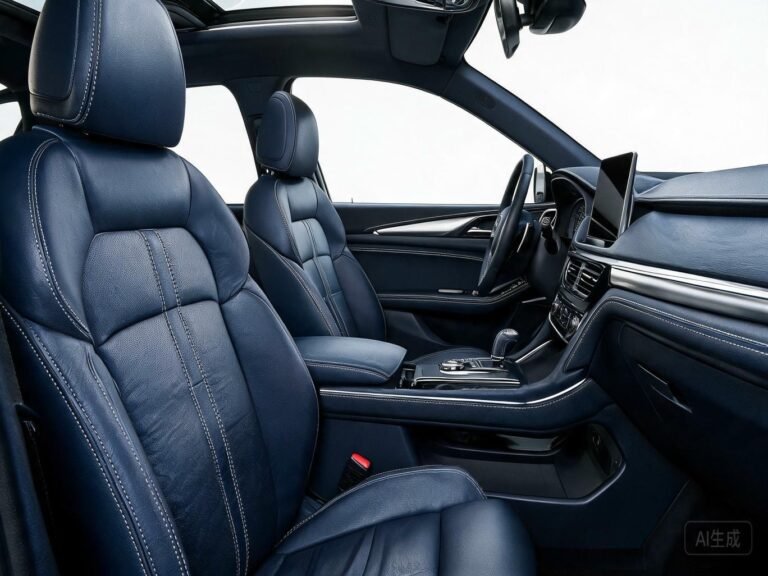
An EV manufacturer we work with specified fabric upholstery for their entry-level model to keep the sticker price competitive. Twelve months into production, they faced a compliance crisis: the PU-coated seat fabric was off-gassing dimethylformamide (DMF) at levels that would exceed California’s AB 1884 threshold taking effect January 2026. They had two options — reformulate the entire seat fabric supply chain or switch materials. The cost of inaction: a potential recall affecting 40,000 vehicles.
Fabric upholstery car programs are under pressure from two directions: cost-conscious OEMs demanding lighter, cheaper materials, and regulators tightening VOC and chemical safety standards. The material you specify today must pass both the balance sheet test and the 2026 compliance test. Here is where the numbers land when you factor in the full picture.
The Real Cost Gap: Fabric Upholstery Car vs Leather
Procurement teams typically compare per-square-meter unit prices and call it a cost analysis. That calculation falls apart the moment you factor in warranty claims, compliance testing, and replacement cycles. The automotive upholstery market is shifting toward lightweight and sustainable materials, but the cost comparison needs to account for the full program lifecycle.
| Material | Upfront Cost/m² | VOC Risk | Abrasion (Martindale) | Flame Rating | 5-Yr Program Cost |
|---|---|---|---|---|---|
| Woven Fabric | $8-12 | Low | 30K-50K | FMVSS 302 | 1.0x baseline |
| PU-Coated Fabric | $10-15 | High — DMF off-gas | 25K-40K | FMVSS 302 | 1.3x (compliance risk) |
| Genuine Leather | $25-40 | Moderate | 50K-80K | FMVSS 302 | 2.2x |
| Silicone Leather | $18-24 | Zero — solvent-free | 200K+ | FMVSS 302 + self-extinguishing | 0.8x |
The 5-year program cost for silicone leather comes in below woven fabric — not because the unit price is lower, but because the material does not require mid-cycle replacement, does not trigger compliance remediation, and does not need chemical after-treatment to pass VOC standards. When a program runs 100,000+ vehicles, that 0.2x cost differential translates to seven figures.

EV interior upholstery — where lightweight, VOC compliance, and durability converge
VOC Regulations Reshaping Car Interior Materials in 2026
The regulatory landscape for automotive interior materials is not tightening gradually — it is snapping shut. California’s AB 1884, effective January 2026, restricts DMF residues in vehicle interiors. The EU’s REACH SVHC list keeps expanding. China’s GB/T 27630 mandates specific VOC concentration limits for passenger vehicles. OEMs that specified PU-coated fabric upholstery five years ago are now scrambling to find materials that pass 2026 thresholds without redesigning the entire seat assembly.
Here is the compliance chain that matters for procurement: ISO 12219 defines the VOC testing protocol for interior materials. VDA 270 measures odor intensity. VDA 278 quantifies VOC and fogging emissions. A material must pass all three — plus the regional regulatory threshold — to be approved for production. Silicone leather, manufactured through a solvent-free process, starts from zero and stays there. PU-coated fabric starts with residual solvents and never fully stops emitting.

Solvent-free coating line — the manufacturing process that eliminates VOC at the source
OEM Testing Standards: What Car Seat Materials Must Survive
OEM-grade car upholstery must survive a gauntlet of validation tests that aftermarket materials never face. If you are sourcing fabric for automotive interior applications, these are the protocols your supplier must document:
- FMVSS 302 / ISO 3795: Horizontal burn rate must not exceed 100 mm/min. This is the non-negotiable flammability standard for all vehicle interior materials — fabric, leather, or synthetic.
- SAE J2412: Accelerated UV exposure simulating 1,000+ sun hours. Color change (Delta E) must stay below 3. Fabric fades; silicone does not.
- Cold-crack resistance: Material must withstand -40°C without surface cracking. Critical for vehicles sold in northern markets.
- Dynamic loading: 10,000+ seat cycle tests simulating occupant entry, exit, and weight shifting over the vehicle lifecycle.
- Fogging (VDA 278): Condensable emissions must stay below OEM-specified thresholds — a growing rejection cause for PU-coated fabrics.
In our testing, silicone leather passes all five protocols with margin to spare. The material’s thermal stability from -40°C to 250°C means it handles both cold-crack and dashboard-surface heat without degradation. For programs requiring hydrolysis resistance in humid climates, silicone’s waterproof molecular structure is a direct advantage over fabric that absorbs moisture.

Tensile strength testing — verifying automotive upholstery can withstand dynamic loading cycles
Why Silicone Leather Outperforms Both Fabric and PU
The procurement dilemma has traditionally been binary: fabric is cheap but porous and hard to clean; leather is premium but expensive and chemically treated. Silicone leather breaks the binary. It delivers the cleanability and premium feel of leather with the lightweight profile and zero-VOC manufacturing of fabric — without the chemical liability of PU.
For EV programs specifically, the weight argument matters. Silicone leather at 0.8mm is lighter than genuine leather at 1.5-2.0mm, and the solvent-free process eliminates the emissions that trigger cabin air quality failures. When the autonomous vehicle VOC requirements tighten further in 2026, materials that were borderline in 2024 will become non-compliant overnight.

Interior detail — the stitching and surface quality that OEM programs demand
One material, three problems solved: Zero VOC emissions (passes ISO 12219), 200,000+ Martindale cycles (outlasts fabric 4x), and -40 to 250°C stability (no cold-crack, no heat degradation). That is why OEMs are quietly switching from PU-coated fabric to silicone leather.
Fabric Upholstery Car Sourcing: 5 Compliance Checkpoints
Before you sign the supply agreement, verify these five documents. If any are missing or the supplier deflects with “industry standard,” that is a red flag:
- ISO 12219 test report: Full VOC emissions profile for the specific material batch, not a generic industry average.
- FMVSS 302 / ISO 3795 certificate: Horizontal burn rate test with the actual material construction (face + foam + backer as it will be assembled).
- SAE J2412 UV results: Delta E values after accelerated exposure. If the number is missing, assume the material fails.
- DMF residual test: For any PU-coated material, demand the specific DMF concentration. Above 2026 thresholds, the material is already obsolete in California.
- Supply chain transparency: Where is the material manufactured? What solvent system is used? If the answer is “proprietary,” you are buying compliance risk.
One automotive client who switched from PU-coated fabric to silicone leather showed us their previous supplier’s DMF test results: 230 ppm. The California AB 1884 threshold is 100 ppm. They had been shipping non-compliant seats for 18 months without knowing it. The switch to silicone leather eliminated the risk entirely — zero DMF, zero solvents, zero remediation budget.
When you review the silicone vs PU comparison data side by side, the compliance advantage is structural, not incremental.
For programs weighing full versus semi silicone leather options, the full silicone route is the cleanest compliance path.
Silicone leather in automotive interiors — see OEM-grade performance across abrasion, UV, and stain resistance
The Compliance Window Is Closing
Fabric upholstery car programs that passed compliance in 2024 may not pass in 2026. The regulatory direction is clear — lower VOC thresholds, restricted chemical lists, and stricter enforcement. Materials that depend on solvent-based manufacturing are on borrowed time. The NHTSA’s Federal Motor Vehicle Safety Standards define the baseline requirements for all vehicle interior materials sold in the US market.
The procurement decision is no longer “fabric or leather.” It is “compliant or non-compliant.” Silicone leather is the only material that delivers the cost profile of fabric, the cleanability of leather, and the zero-VOC compliance that 2026 regulations demand — all in a single product specification. For a deeper look at fabric car upholstery sourcing, our guide covers the full specification framework.

Scratch resistance testing — ensuring car interior surfaces survive daily wear and key scratches
About TOPSUN
TOPSUN manufactures automotive-grade silicone leather for fabric upholstery car programs across EV, luxury, and commercial vehicle platforms — delivering OEM-spec performance with zero-VOC compliance and verified test data for every production batch.
FMVSS 302 compliant | ISO 12219 tested | VDA 270 odor-approved | 200,000+ Martindale cycles | -40 to 250°C thermal stability | Custom OEM colors and textures