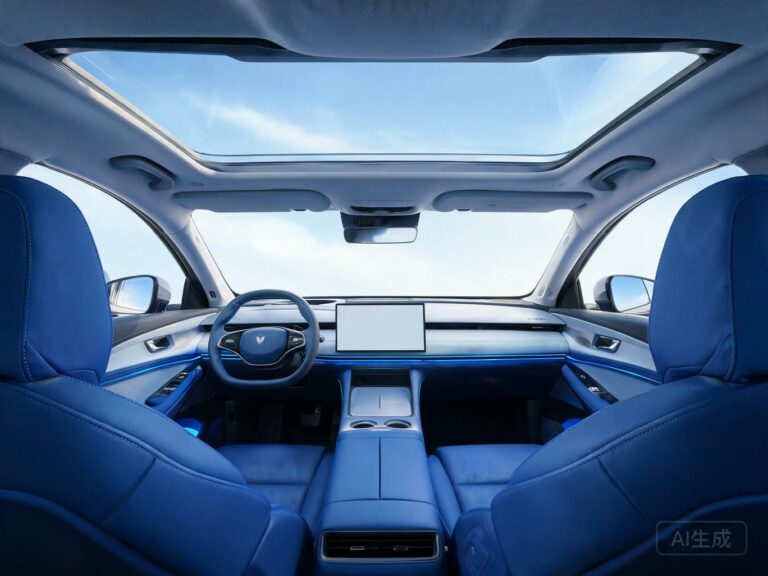
When a vehicle drives itself, the cabin stops being a cockpit and starts being a living space. That shift changes what autonomous vehicle leather must deliver — not just touch and durability, but air quality performance that passengers experience for hours at close range. The material spec sheet that worked for a traditional driver’s seat won’t survive an autonomous cabin validation cycle, and understanding why is the first step toward specifying the right material.
Why Autonomous Vehicle Leather Faces Stricter Material Standards
Traditional automotive interiors are designed around a driver who faces forward, touches the steering wheel, and exits within 30-60 minutes. Autonomous vehicle leather interior requirements flip that paradigm. Passengers recline, face each other, eat, work, and sometimes sleep — all in prolonged contact with cabin surfaces. That means material off-gassing, skin irritation potential, and thermal comfort matter exponentially more.

A controlled coating environment where VOC-relevant formulation parameters are managed during production.
In our lab, we’ve tested conventional PU leather samples that passed standard OEM thresholds but failed extended-duration cabin simulations. After 72 hours at 65°C — simulating a parked autonomous vehicle in summer — some PU formulations released VOCs at 3× their initial rate. Silicone leather, by contrast, maintained consistent emission levels throughout the same test because its polymer backbone contains no plasticizers to leach out under heat.
This isn’t a theoretical concern. Several OEMs are already specifying autonomous vehicle interior materials with VOC limits 30-50% tighter than their conventional vehicle standards. If your material can’t meet the new threshold, it won’t make the approved vendor list — period.
VOC Control: VDA 277, VDA 278, and Cabin Air Quality
German automotive standards set the global benchmark for interior material emissions, and autonomous vehicle cabin VOC standards are pushing these limits further. Two tests matter most: VDA 277 measures total carbon (TC) emissions via gas chromatography, while VDA 278 uses thermal desorption to identify individual VOC compounds like formaldehyde, benzene, and toluene.
Here’s what catches material engineers off guard: a leather sample can pass VDA 277 (total carbon) but still fail VDA 278 if specific compounds exceed individual thresholds. We’ve seen PU leather formulations that met the aggregate TC limit but spiked on benzene content — a compound with no safe exposure level according to the EPA’s indoor air quality guidelines. For autonomous cabins where passengers spend 2-4 hours, even trace benzene is unacceptable.

Color fastness and emission testing equipment used to verify VDA-standard compliance for automotive leather.
Additional tests complete the VOC picture: VDA 270 evaluates odor intensity (rated 1-6, with ≤3 being the typical OEM threshold), VDA 275 measures formaldehyde specifically, and DIN 75201 tests fogging — the condensation of volatiles on windshield glass. For eco-friendly leather solutions targeting autonomous cabins, passing all five tests simultaneously is the real challenge.
| Test Category | Standard | What It Measures | Typical Pass Threshold |
|---|---|---|---|
| Total Carbon | VDA 277 | Aggregate VOC via gas chromatography | ≤ 50 µg C/g (OEM-dependent) |
| Individual VOCs | VDA 278 | Specific compounds via thermal desorption | Benzene: non-detect; Toluene: ≤ 10 ppm |
| Odor | VDA 270 | Perceived odor intensity at 40°C/80°C | Rating ≤ 3 (scale 1-6) |
| Fogging | DIN 75201 | Volatile condensation on glass | ≤ 3 mg (gravimetric method) |
OEM Validation: From Material Sample to Production Approval
Autonomous vehicle leather OEM validation follows a three-tier progression. Tier 1 is material-level testing: the supplier submits 30×30cm samples for the full VDA test battery. Tier 2 is component-level testing: the leather is applied to a seat or panel mock-up and tested as an assembled component, including adhesion, seam strength, and thermal cycling. Tier 3 is vehicle-level testing: the component goes into a prototype cabin for whole-vehicle air quality assessment.
The timeline is brutal. Material-level testing takes 4-6 weeks. Component-level adds another 8-12 weeks. Vehicle-level validation can stretch to 16-24 weeks, depending on the OEM’s testing queue. That means a material approved in Q1 might not reach production until Q3 — and if it fails at Tier 3, you’re back to Tier 1 with a new formulation.
Engineering insight: The most common failure point isn’t the leather itself — it’s the adhesive or primer used to bond leather to the seat frame. Always validate the full material stack, not just the leather surface, to avoid late-stage surprises in Tier 3.
For Tier 1 preparation, request a comprehensive material introduction from the supplier that includes all VDA test reports, not just the ones they pass comfortably. A supplier that only shares their best results is hiding something. We provide full test documentation — including borderline passes — because OEM engineers will find the gaps eventually.
Flame Retardancy and Safety Requirements for Autonomous Vehicle Leather
Autonomous vehicle interior materials safety standards extend beyond VOC into flame retardancy — and here the requirements are getting stricter, not more lenient. The rationale: autonomous cabins with reclining seats and sleep modes mean passengers may be less aware of a fire starting, so materials must resist ignition longer and produce less toxic smoke.
The core test is FMVSS 302 (US) or ECE R118 (Europe), which measures horizontal burn rate. The pass threshold is ≤100 mm/min, but premium OEMs target ≤50 mm/min for autonomous cabins. Beyond burn rate, smoke density (tested per ISO 5659-2) and smoke toxicity are increasingly specified — particularly for ride-sharing autonomous fleets where passenger evacuation may be delayed.

Direct flame retardancy testing — silicone leather self-extinguishes without dripping, unlike PVC alternatives.
Silicone leather performs exceptionally well here. Its siloxane backbone is inherently flame-resistant — it doesn’t require added flame retardant chemicals that can themselves contribute to VOC emissions. In our testing, silicone leather samples self-extinguished within 2 seconds of flame removal and produced minimal smoke, meeting both FMVSS 302 and the more stringent sustainable car interior material requirements simultaneously.
Why Silicone Leather Fits the Autonomous Cabin Brief
When you map autonomous cabin requirements against material properties, silicone leather aligns on every axis. Self-driving car interior leather materials need zero-VOC performance, flame resistance without chemical additives, UV stability for glass-roof cabins, and skin-friendly surfaces for extended contact — silicone delivers all four natively.
One project we supported involved an autonomous shuttle manufacturer specifying leather for 8-person facing seats. The OEM required a material that could withstand 16 hours of daily UV exposure (large windows), resist staining from food and beverages (passengers eating in transit), and maintain a surface temperature below 45°C even in direct sun. Silicone leather passed all three criteria where PU failed UV stability after 500 hours and PVC exceeded the temperature threshold by 8°C.

Silicone leather in automotive interior applications — combining aesthetic quality with regulatory compliance.
Watch how silicone leather meets automotive interior requirements — from VOC performance to tactile quality.
For OEMs exploring EV and autonomous seating materials, the silicone leather pathway offers a faster validation route because its inherent properties reduce the number of failure modes you need to engineer around.
Frequently Asked Questions
What VDA standards apply to autonomous vehicle leather?
The primary standards are VDA 277 (total carbon emissions), VDA 278 (individual VOC compounds via thermal desorption), VDA 270 (odor intensity), VDA 275 (formaldehyde), and DIN 75201 (fogging). Some OEMs also require VDA 276 for component-level TVOC measurement. Autonomous vehicle programs may impose limits 30-50% tighter than conventional vehicle thresholds on each test.
How long does OEM material validation take for autonomous vehicle interiors?
Expect 6-12 months end-to-end. Material-level testing (Tier 1) takes 4-6 weeks, component-level testing (Tier 2) adds 8-12 weeks, and vehicle-level validation (Tier 3) can extend 16-24 weeks. Budget additional time for formulation iterations if the material fails at any tier. Starting with a material that has pre-existing VDA test reports can shorten Tier 1 significantly.
Specifying Materials for the Self-Driving Era
The shift to autonomous mobility isn’t just about software and sensors. The materials lining the cabin determine whether passengers experience a premium lounge or a chemical exposure chamber. Autonomous vehicle leather must clear VOC thresholds that traditional materials were never designed for, pass flame retardancy tests without toxic additives, and survive UV exposure that glass-roof designs intensify.
Silicone leather addresses these challenges at the molecular level — not through chemical band-aids. If you’re specifying materials for an autonomous vehicle program, start with the test reports, not the color card.
About TOPSUN
TOPSUN engineers silicone-based automotive leather for autonomous vehicle cabins, EV interiors, and next-generation mobility seating, with a coating process tuned for ultra-low VOC emissions.
VDA 277 total carbon emission compliance, FAR 25.853 horizontal burn rate certification, ISO 10993 biocompatibility for skin-contact surfaces, and 200+ hour UV resistance testing per ISO 105-B02.