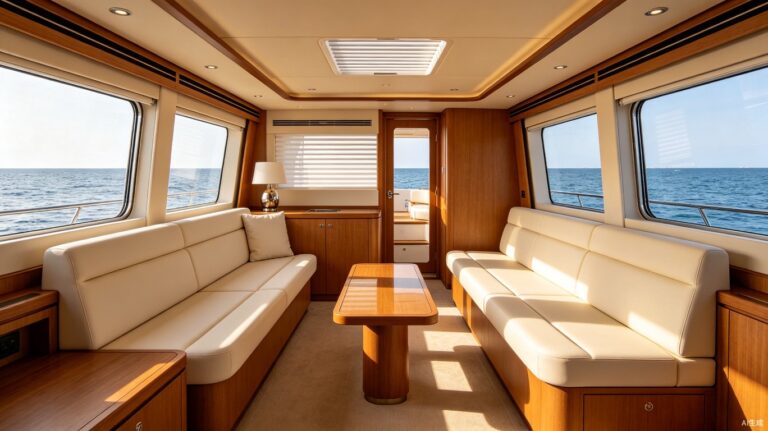
Why does the same fabric for boat interior project age ten years on one yacht and two seasons on another? We audit marine upholstery failures across our export accounts, and the pattern repeats: one material for the whole cabin. The helm seat cracked under glass-filtered sun while the berth cushion below stayed new. A boat interior is not one environment. It is three stacked climates, and each destroys fabric differently.
One Boat, Three Climates: Where Fabric for Boat Interior Fails First
Start at the helm. Glass concentrates sunlight, and the sea reflects a second dose upward, so helm seating takes roughly 1.5 times the UV load of furniture on land. Standard marine vinyl yellows and embrittles after 300 to 500 accelerated weathering hours. Buying guides treat a published UV figure above 500 test hours as the entry ticket for true marine grade material. Vague sun-proof adjectives do not survive a Gulf summer.
Move to the main salon and the math changes. Salt air, wet-dry cycles, sunscreen, and flexing attack coatings and seams. Marine guides call for 500 to 1,000 hours of salt spray under ASTM B117 on seating substrates, plus 50,000 Wyzenbeek double rubs. Salt water resistant fabric is a tested clause, not a feeling.
Drop below deck and humidity takes over. Warm, still air in berths and headliners breeds mold, which is why credible marine spec sheets cite ASTM G21. Three zones, three failure modes: UV, salt, mildew. One blanket fabric choice usually loses to all three.

One cabin, three climates, three failure tests.
The Numbers Behind a Marine Upholstery Fabric Spec
Buyers who compare spec sheets instead of swatches avoid most surprises. The market rewards that discipline: fabrics for marine upholstery were valued at $2.8 billion in 2025, heading for $4.3 billion by 2033 at 5.8 percent annual growth. Volume is climbing, and so is the cost of a wrong pick.
| Spec Line | Marine Vinyl Benchmark | What to Demand | TOPSUN Silicone Leather |
|---|---|---|---|
| Salt spray (ASTM B117) | 500-1,000 h | 1,000+ h, lot certificate | 1,000+ h verified |
| UV exposure | 500 h minimum | 1,500+ h, no fading | 1,500+ h, grade 4-5 fastness |
| Mildew (ASTM G21) | Treated surface | Zero-plasticizer build | Zero plasticizer, solvent-free |
| Cold crack | -20°F (-29°C) | -40°C service | -40°C to 200°C range |
The mildew row deserves one extra line. Plasticizers that keep vinyl soft also feed microbes; when they migrate, coatings crack and mold blooms. Silicone carries no plasticizers and no ester bonds, so nothing migrates and nothing hydrolyzes. We document the gap on our silicone versus PU comparison page, plus the 14-week chamber data behind our hydrolysis-resistant silicone leather line.
Outdoor UV and weather resistance after accelerated sun exposure.
Specifying Fabric for Boat Interior Zones: A Purchasing Checklist
Write the spec by zone, not by catalog. Four lines cover most vessel tenders.
Helm, flybridge, and cockpit: UV resistant boat upholstery with 1,500+ published UV hours and grade 4-5 color fastness.
Salon and main-deck boat seat material: salt water resistant fabric with 1,000+ hour ASTM B117 results, 50,000+ double rubs, and alcohol-safe cleanability.
Berths, headliners, and crew quarters: mildew resistant boat fabric that passes ASTM G21 without surface treatments. Zero-plasticizer construction stays inert in still, humid air.
All passenger-vessel zones: add the flame class your flag state requires. Our Super Flame Retardant line carries EN 13773 Class 4.

Waterproof surfaces turn wet-dry cycles into a wipe-down.
Certified materials pay back operationally. One European ferry operator that switched to certified marine-grade upholstery reported 40 percent lower maintenance costs and a refurbishment cycle extended by three years. Zone-matched specs do the same work for private yachts, only quieter. See the program on our marine and outdoor applications page.

Zone-matched specs from one certified supply chain.
A fabric for boat interior use is never one purchase; it is three specs wearing one label. Match each zone to its number, and the cabin stops being a warranty line item.
Request Zone-Matched Marine Samples
Talk to Our Marine Supply Team
About TOPSUN
TOPSUN supplies silicone-coated marine fabrics to yacht and commercial vessel builders in 30+ countries: 500,000 m monthly capacity, 500 m MOQ, 7-15 day delivery.
ASTM B117 salt spray 1,000+ hours, UV-stable 1,500+ hours, and SGS test reports with every order.
References
- https://dataintelo.com/report/global-fabrics-fo… — Marine upholstery market size and 2025-2033 forecast.
- https://www.decorativefabricsdirect.com/blog/ma… — Marine grade benchmarks: UV hours, ASTM G21, double rubs, cold crack.
- https://szoneierfabrics.com/marine-vinyl-fabric/ — ASTM B117 ranges and a ferry refurbishment case.