Last quarter, our R&D team received a brief from an automotive OEM client: “Find us an eco performance fabric for the new EV interior line.” Simple enough — except every supplier we contacted defined “eco performance” differently. One pitched recycled polyester with GRS certification. Another touted zero-VOC silicone coating. A third pointed to OEKO-TEX Standard 100 compliance. All three were technically correct. None of them covered all the metrics that actually matter.
Request Eco Performance Samples
What Is Eco Performance Fabric? The Definition Problem
The sustainable fabrics market is projected to reach USD 118 billion by 2034, growing at 12.3% CAGR. But “eco performance fabric” has no unified industry definition. Suppliers cherry-pick whichever metric makes their product look best. Recycled content? That is GRS. Chemical safety? That is OEKO-TEX. Indoor air quality? That is Greenguard. Each certification verifies one dimension — none verifies the full picture. For a deeper look at what environment-friendly fabrics actually means in practice, the gap between marketing and measurable performance is wider than most buyers expect.

Solvent-free silicone coating line — the production process behind true eco performance fabric
7 Metrics That Actually Verify Eco Performance
After evaluating dozens of materials against our silicone leather technical framework, we identified seven metrics that together define genuine eco performance fabric. No single certification covers all seven — but a material should meet every one:
- 1. VOC emissions: Zero or near-zero volatile organic compounds during production and use. Verify via ISO 16000-6 or VDA 277 testing.
- 2. Recyclability: Material can be reclaimed at end-of-life without hazardous waste classification. 100% recyclable is the benchmark.
- 3. Abrasion resistance: 200,000+ Martindale cycles (ISO 12947-2). Performance means durability — a fabric that fails in 3 years is not sustainable regardless of its recycled content.
- 4. Stain resistance: CFFA-141 Class 5 or equivalent. Easy cleaning without harsh chemicals reduces environmental impact during the use phase.
- 5. Weather/UV stability: 1,000+ hours UV resistance (ASTM G154). Material that degrades outdoors generates replacement waste.
- 6. Service life: 10+ years minimum. The greenest fabric is the one you do not replace.
- 7. Chemical safety: Free from phthalates, BPA, formaldehyde, DMF, and heavy metals. Verify via REACH and RoHS compliance.

Quality inspection — verifying performance metrics on the production floor, not just in marketing claims
Silicone Leather: Meeting All 7 Metrics Without Trade-offs
In our R&D testing, silicone leather is the only material we have found that meets all seven metrics simultaneously. Zero VOC emissions through solvent-free dry coating. 100% recyclable with no hazardous waste classification. 200,000+ Martindale cycles verified. CFFA-141 Class 5 stain resistance. 1,000+ hours UV stability. 10+ year service life. REACH and RoHS compliant with zero phthalates, BPA, formaldehyde, or DMF. For the full technical breakdown, see our silicone vs PU comparison with side-by-side test data.
No trade-off between eco and performance. No certification gap. No recycled content without durability, no durability without chemical safety. That is what eco performance fabric should mean — and until the industry agrees on a unified standard, these seven metrics are the checklist we use. For more on how synthetic fabric production processes affect sustainability outcomes, see our production analysis.
Silicone leather properties overview — how one material meets all 7 eco performance metrics

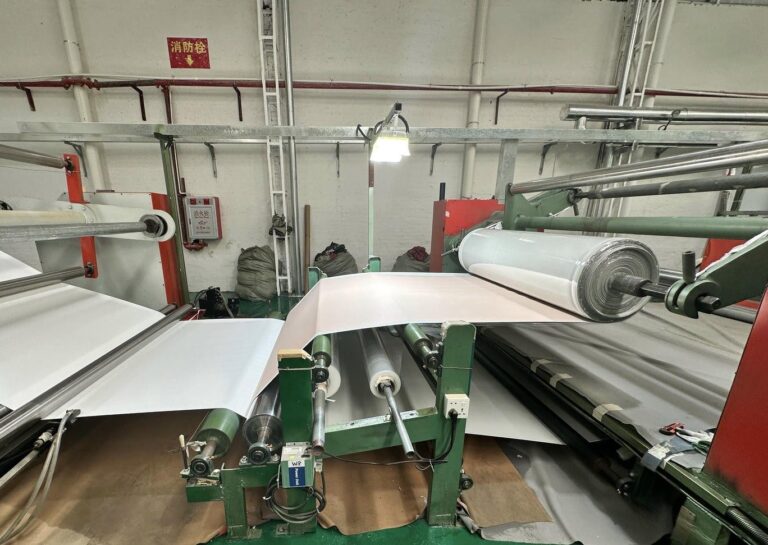
Base fabric unwinding on the production floor — the starting point for solvent-free eco performance fabric manufacturing
Your Eco Performance Fabric Verification Checklist
Before you sign a supply contract for eco performance fabric, verify these seven items:
- ☐ Request ISO 16000-6 or VDA 277 VOC test report — not just a safety data sheet
- ☐ Confirm recyclability classification — ask for end-of-life documentation
- ☐ Check Martindale abrasion data — minimum 200,000 cycles for commercial use
- ☐ Verify CFFA-141 or equivalent stain resistance rating — Class 5 for healthcare/hospitality
- ☐ Review UV resistance testing — 1,000+ hours per ASTM G154 for outdoor/marine applications
- ☐ Ask for service life data backed by accelerated aging tests, not marketing claims
- ☐ Demand REACH and RoHS compliance documentation — full chemical disclosure, not just certifications
If a supplier cannot provide test data for all seven metrics, their eco performance fabric claim is incomplete — not necessarily false, but unverified. In our experience, most suppliers can provide two or three. Silicone leather is the only material we have tested that provides documentation for all seven.