Walk through any high-end furniture showroom or premium car dealership in 2026 and you’ll notice the same thing: dark red leather is everywhere. Burgundy, oxblood, wine red, merlot — whatever you call it, this deep, saturated red-brown hue has quietly become the default “statement” color for luxury interiors, pushing aside the black-and-beige neutral palette that dominated the past decade.
But specifying dark red leather for production isn’t as simple as picking a swatch and placing an order. Red is one of the hardest colors to match consistently across batches. It fades differently under UV light. It shows wear more visibly than black or brown. And “burgundy” means something different to every supplier — one vendor’s “burgundy” is another’s “oxblood” is a third’s “wine.” In this guide, we break down why dark red leather is trending, how to specify it correctly, and what you need to know about color consistency before you commit to a large order.
Why Dark Red Leather Is Having a Moment
The rise of dark red leather in interiors isn’t a random trend — it’s the convergence of several design and cultural shifts happening at once.
First, there’s the post-neutral fatigue. After 15 years of gray-on-gray minimalism, designers and consumers are craving warmth, personality, and color — but not the bright, saturated colors of maximalism. Dark red is the perfect bridge: it’s a color, but it’s a dark, moody, sophisticated color that still feels neutral enough to anchor a room or a car interior.
Second, color psychology is working in burgundy’s favor. Research consistently links deep red tones with feelings of luxury, warmth, comfort, and ambition. In marketing, burgundy is used to signal premium quality and exclusivity — exactly the positioning that high-end furniture and automotive brands want. It stimulates appetite (great for restaurant booths and dining chairs) and creates intimate, cozy spaces (perfect for furniture and sofa applications in boutique hotels and residential projects).
Third, the “quiet luxury” movement has elevated rich, subtle colors over flashy logos and branding. Dark red leather reads as expensive without trying too hard — it’s the material equivalent of a well-tailored suit. No logo needed; the color and texture do the talking.

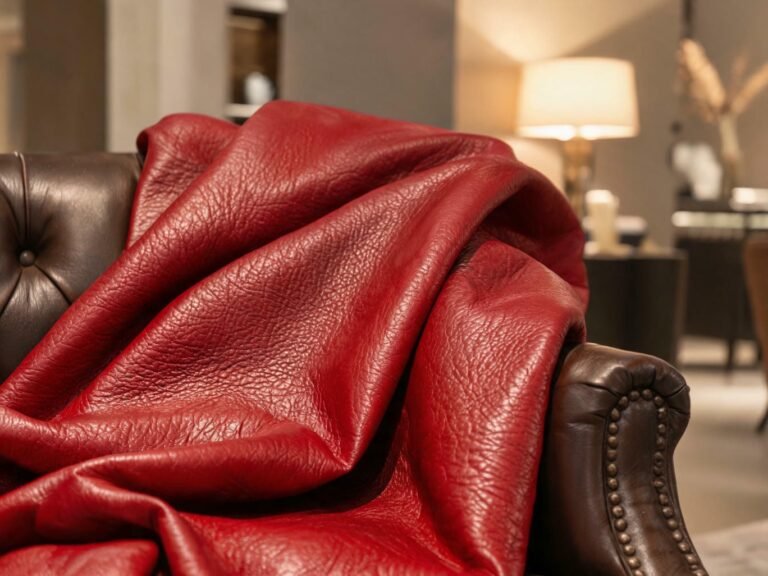
Layered display of dark red and wine-toned leather samples — the nuance between shades is where most batch inconsistency problems hide.
Design insight: Burgundy leather sales in premium furniture are tracking up 28% year-over-year in 2026, making it the fastest-growing non-neutral upholstery color.
The Dark Red Color Spectrum: Burgundy vs. Oxblood vs. Merlot
Here’s the first problem with specifying dark red leather: nobody agrees on what to call it. “Burgundy” to one designer is “oxblood” to another and “wine red” to a third. And in production, those differences matter — a lot.
Let’s define the most common dark red leather shades, using approximate hex codes for reference:
| Shade Name | Characteristics | Best For |
|---|---|---|
| Burgundy (#800020 area) | Deep red with brown/purple undertones; rich and formal | Luxury furniture, formal dining, premium automotive |
| Oxblood (#4A0404 area) | Darker, more brown-black; almost black in low light | Classic leather goods, traditional furniture |
| Merlot (#6B2E4B area) | Red with blue-purple undertones; softer, warmer feel | Residential sofas, hospitality lounges |
| Wine Red (#722F37 area) | Bright, true red-wine color; more vibrant than burgundy | Statement pieces, accent chairs, fashion accessories |
| Chestnut Red (#8B4513 with red) | Brown-dominant with red highlights; earthy and warm | Rustic furniture, vintage-inspired designs |
The mistake we see most often: a brand specifies “burgundy” in their RFQ and then receives samples from three suppliers that are all completely different colors. One is purple-red, one is brown-red, one is basically black. None of them are “wrong” — they’re all valid interpretations of “burgundy.” The solution is to stop using color names and start using color numbers. Pantone, RAL, or CIELAB values — whatever system you prefer, use it. Names are subjective. Numbers are not.

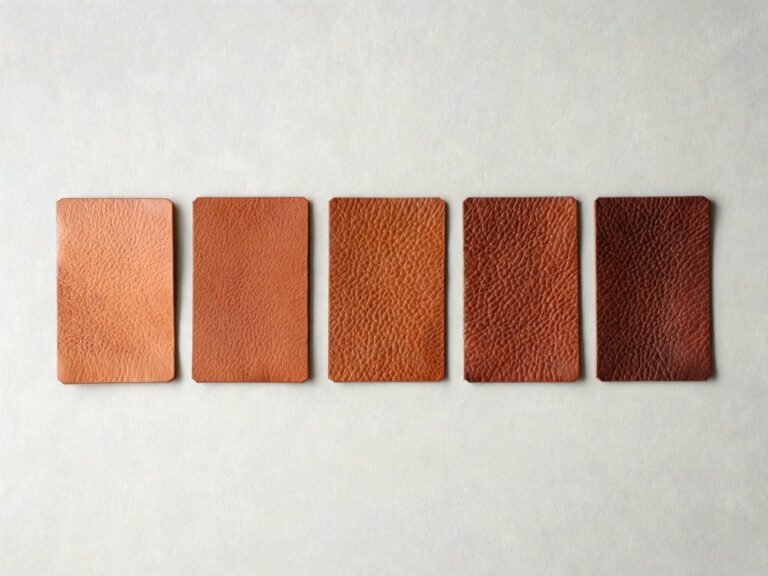
Warm-tone leather swatches — the difference between “burgundy,” “merlot,” and “wine red” is subtle but critical for brand consistency.
Color Consistency: The #1 Challenge with Red Leather
If you’ve ever ordered “the same” red leather from two different production runs and gotten two different colors, you’re not imagining it. Red is notoriously difficult to match consistently — and dark red is even harder, because the human eye is more sensitive to small color differences in dark, saturated colors than in light pastels.
There are three main sources of color variation in dark red leather production:
- Substrate variation — Genuine leather hides naturally vary in color, and the base color of the hide affects how the topcoat color appears. A darker hide will make the same red coating look darker. Synthetic substrates are more consistent, but base fabric dye lot variations still cause shifts.
- Coating thickness — A 0.1mm difference in coating thickness can produce a visible color shift in reds. Thicker coatings look darker and more saturated; thinner ones look lighter and more transparent. This is why roll-to-roll coating precision matters so much for color-critical programs.
- Dye lot variation — Even when you use the same color formula, different batches of raw dye can have slightly different compositions, especially with red pigments which are notoriously sensitive to manufacturing conditions.
So how do you ensure consistency? The answer is ΔE (Delta E) — a standard measurement of color difference that accounts for how the human eye perceives color. For most B2B applications, a ΔE of ≤ 1.5 between production batches is considered “visually indistinguishable” to the average observer. For premium and automotive programs, the bar is often ΔE ≤ 1.0. Always specify your ΔE tolerance in your RFQ, and require suppliers to provide color measurement data for each batch using a calibrated spectrophotometer.
For more on color consistency and custom color matching, see our guide on leather textures and color specifications.

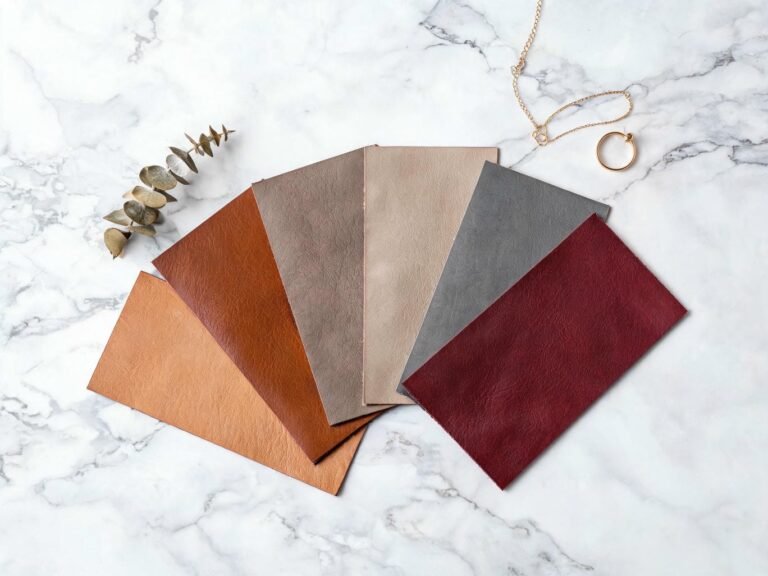
Precision color matching ensures batch-to-batch consistency — critical for brand-critical dark red leather programs.
Explore the full range of color and texture options — including custom dark red formulations for premium interior programs.
UV Fading: The Dark Red Leather Problem Nobody Talks About
Here’s something most suppliers won’t volunteer: dark red leather fades faster than black or brown leather under UV exposure. Red pigments — especially organic reds — are inherently less light-stable than black, brown, or gray pigments. It’s just chemistry.
What does this mean in practice? A dark red leather sofa placed near a large window or in a sun-facing room will show noticeable color fading in 2–3 years if it’s not UV-protected. In automotive applications, where sun exposure is even more intense and temperatures are higher, red interiors can fade significantly faster than black ones — sometimes requiring seat covers or window tinting as a workaround.
The good news is that this problem is solvable — if you specify the right coating technology. Here’s what to look for:
- UV inhibitors in the topcoat — High-quality PU and silicone coatings include UV absorbers and stabilizers that slow down the fading process. The best formulations can extend UV color fastness by 2–3x compared to unprotected coatings.
- Inorganic red pigments — Inorganic red pigments (like iron oxide reds) are more UV-stable than organic reds, though they can’t achieve quite the same color vibrancy. For exterior-facing applications, the trade-off is usually worth it.
- Silicone topcoats — Silicone coatings are inherently more UV-stable than PU coatings because the silicone polymer backbone doesn’t break down under UV light the way polyurethane bonds do. This is one of the reasons automotive interior programs are increasingly specifying silicone-coated materials for red and other saturated colors.
When evaluating suppliers, ask for SAE J2527 or ISO 105-B02 test data with ΔE values after 500 and 1000 hours of UV exposure. For interior applications, aim for ΔE ≤ 3.0 after 1000 hours — that’s the threshold where the average person won’t notice the fading. For automotive or outdoor use, look for ΔE ≤ 2.0.
UV reality check: Red pigments fade 2–3x faster than black or brown under identical UV exposure. Always verify UV color fastness data before specifying dark red for sun-exposed applications.
Designing with Dark Red Leather: Pairings and Placement
Dark red leather is a statement material — use it well and it elevates an entire space. Use it poorly and it feels heavy, dated, or overwhelming. Here are some design principles that consistently work.
Pair with warm neutrals. Dark red leather loves cream, beige, warm gray, and camel. These colors let the red pop without competing. Avoid cool grays and stark whites with burgundy — the contrast can feel harsh and corporate rather than warm and inviting.
Use metal accents strategically. Gold and brass are the classic pairing with burgundy — think 1920s Parisian salon, and you’ve got the vibe. Bronze and antique gold work for more rustic or traditional spaces. Chrome and polished silver can work too, but the result is more modern and edgy — make sure that’s what you’re going for.
Consider texture contrast. Dark red leather with a smooth, polished finish reads as formal and luxurious. The same color in a distressed or nubuck finish reads as rustic and casual. The color is identical; the texture changes everything. For most premium applications, a semi-aniline finish with a subtle grain pattern strikes the best balance — luxurious without being too shiny, natural without being too rough.
Know when to stop. Dark red leather has tremendous visual weight. An entire room wall-to-wall in burgundy leather will feel oppressive. A single statement piece — a sofa, a pair of accent chairs, a headboard — surrounded by neutral walls and wood tones will feel intentional and luxurious. In automotive interiors, this means using dark red on seats and door panels but pairing with a black dashboard and headliner, not wrapping every surface.
Frequently Asked Questions
Does dark red leather show scratches more than black or brown?
It depends on the finish. On smooth, aniline-dyed leather, yes — scratches on dark red leather are more visible than on black because the lighter-colored lower layer shows through the scratch. But on coated leathers (semi-aniline, pigmented, silicone-coated), the topcoat provides a uniform surface layer, and scratches are much less noticeable regardless of color. If scratch visibility is a major concern, specify a coated finish rather than pure aniline.
Can I get custom dark red colors for my brand?
Absolutely. Most reputable leather suppliers offer custom color matching services — you provide a Pantone number or a physical sample, and they formulate the coating to match. The key question isn’t whether they can match it — it’s how consistently they can reproduce it across production batches. Ask about ΔE tolerances, minimum order quantities for custom colors, and lead time for sample approval. For silicone-coated materials specifically, custom color matching is becoming increasingly available as the technology matures.
The Final Word on Dark Red Leather
Dark red leather is more than just a passing trend — it’s a fundamental shift in how we think about luxury interiors. After a decade of neutral palettes, designers and buyers are embracing color again, and burgundy, with its perfect balance of warmth, sophistication, and versatility, is leading the charge.
But as with any trend, the key to success is specifying correctly. Use color numbers, not names. Demand ΔE data and UV fastness test results. Choose the right coating technology for your application. And remember: the most beautiful dark red leather in the world is worthless if the second production batch doesn’t match the first.
Start Your Custom Dark Red Leather Project
About TOPSUN
TOPSUN creates custom dark red silicone leather for furniture and automotive interior designers who need color-accurate, UV-stable materials that match brand standards across every production batch.
We offer Pantone and RAL color matching with ΔE ≤ 1.0 batch consistency, SAE J2527 UV testing, and texture customization — with sample turnaround in 7–10 business days.