There’s something irresistible about leather red. A burgundy sofa anchors a room like nothing else. A cherry-red car interior feels sporty and luxurious. A crimson accent chair adds personality to an otherwise neutral space. But if you’ve ever owned red leather furniture or accessories, you’ve probably noticed something frustrating: it fades. And it fades a lot faster than black or brown leather.
This isn’t a coincidence — it’s chemistry. Red dye molecules are inherently less stable under UV light than darker pigments. The chromophores that give red its vibrant hue absorb energy in the blue-green spectrum where sunlight is strongest, causing molecular bonds to break and the color to wash out. In some cases, red leather can show measurable fading (Delta E > 3.5) in as little as 12–24 months of regular use.
The good news: not all red leather fades at the same rate. The type of finish, the dye chemistry, and whether you’re looking at genuine leather or a synthetic alternative make a huge difference in color retention. This guide breaks down the science of red leather fading, compares the major finish types, and gives specifiers a checklist for making sure your red leather stays red.
The Science: Why Red Leather Fades Faster Than Black or Brown
To understand why red fades faster, you need to understand what gives leather its color in the first place. Leather color comes from dye molecules called chromophores — specific chemical structures that absorb some wavelengths of light and reflect others. What you see as “red” is the wavelength that the chromophore reflects back to your eye.
The problem with red is that the chromophores that produce red wavelengths (typically azo dyes, anthraquinone derivatives, or metal-complex dyes) absorb strongly in the blue-green part of the spectrum (400–550 nm). And here’s the kicker: that’s exactly where solar irradiance peaks. Every photon of blue-green light that hits a red dye molecule delivers energy that can break the covalent bonds holding the chromophore together.
Compare that to black leather, which uses carbon black or iron oxide pigments. These pigments absorb light across the entire visible spectrum without undergoing significant molecular degradation — they simply convert light energy to heat. That’s why black leather stays black for decades, while red leather shifts toward pinkish-orange or pale tan tones.

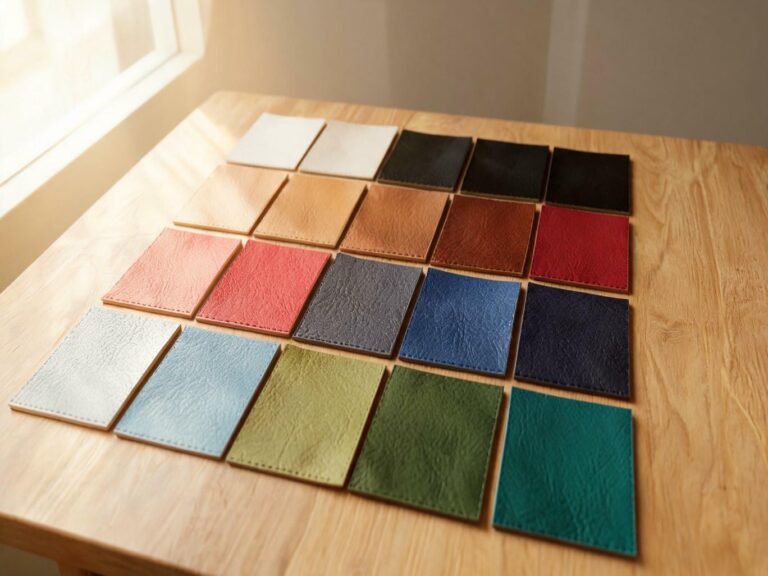
Red leather samples — color stability varies dramatically depending on dye type, finish, and base material
Three factors accelerate red fading even further:
- UV radiation through glass. Window glass blocks most UVB but lets most UVA through. In automotive interiors and furniture near windows, UVA exposure is the #1 cause of red leather fading.
- Heat. High temperatures increase the rate of chemical reactions, including dye degradation. A car interior in direct sun can reach 70°C+ — the heat alone accelerates fading even without additional UV.
- Body oils and sweat. Skin oils, sweat, and personal care products can react with dye molecules at the leather surface, causing localized color change on contact areas like headrests, armrests, and seat bolsters.
By the numbers: Independent testing shows red leather can experience a color shift of Delta E > 3.5 after just 12–22 months of regular use in sunny climates — well before the typical 36-month warranty period. Black leather under the same conditions shows Delta E < 1.0, which is invisible to the untrained eye.
Red Leather Finish Types: Which Holds Color Best
The biggest factor in how well red leather holds its color isn’t the hide quality — it’s the type of finish. Different finishes use different dye technologies and have very different light fastness. Here’s how the main types compare:
| Finish Type | How Color Is Applied | Light Fastness (Red) | Look & Feel | Best For |
|---|---|---|---|---|
| Aniline (Full-Grain) | Dye penetrates hide fibers; natural grain visible | Poor — Grade 2–3 | Natural, rich, develops patina | Low-light luxury, fashion accessories |
| Semi-Aniline | Dye + thin pigment topcoat; grain visible | Fair — Grade 3–4 | Balanced natural look with protection | Residential furniture, premium auto |
| Pigmented / Corrected-Grain | Pigment film on surface; grain embossed | Good — Grade 4–5 | Uniform color, less natural feel | High-traffic commercial, auto base trim |
| Silicone Leather (Synthetic) | Color mixed into silicone polymer coating | Excellent — Grade 4–5+ (1,000+ hrs) | Supple, premium hand, consistent | High-traffic, outdoor, sunny locations |
Light fastness grades per ISO 105-B02 / B06 standards. Grade 5 = no fading, Grade 1 = severe fading.
The key tradeoff with genuine red leather is between natural beauty and color stability. Aniline red leather looks incredible when new — deep, rich, with natural grain variation. But it fades fast. Pigmented red leather holds color much better, but the surface coating masks the natural grain and feels less like “real leather” to purists.
Silicone leather solves this tradeoff. Because the red pigment is mixed directly into the silicone polymer matrix rather than sitting on the surface or penetrating fibers, the color is part of the material structure itself. Silicone’s molecular structure is also inherently UV-stable — the silicon-oxygen backbone doesn’t break down under UV exposure the way organic dye molecules do. The result: red silicone leather maintains Delta E ≤ 1.0 color shift after 1,000+ hours of accelerated UV testing, compared to Delta E > 3.5 for aniline red genuine leather under the same conditions.

Color fastness testing machine — measuring how well red pigments hold up under accelerated UV and light exposure
Red Leather in Interior Design: Making the Statement Work
Red leather is having a major moment in 2026 interior design. After years of neutral grays and beiges dominating furniture trends, designers and homeowners are embracing bold color again — and red leather is one of the most popular ways to add drama and warmth to a space.
The key to making red leather furniture feel sophisticated rather than overwhelming is to treat it as a statement piece, not a room-filler. Here’s how designers are using red leather in 2026:
- Single statement piece. One red leather sofa in an otherwise neutral room (white walls, grey rug, natural wood) creates a focal point without overwhelming the space. Burgundy and oxblood are the most popular red shades for this approach — deep enough to feel sophisticated, bright enough to make an impact.
- Accent chairs in pairs. Two matching red leather accent chairs flanking a fireplace or reading nook add symmetry and color. This is a lower-risk way to incorporate red than a full sofa — you can reupholster or move the chairs if you tire of the color.

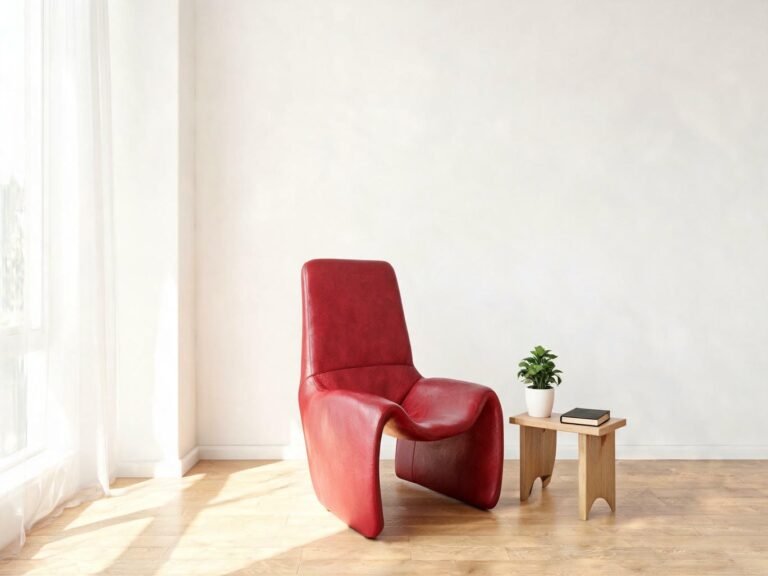
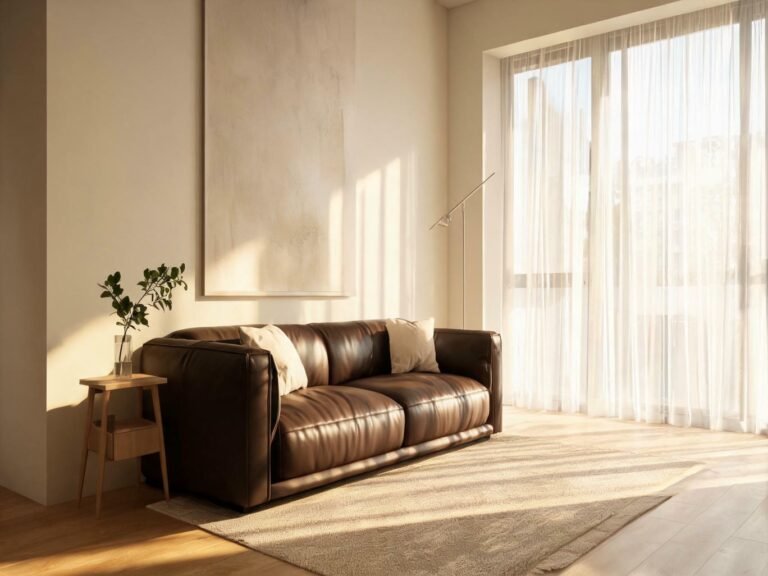
Statement leather furniture — a bold red sofa or accent chair anchors a room and adds personality to neutral interiors
- Tone-on-tone layering. Using different shades of red and warm neutrals in the same space — a terracotta rug, brick-red walls, burgundy leather sofa — creates a rich, layered look that feels intentional and curated rather than “matchy.”
- Contrast with cool metals. Red leather paired with black or gunmetal metal legs, lighting fixtures, and hardware creates a sophisticated modern-contemporary look. The cool metal tones balance the warm red, preventing the space from feeling too heavy.
Explore different surface finishes and textures — including deep red and burgundy tones for furniture and automotive interiors
The Specifier’s Checklist for Fade-Resistant Red Leather
If you’re specifying red leather for a commercial project, hospitality program, or furniture line, don’t rely on a sample swatch and a promise. Verify these things with actual test data:

Quality control verification — always confirm color fastness and batch consistency with test data before specifying red leather
- Light fastness rating (ISO 105-B02 or B06). For indoor furniture near windows, require at least Grade 4. For automotive interiors or outdoor use, require Grade 4–5 with 500+ hours of xenon arc testing. Anything below Grade 3 will show visible fading within 1–2 years in sunny locations.
- Finish type and dye technology. Ask specifically what type of finish it is (aniline, semi-aniline, pigmented) and what dye chemistry is used. Metal-complex dyes generally offer better light fastness than azo dyes for red shades.
- Batch-to-batch color consistency. Red is one of the hardest colors to match consistently across production runs. Require Delta E ≤ 1.0 batch-to-batch consistency for large projects where pieces need to match.
- Warranty on color. A 5-year color warranty tells you the manufacturer stands behind their color fastness claims. A 1-year warranty — or no color warranty at all — should raise red flags (pun intended).
- Maintenance requirements. Some red leathers require specific conditioners or UV protectants to maintain color. If your client won’t do regular maintenance, choose a more color-stable material rather than relying on a care routine that won’t happen.
- Consider silicone leather for high-UV locations. If the furniture will be in direct sun, near large windows, in a car interior, or outdoors, red silicone leather with 1,000+ hours UV resistance will maintain its color far better than any genuine red leather — and it’s more stain-resistant and easier to clean, too.
Frequently Asked Questions
Can faded red leather be restored?
Partially, but it depends on the finish type. Pigmented red leather can often be re-colored or touched up with leather dye kits, though it won’t look exactly like new. Aniline and semi-aniline red leather are harder to restore because the dye is in the fiber, not on the surface — once the dye molecules break down, you can’t fully reverse it. The best approach is prevention: choose a color-stable finish from the start, use UV-protective treatments, and keep leather out of direct sun when possible.
What shade of red leather is most colorfast?
Darker reds like burgundy, oxblood, and cherry generally hold color better than bright, vivid reds like scarlet or fire-engine red. The darker the shade, the more pigment is in the dye formula, and the longer it takes for fading to become visible. That said, the finish type matters more than the specific shade — a pigmented bright red will outlast aniline burgundy in direct sun. For maximum color retention in any red shade, look for pigmented finishes or silicone leather with UV-stable pigments.
Red Leather Is Worth It — If You Spec It Right
Red leather’s tendency to fade faster than other colors isn’t a flaw in the material — it’s a fundamental property of how red dye molecules interact with light. But that doesn’t mean you can’t have red leather that stays red for years. It means you need to choose the right finish, the right shade, and the right material for the specific conditions your furniture or product will face.
For low-light residential settings where you want that natural aniline look, embrace the patina — red leather that ages beautifully can be a feature, not a bug. For high-traffic commercial spaces, sunny locations, or applications where color consistency matters, go with pigmented finishes or silicone leather. And for automotive, outdoor, and extreme-UV applications, silicone leather’s 1,000+ hours of UV resistance makes it the clear choice for keeping red looking red.
We offer custom red color matching from Pantone and RAL in silicone leather, with Delta E ≤ 1.0 batch-to-batch consistency and verified 1,000+ hour UV resistance. Request free samples and see for yourself how vibrant, supple, and color-stable red silicone leather can be.
About TOPSUN
TOPSUN produces color-stable red silicone leather for furniture, automotive interiors, and fashion accessories — engineered to maintain vibrant red shades for 10+ years with minimal fading even under high UV exposure.
Pantone and RAL color matching with Delta E ≤ 1.0, 1,000+ hours UV resistance verified, 100+ texture options, ISO 10993 biocompatible, REACH compliant, custom OEM development available.