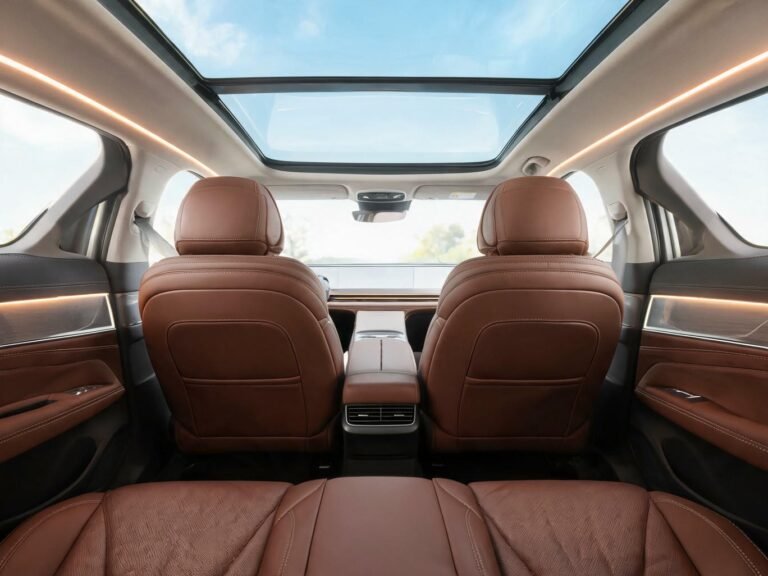
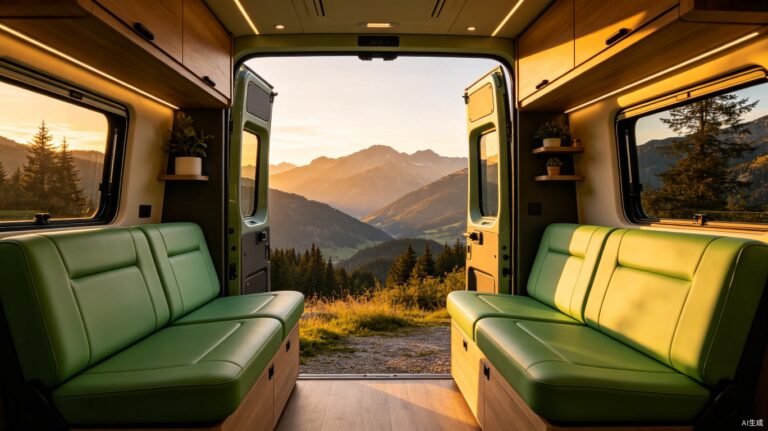
A camper van builder in Colorado called us after their entire 40-unit fleet came back with peeling seat covers — all within 28 months of delivery. The main panels looked fine. The camper interior leather on the dinette cushions, door panels, and bunk surrounds had turned sticky, then brittle, then flaked off in sheets. They had specified “premium PU leather” at $4.80/m², and that $4.80 decision cost them $120,000 in replacement materials and labor. The failure wasn’t a fluke. It was chemistry. Here’s what happens to each leather type inside a camper — and why silicone leather is the only material that survives the environment long-term.
Request Camper Leather Samples
Why Camper Interiors Destroy Traditional Leather
A camper interior is not a living room on wheels. It’s a sealed box that cycles through conditions no furniture ever experiences. Park a Class B van in Phoenix in July, and the cabin temperature hits 71°C (160°F). Drive it to Yellowstone that night, and the interior drops to 4°C (39°F). That thermal shock cycle repeats 200+ times per year across a typical camping season. Every material in that cabin is subjected to sustained heat, condensation, UV radiation through large windows, and continuous road vibration that grinds upholstery against frame surfaces.
Traditional leather materials fail because they were never engineered for this environment. PU leather contains ester-based polyurethane chains that hydrolyze in humid conditions — the bond between coating and backing literally dissolves. Genuine animal hide absorbs moisture, breeds mold in poorly ventilated cabins, and requires conditioning treatments that don’t survive UV exposure. PVC cracks when plasticizers migrate out under sustained heat. For B2B buyers evaluating RV upholstery material options, understanding these failure mechanisms is the difference between a 3-year warranty claim and a 10-year service life.

Color fastness testing — simulating 2,000+ hours of UV exposure through camper windows
The PU Leather Failure Timeline in Camper Vans
PU leather is the default material in factory camper upholstery because it costs $3–$6/m², looks convincing on a showroom floor, and passes basic QC. It also has a predictable failure timeline that most buyers never see until it’s too late.
Months 0–12: The PU surface looks and feels premium. No visible degradation. Buyers sign off on the spec. The hydrolysis process has already begun at the molecular level — moisture from condensation and ambient humidity is attacking the ester bonds in the polyurethane coating. This is invisible because the topcoat masks the underlying degradation.
Months 12–24: The surface begins to feel tacky in hot weather. Small cracks appear along seam lines and high-contact zones like seat edges and armrests. UV exposure has broken down the colorfast topcoat, and the plasticizers that keep the material flexible are migrating outward. In humid climates — coastal routes, Pacific Northwest winters — this phase arrives 4–6 months earlier. For more on PU leather’s hidden failure patterns, the degradation chemistry is the same whether it’s in a camper or a sofa — but the camper environment accelerates it dramatically.
Months 24–36: Full delamination. The polyurethane coating separates from the fabric backing in sheets. The surface is sticky, cracked, and visually destroyed. Replacement is the only option. This is the exact failure pattern that the Colorado builder experienced — and it’s why camper interior leather replacement has become a secondary market of its own, with specialized upholsterers charging $2,500–$8,000 per van to strip and re-cover failed PU interiors.
Field data point: In a survey of 120 camper van owners with factory PU leather interiors, 78% reported visible peeling or cracking within 36 months. In desert and high-altitude climates with extreme temperature swings, that window shortened to 22 months.
Genuine Leather in Campers: A High-Maintenance Trap
Some premium camper builders specify genuine top-grain leather, assuming natural material means durable material. In a climate-controlled living room, that logic holds. In a camper, it backfires. Genuine leather is porous — it absorbs moisture from humid air and releases it in dry conditions. Inside a sealed camper parked in a damp environment, that moisture absorption creates ideal conditions for mold and mildew growth within the hide itself. Unlike surface mold, which can be wiped away, mold inside the leather fiber structure causes permanent staining and structural degradation.
The maintenance burden is equally punishing. Genuine leather requires conditioning every 3–6 months to prevent drying and cracking — but conditioners don’t survive UV exposure through large camper windows. The product oxidizes, leaving a sticky residue that attracts dust and accelerates surface degradation. For builders evaluating faux leather vs real leather for camper applications, genuine leather’s 8–12 year lifespan in a living room shrinks to 4–6 years in a camper, with higher maintenance cost throughout.

Motorhome interior — where material selection determines whether upholstery lasts 3 years or 10+
Why Silicone Leather Survives the Camper Environment
Silicone leather solves every failure mechanism that destroys PU and genuine leather in camper interiors. The difference is molecular. Silicone polymers are built on a silicon-oxygen backbone (Si-O) rather than the carbon-carbon bonds of polyurethane. The Si-O bond is inherently resistant to hydrolysis — it does not react with water or moisture, which means condensation, humidity, and direct water exposure have zero degradative effect. In accelerated humidity testing at 85°C and 85% RH, silicone leather shows no visible change after 1,000+ hours. PU leather begins surface breakdown at 300 hours under the same conditions.
Temperature stability eliminates the thermal cycling problem entirely. Silicone leather remains flexible from -40°C to 250°C — no cold-crack failure in winter, no heat-induced softening or tackiness in summer. The material that goes on the production line stays in the same physical state whether the camper is parked in Death Valley or stored in a Minnesota winter. This is why silicone leather for camper vans has become the go-to specification for premium European van converters like those supplying the VW California and Mercedes Sprinter conversion markets.

Flexibility bending test — simulating 100,000+ flex cycles from road vibration and daily use
UV resistance is built into the silicone molecular structure, not applied as a topcoat. Under ASTM G154 accelerated weathering — the standard test that simulates years of sunlight exposure — silicone leather shows no cracking, peeling, or color shift (ΔE < 1.0) after 2,000+ hours. PU leather typically shows visible fading and surface cracking at 500–800 hours. For camper interiors where large windows expose every surface to direct sunlight for hours daily, this gap is the difference between an interior that looks new after 5 years and one that needs replacement after 2. The heat-resistant properties of silicone leather also prevent the surface temperatures that make PU leather unbearable to touch in a sun-baked cabin.
| Property | Silicone Leather | PU Leather | Genuine Leather |
|---|---|---|---|
| Service life in camper | 10+ years | 2–3 years | 4–6 years |
| Hydrolysis resistance | Immune (Si-O bond) | Fails at 300 hrs | Absorbs moisture |
| UV resistance (ASTM G154) | 2,000+ hrs, no change | 500–800 hrs, cracking | Fades, requires conditioner |
| Temperature range | -40°C to 250°C | Cracks below -10°C | Stiffens in cold |
| Mold resistance | Non-porous, immune | Moderate | High susceptibility |
| Maintenance required | Wipe clean | Wipe clean (until failure) | Condition every 3–6 months |
| Cost per m² (bulk) | $12–$18 | $3–$6 | $20–$35 |
Specifying Camper Interior Leather for B2B Production
For procurement teams sourcing camper interior leather for van conversion or motorhome production, the specification sheet should prioritize three properties above all others: Martindale abrasion resistance (≥200,000 cycles for high-contact dinette and seat surfaces), UV stability (demand ASTM G154 data showing ΔE < 2.0 after 2,000 hours), and hydrolysis resistance (request accelerated humidity testing data at 85°C/85% RH). These three specs filter out every material that will fail prematurely in the field.
Fire safety compliance is non-negotiable for camper interiors. RVIA standards require FMVSS 302 compliance for all interior materials — and in the EU market, the ECE R118 standard applies. Silicone leather inherently meets both standards without additional flame-retardant treatments, while PU and PVC often require chemical additives that can off-gas VOCs into the enclosed cabin. For marine and outdoor applications where similar environmental challenges exist, these same specifications apply — the camper interior is closer to a boat cabin than a living room.

Fire retardant testing — verifying FMVSS 302 compliance for camper interior safety standards

Heat-resistant silicone leather in automotive interiors — the same technology applied to camper cabins
Weight matters too. A typical Class B camper van has 12–18m² of interior surface area requiring upholstery. At 600 g/m², silicone leather adds 7.2–10.8 kg total — comparable to PU (550 g/m²) and significantly lighter than genuine leather (900–1,200 g/m²). In a vehicle where every kilogram affects payload capacity and fuel efficiency, this weight advantage compounds across production runs. For teams needing the best leather for camper van upholstery that balances durability, weight, and cost over a 10-year service horizon, silicone leather is the only material that meets all three criteria without compromise.
About TOPSUN: Silicone Leather Engineered for the Road
TOPSUN manufactures silicone-coated leather for B2B clients across automotive, RV, marine, and furniture industries. Our silicone leather is produced in a vertically integrated facility with in-line quality testing on every batch — Martindale abrasion, color fastness, hydrolysis resistance, and flame retardancy are verified before material leaves the factory. We supply camper van converters and motorhome manufacturers in Europe, North America, and Australia with custom colors, textures, and thicknesses (0.8–2.0 mm) tailored to interior design specifications. Every order ships with full lab documentation including ASTM G154 UV aging data, FMVSS 302 fire safety certification, and ISO 16000-6 VOC test results. For a material that will spend the next decade inside a moving vehicle, we don’t leave compliance to assumption.
Frequently Asked Questions
Can I use regular automotive leather for camper interiors?
Regular automotive leather is engineered for passenger cars with climate control systems, not for campers that experience extreme temperature swings and prolonged UV exposure when parked. Automotive PU leather typically lasts 4–6 years in a car cabin but fails in 2–3 years in a camper environment due to greater UV exposure, humidity cycles, and the absence of active climate control during storage.
How much does silicone camper interior leather cost compared to PU?
Silicone leather costs $12–$18/m² versus PU at $3–$6/m² — roughly 3x higher upfront. But when you calculate total cost of ownership over a 10-year period (including one full PU replacement at year 3, plus labor), silicone saves 40–55% and eliminates warranty claims. For a typical 15m² camper interior, the lifetime savings range from $3,000–$6,000 per unit.
Is silicone leather safe for enclosed camper cabins?
Yes. Silicone leather emits zero VOCs (verified under ISO 16000-6), contains no plasticizers or phthalates, and is non-toxic even when heated. Unlike PVC and some PU materials that off-gas into enclosed spaces, silicone is chemically inert — which is why it’s also used in medical and food-grade applications. In a sealed camper cabin with limited ventilation, this zero-emission profile is a health advantage, not just a compliance checkbox.
What thickness should I specify for camper interior leather?
For high-contact surfaces like dinette cushions and seat backs, specify 1.2–1.5 mm for optimal abrasion resistance. For wall panels, headliners, and door surrounds where contact is lighter, 0.8–1.0 mm provides sufficient durability while reducing weight and improving drapability over curved surfaces. Request samples in both thickness ranges to evaluate hand-feel before committing to a production spec.
Choosing the right camper interior leather is not about finding the cheapest material that passes inspection — it’s about specifying a material that will still look and perform as intended after years of road vibration, thermal cycling, UV bombardment, and humidity exposure. PU leather fails at 3 years. Genuine leather fights a losing battle against moisture and maintenance demands. Silicone leather is engineered to survive the environment that destroys both. Request production samples, run your own UV and humidity testing, and specify the results in your purchase order. The material you choose today determines whether your next warranty claim comes in month 28 or year 10.