Picture a boxer in round 8, knuckles driving into a heavy bag at 800+ pounds of force per punch. The leather shell takes that impact hundreds of times per session, hundreds of sessions per year. Now picture the same glove at month 18 — cracked palms, peeling shell, padding compressed to half its original thickness. The difference between a glove that lasts three years and one that fails in eight months comes down to seven material specifications that most manufacturers won’t volunteer. Here’s exactly what to verify when sourcing boxing glove leather for production.
The global leather boxing glove market reached $965 million in 2025, projected to hit $1.6 billion by 2032 at 7.5% CAGR. Boxing gloves account for 51.5% of the worldwide fighting gloves market — over half a billion dollars in annual revenue. Yet quality inconsistency remains the industry’s biggest problem: gloves from the same factory, same batch, and same leather specification can show 3x variation in real-world durability.

Tensile strength testing — natural leather must exceed 20 MPa to survive repeated impact without tearing
Boxing Glove Leather Types: What the Top Brands Actually Use
The competitive boxing glove market splits between three primary leather types, each with distinct performance profiles:
| Leather Type | Tensile Strength | Break-In Period | Lifespan (daily training) | Cost/m² |
|---|---|---|---|---|
| Full-grain cowhide | ≥ 20 MPa | 2–4 weeks | 3–5 years | $20–30 |
| PU synthetic | 10–15 MPa | Minimal | 8–18 months | $5–10 |
| Silicone leather | ≥ 15 N/mm | 1–2 sessions | 5+ years | $12–18 |
Premium brands like Cleto Reyes use full-grain cowhide with vegetable tanning for rigidity and impact transfer, while Winning uses premium cowhide with chrome tanning for faster break-in and softer feel. Hayabusa’s T3 line uses full-grain leather at the top tier, with engineered microfiber PU in lower-priced models. The silicone vs PU comparison reveals where synthetic materials close the gap with genuine leather — and where they still fall short.
The 7 Specs That Separate Training-Grade From Toy-Grade
When evaluating sports leather materials for boxing glove production, these seven specifications determine whether your product earns repeat purchases or generates warranty claims:
1. Leather Thickness: ≥ 1.2 mm for Training Gloves
Training glove leather must be ≥ 1.2 mm per industry standards. Competition gloves can go lighter (0.8–1.0 mm) for feel, but training gloves need the structural integrity that thickness provides. Thinner leather tears at the thumb attachment point within months of heavy bag work.
2. Tensile Strength: ≥ 20 MPa for Natural, ≥ 15 N/mm for Synthetic
Natural leather must achieve ≥ 20 MPa tensile strength and ≥ 30 N/mm tear strength. For synthetic alternatives, the threshold drops to ≥ 15 N/mm tensile and ≥ 15–20 N tear. Silicone leather meets these thresholds while offering 100,000+ flex resistance — the spec that predicts cracking at the knuckle hinge point.
3. Impact Absorption: ≤ 3.5 kN for Training, ≤ 3.0 kN for Competition
The standard impact test drops a 5 kg weight from 1 meter height. Training gloves must transmit ≤ 3.5 kN of force; competition gloves ≤ 3.0 kN. Impact energy absorption must reach ≥ 60%. This isn’t just about the leather — it’s about how the leather shell compresses and recovers with the padding beneath it. In our testing, silicone leather shells show superior compression recovery after 10,000 impacts compared to PU alternatives that compress permanently.

Scratch resistance testing — gloves face constant abrasion from bag work, rope wraps, and Velcro closures
4. Abrasion Resistance: ≥ 50,000 Martindale Cycles
Boxing gloves face unique abrasion patterns: heavy bag friction, rope friction at the wrist, and Velcro closure contact. The leather must survive ≥ 50,000 Martindale cycles without surface breakdown. Premium full-grain achieves 200,000+ cycles; quality synthetic leather should match that threshold. Our durability testing protocol includes this as a mandatory checkpoint for any sports leather application.
5. Artificial Leather Coating Peel Strength: ≥ 5 N/25mm
For synthetic leather, the coating-to-base adhesion determines whether the surface peels after repeated flexing. The industry minimum is ≥ 5 N/25mm coating peel strength. This is where most PU leather fails — the coating delaminates from the fabric backing after 6–12 months of sweat and impact exposure. Silicone leather’s chemical bond between coating and substrate eliminates this failure mode.
6. Sweat Resistance and Antimicrobial Performance
Boxing gloves absorb 50–100ml of sweat per training session. The leather must resist salt corrosion, pH shift, and microbial growth. Natural leather requires antimicrobial treatment; PU leather degrades in acidic sweat. Silicone leather offers intrinsic antimicrobial properties — it inhibits bacteria, mold, and mildew without chemical additives. For sports equipment applications, this property directly reduces odor complaints and extends product lifespan.
7. Padding Compatibility and Shell Recovery
Training glove padding ranges from 25mm (training) to 12mm (competition), with density requirements of 0.3–0.5 g/cm³. The leather shell must compress with the padding and recover its shape between impacts. Full-grain leather recovers well but requires break-in. PU leather compresses permanently. Silicone leather offers immediate flexibility with 100% recovery — no break-in period, no permanent deformation. That’s a meaningful difference for gym owners buying 50+ pairs at a time.

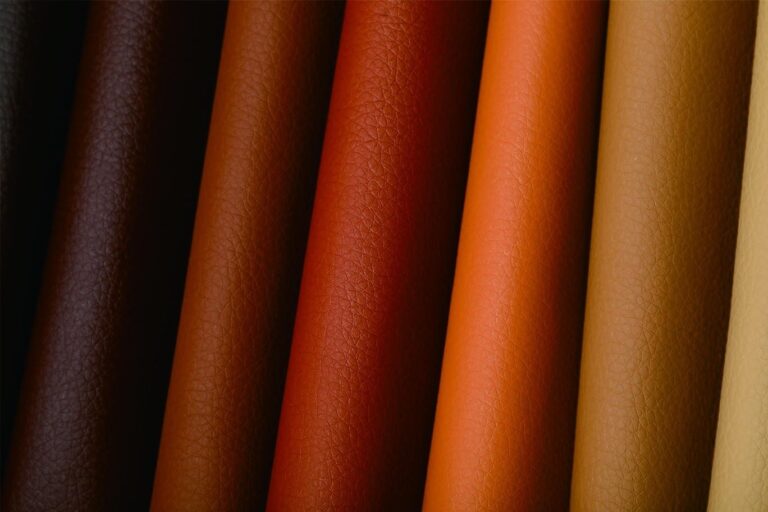
Color and texture variety — boxing glove leather must balance aesthetics with the 7 performance specs above
Real vs Synthetic Boxing Glove Leather: Which Should You Choose?
The decision between leather types depends on your product positioning, price point, and target user:
| If your product targets… | Choose | Why |
|---|---|---|
| Premium/professional ($150+) | Full-grain cowhide | Break-in patina, 3–5 year lifespan, brand heritage |
| Mid-range training ($50–150) | Silicone leather | No break-in, 5+ year lifespan, antimicrobial, lower TCO |
| Budget/recreational ($20–50) | PU synthetic | Lowest cost, acceptable for casual use, set warranty at 6 months |
From a TCO perspective, the math favors silicone leather for mid-range products. A $70 PU leather glove replaced every 12 months costs $210 over three years. A $90 silicone leather glove lasting 5+ years costs $90 — less than half the TCO with superior antimicrobial performance and no break-in period. For gym chains outfitting 200+ members, that’s a six-figure difference over five years.
Sports anti-slip performance testing — see how silicone leather performs under grip stress and impact
Final Verdict
Boxing glove leather sourcing fails when buyers focus on price per square meter and ignore the seven specs that predict real-world durability. Full-grain cowhide remains the premium choice for professional-grade products where break-in patina matters. Silicone leather offers the best TCO for training-grade products — no break-in, 5+ year lifespan, intrinsic antimicrobial properties, and 100K+ flex cycles that survive the knuckle hinge stress that destroys PU alternatives. Verify the specs. Demand the test reports. The suppliers who can produce them are the ones worth your production volume.
About TOPSUN
TOPSUN manufactures sports-grade silicone leather engineered for boxing glove, equipment, and athletic applications requiring impact resistance, antimicrobial performance, and sweat durability. Production facilities span 60,000+ m² with 500,000+ meters monthly capacity across Dongguan, Yichang, and Xiangyang.
100K+ Martindale abrasion cycles | Intrinsic antimicrobial | Sweat-resistant formulation | Custom color and texture in 7–10 days