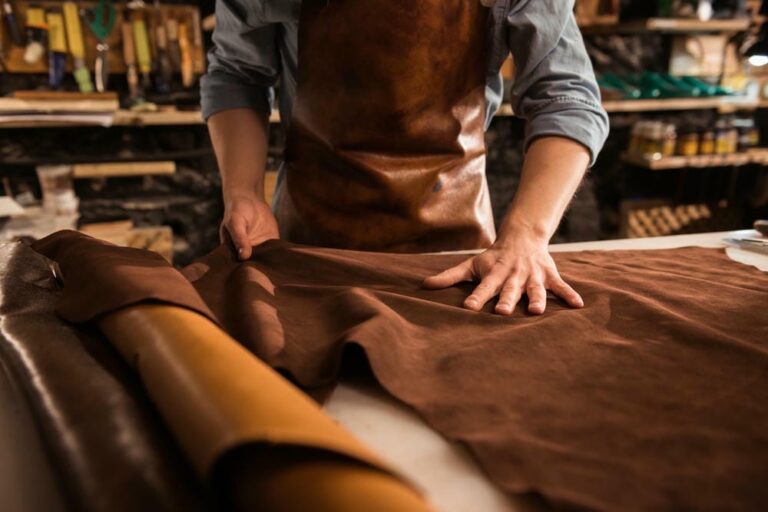
Jaguar Land Rover made headlines when it piloted blockchain leather traceability with Circulor — tracking every hide from source to finished vehicle interior. The project proved that a fully transparent leather supply chain is technically possible. But the bigger story is what it revealed about the inadequacy of the paper-based documentation systems that most leather suppliers still rely on.
For B2B brands facing growing regulatory pressure — the EU Deforestation Regulation, REACH compliance audits, and consumer demands for ethical sourcing — the gap between “we have certificates” and “we can prove every step” is widening fast. Paper documentation can be lost, forged, or simply not match what was actually shipped. Blockchain leather traceability closes that gap by making every transaction in the supply chain immutable and verifiable.
Here’s how the two approaches compare — and why brands selling into regulated markets are quietly building digital traceability into their supplier requirements.
Request Our Traceability Documentation

Production process flow chart — each step in the supply chain represents a traceable data point
Why Leather Supply Chain Traceability Matters in 2026
The leather supply chain is one of the most complex in manufacturing. A single finished leather product can pass through 5–8 separate entities: ranch, slaughterhouse, tannery, finishing facility, distributor, manufacturer, and brand. Each handoff is a point where information can be lost, altered, or omitted — either intentionally or through administrative error.
For genuine leather, this complexity is inherent. For synthetic leather — including silicone leather — the supply chain is dramatically shorter: raw silicone polymer, fabric backing, coating facility, and finished goods. Fewer steps mean fewer data points to track, but the same transparency principles apply.
Three forces are driving the demand for leather traceability right now:
- EU Deforestation Regulation (EUDR): Requires companies to prove leather sourcing doesn’t contribute to deforestation — documentation that paper systems struggle to provide at scale.
- Consumer trust: 73% of consumers say they’d change consumption habits to reduce environmental impact, but only if they can verify brand claims. Paper certificates don’t satisfy this audience.
- ESG reporting requirements: Investors and regulators now demand verifiable data on material sourcing, carbon footprint, and social compliance across the supply chain.
For more on responsible sourcing practices, see our guide to B2B leather platform compliance.
Paper Documentation vs Blockchain: The Real Gap
Most leather suppliers today provide compliance documentation as PDF certificates — material safety data sheets, REACH compliance letters, test reports from third-party labs. These documents are necessary, but they have structural weaknesses that blockchain leather traceability addresses:
| Factor | Paper / PDF System | Blockchain Traceability |
|---|---|---|
| Data integrity | Can be altered or forged | Immutable — cryptographically sealed |
| Chain of custody | Discontinuous — gaps between handoffs | Continuous — every transfer recorded |
| Audit time | 2–6 weeks per supplier | Minutes — query the chain |
| Deforestation risk | Self-declared — unverifiable | Satellite + geo-data verified |
| Consumer transparency | Inaccessible to end users | QR code → full product history |
| Compliance cost | High — manual verification labor | 60% lower — automated verification |
The compliance cost reduction is the most immediately compelling argument for B2B brands. Jaguar Land Rover’s pilot with Circulor demonstrated that digital traceability could reduce audit labor by 50–70% compared to manual certificate verification — a significant saving for brands managing dozens of suppliers across multiple product lines.

Modern production facility — every batch is traceable from raw material to finished goods
How Blockchain Leather Traceability Actually Works
The technology stack for leather supply chain traceability typically combines several tools:
- NFC tags or QR codes attached to each batch of leather material — scanned at every transfer point to create a digital record.
- Smart contracts on a blockchain (Ethereum, Cardano, or enterprise chains) that automatically record each scan as an immutable transaction — meaning no party can alter or delete the record after it’s created.
- IPFS (InterPlanetary File System) for storing test certificates and compliance documents — the document hash is recorded on-chain, so if the certificate is changed, the hash won’t match.
- Satellite imagery and geo-data for verifying raw material sourcing against deforestation cut-off dates — automated risk screening before materials enter the supply chain.
For synthetic leather — where the supply chain is shorter — blockchain traceability is even more straightforward. A silicone leather manufacturer like TOPSUN can record: raw silicone polymer source, fabric backing origin, coating batch number, test results, and shipping destination — all in a single chain of custody that’s verifiable by any brand or auditor. For more on our factory production and quality control processes, the documentation is already structured for digital traceability.
Export certification and compliance documentation — structured for digital traceability verification

Quality inspection process — each batch’s compliance data can be anchored to a blockchain record
The Shorter Synthetic Supply Chain Advantage
One of the most overlooked advantages of synthetic leather — including silicone leather — is that its supply chain is inherently simpler and more traceable than genuine leather. Genuine leather passes through ranches, slaughterhouses, tanneries, and finishing facilities — each with its own documentation gaps and compliance risks.
A silicone leather supply chain has three primary stages: polymer supplier, fabric backing supplier, and coating/finishing facility. That’s 3 data points instead of 8 — making blockchain leather traceability dramatically easier to implement and audit. For brands that need to demonstrate supply chain transparency to regulators, investors, or consumers, this shorter chain is a structural advantage.
Additionally, silicone leather’s eco-friendly profile — zero VOC, solvent-free dry coating process, PVC-free, recyclable — means the compliance documentation that gets recorded on-chain is consistently clean. There are no restricted substances to track, no tanning chemicals to disclose, and no animal welfare questions to answer.
Frequently Asked Questions
Can blockchain traceability work for synthetic leather?
Yes — and it’s actually easier to implement for synthetic leather than for genuine leather. The supply chain is shorter (fewer intermediaries), the materials are more consistent (no natural variation), and the compliance documentation is already structured as test reports and certificates. Recording these on a blockchain creates a tamper-proof audit trail that brands can share with regulators and consumers.
Does blockchain traceability add cost to leather material?
The per-unit cost of blockchain traceability is minimal — NFC tags cost $0.05–0.15 each, and blockchain transaction fees are negligible. The real cost saving comes from reduced audit labor: automated verification of compliance documentation replaces 50–70% of manual certificate checking, which typically costs $15–25 per supplier per audit. For brands with 50+ suppliers, the ROI is immediate.
The Future of Leather Sourcing Is Verifiable
Blockchain leather traceability isn’t a hype buzzword — it’s becoming a procurement requirement. Jaguar Land Rover, Latin America’s largest fashion group, and leading Italian leather manufacturers are already implementing it. For B2B brands, the question isn’t whether to adopt digital traceability, but when — and whether their current suppliers can support it.
The brands that move first will have a transparency advantage that’s difficult to copy. Shorter synthetic supply chains — especially silicone leather — make this transition faster, cheaper, and more reliable. If your supplier can’t provide digital chain-of-custody documentation today, they won’t be ready when your customers — or regulators — start asking for it tomorrow.
Request Supply Chain Documentation
About TOPSUN
TOPSUN operates a transparent, short-chain silicone leather supply chain with full batch-level traceability, structured compliance documentation, and third-party-verified test reports ready for digital integration.
Full REACH & RoHS documentation | ISO-standard test reports | Batch-level traceability | Zero VOC verified | FDA food-contact compliant | Free A4 swatches