Eighteen to thirty months. That is the service life of standard artificial PU material in a humid climate, according to footwear industry field data. The same polymer can last five to ten years in a dry one. The difference is not luck, thickness, or price tier. It is chemistry, and most product pages never name it.
I have spent twelve years formulating polymer coatings for upholstery and footwear brands. Give me a spec sheet without the chemistry, and I can only guess at lifespan. Give me the polyol type, and I can predict it. This guide explains the three formulations behind one name, where each one fails, and what to ask before you buy.
What Artificial PU Material Actually Is
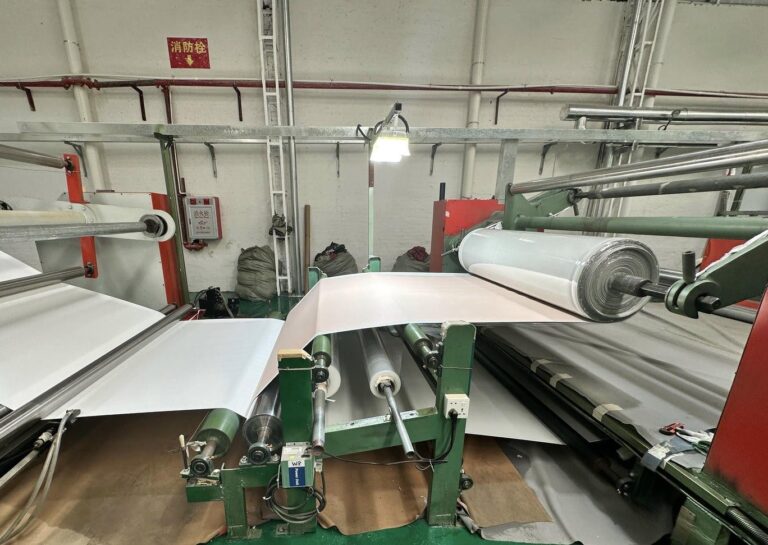
Artificial PU material is a polyurethane coating bonded to a fabric base, usually polyester, cotton, or a non-woven blend. The polymer layer supplies the leather-like surface: color, grain, and hand feel. The fabric supplies tensile strength and tear resistance. In production, liquid PU resin is spread onto the base by knife or transfer coater, then cured into a flexible film. Coating thickness runs 0.1 to 0.4 mm on a substrate of 0.4 to 0.8 mm. Embossing at 150-180°C presses in the grain, and a top coat seals the surface.
That construction is why PU feels closer to hide than PVC does. The polymer is soft and elastic in its own right, without plasticizers. It also means quality is decided twice: once by the resin formulation, and once by the coating process. Two rolls with identical embossing can differ by years in service life.

Every roll starts as a formulation decision: the resin drums hold the chemistry that sets the lifespan.
The Three Chemistries Behind One Name
Here is the fact that reshapes sourcing conversations. PU coatings are built on three polyol chemistries: polyester, polyether, and polycarbonate. They sit in ascending order of hydrolysis resistance and cost. Almost everything sold as artificial PU material uses the cheapest and shortest-lived of the three. The spec sheet rarely tells you which one you are getting.
Polyester PU is the volume grade. It bonds dyes well and feels pleasantly dry, but its ester links are water-sensitive. In a published aging study, a commercial polyester polyurethane lost roughly twenty times its average molecular weight after two months of high-humidity exposure. Polyether PU swaps in ether links, which shrug off water far better and suit humid interiors. Polycarbonate PU is the premium tier, resisting both water and heat, and it commands the highest price.
| Chemistry | Water sensitivity | Relative cost | Typical role |
|---|---|---|---|
| Polyester PU | High | $ | Volume furniture, bags, shoe uppers |
| Polyether PU | Moderate | $$ | Humid-climate interiors, boats, gyms |
| Polycarbonate PU | Low | $$$ | Premium seating, healthcare, high-flex parts |
One caution for buyers: chemistry names rarely appear on finished-goods labels. They live in the resin supplier’s technical datasheet, one step upstream. Ask your coating supplier for the datasheet reference, not just the marketing grade name. In twelve years of audits, the suppliers who sent datasheets within a day were consistently the ones whose rolls tested as specified.
Dry Process vs Wet Process
Chemistry is half of the story; the production route is the other half. Dry processing casts PU resin onto release paper, then laminates the film onto the fabric. It yields a denser, more durable coating and costs more per square foot. Wet processing coagulates solvent-based resin in a water bath, producing a softer, more breathable structure at a lower price.
Industry benchmarks put dry-process PU at roughly $1.80-3.00 per square foot against $1.20-2.20 for wet process. Buyers should match the route to the end use. Dry process suits abrasion-heavy seats and luggage. Wet process suits programs where drape and softness lead. There is also a regulatory push toward water-based PU, driven by solvent rules in Europe, which removes DMF from the equation entirely.
Where the coating meets the base: bond quality decides whether the surface stays on for years or lifts in months.
The 2026 Shift Toward Water-Based PU
The solvent question is reshaping the supply base. Wet processing historically used DMF, a solvent now restricted under EU REACH regulations. Water-based PU systems eliminate it, and adoption has accelerated through 2026. For buyers, the change lands in two places: compliance paperwork gets simpler, and suppliers able to offer water-based grades signal real formulation capability.
Ask every shortlisted supplier how they handle the solvent question. Some run water-based lines. Others offer DMF-free dry process. A few will have no answer at all. Treat silence as a data point, because the regulation is not waiting for anyone.
The Hydrolysis Clock: How Artificial PU Material Fails
Every ester-based PU carries a hidden countdown. Water molecules attack the polymer chains, a reaction called hydrolysis. Heat and humidity accelerate it. The surface turns sticky, then brittle, then it peels away from the fabric. Friction is not the trigger. That is why an unused sofa in a warehouse can fail as surely as one in a showroom.
Climate decides the pace. Field data puts standard PU at 18-30 months of service in tropical regions, and 5-10 years in dry ones. Hydrolysis-resistant grades extend tropical life to 4-6 years, at a 30-50% price premium. Buyers shipping to Southeast Asia, coastal Brazil, or the Gulf should treat that premium as insurance. Our hydrolysis-resistant silicone leather page documents the 14-week, 85°C/85%RH protocol we use to verify that class of durability.

The same surface, two fates: formulation and climate set whether it looks new in year four.
Artificial PU Material vs PVC and Microfiber
Within the synthetic hierarchy, PU sits in the middle. PVC costs less, about $0.50-1.20 per square foot, and resists abrasion well, but it is stiff, non-breathing, and built on chlorine chemistry. Microfiber synthetic leads the tier at $3-6 per square foot, with a fiber structure that carries performance much further. Standard PU holds the volume middle ground at $1-3 per square foot, still 60-75% below top-grain hide.
If your program needs maximum lifespan per dollar and accepts a firmer surface, PVC earns its place. If hand feel and brand story lead, microfiber justifies its premium. If you need leather looks at volume pricing, artificial PU material remains the workhorse. The cross-section photos on our silicone microfiber product page show exactly where the structures diverge.

Coating discipline at the line: even application and clean curing protect the chemistry you paid for.
Reading a Spec Sheet Like a Formulator
Most spec sheets are written to impress, not to inform. Read yours in this order. Start with total thickness, which should fall between 0.5 and 1.2 mm for footwear and upholstery grades. Then check the substrate line: woven polyester is the durable standard, while unspecified non-woven bases usually signal a cost cut.
Next, hunt for the process route and the chemistry. Neither may appear, and absence is itself information. Finish with the performance block: abrasion targets near 50 mg Taber loss per 1,000 cycles, and a hydrolysis protocol stated in weeks, temperature, and humidity. A sheet that names all four earns a sample order. A sheet that hides them earns a longer list of questions.
- Thickness: 0.5-1.2 mm total, with a coating of 0.1-0.4 mm.
- Chemistry: polyester, polyether, or polycarbonate, named in writing.
- Hydrolysis: a stated protocol with numbers, not the word “premium”.
Four Questions to Ask Before You Buy
- Which polyol chemistry is in the coating? If the answer is just “PU”, keep asking until you get a name.
- Dry process or wet process? Match the route to your abrasion and drape priorities.
- What is the hydrolysis rating for my destination climate? Standard grades fail in 18-30 months in the tropics.
- What do the abrasion numbers say? Ask for Taber loss below 50 mg per 1,000 cycles as a reference point.
Match the Chemistry to Your Market
The final call is simpler than most sourcing debates make it. Decide where the goods will live, then buy the chemistry that survives that address:
| If your program is… | Specify | Why |
|---|---|---|
| Dry-climate furniture, 5-year horizon | Standard polyester PU, dry process | Lowest cost, adequate lifespan |
| Humid or tropical market | Polyether or hydrolysis-resistant PU | Survives the moisture clock |
| Premium seating with heavy flex | Polycarbonate PU or microfiber | Lifespan that holds up under use |
The price gap between the best and worst artificial PU material is small at the roll level and enormous at the program level. Name the chemistry in your purchase order, and the lifespan follows. Suppliers who volunteer that detail, the way our silicone leather introduction does layer by layer, are the ones worth auditing first. Twelve years of formulation work comes down to one habit: the polymer decides, and the label merely describes it.
About TOPSUN — We formulate solvent-free silicone leather for buyers who want the chemistry disclosed, not hidden behind a marketing name. Every layer is named on the spec sheet, from surface polymer to base fabric. We supply furniture, automotive, and outdoor programs across 30+ countries, with hydrolysis performance verified at 85°C and 85% relative humidity for 14 weeks.
Is artificial PU material waterproof? Water sits on PU surfaces better than on hide, but the coating absorbs moisture over time. That moisture is what drives hydrolysis inside the film. For standing-water or outdoor use, specify silicone or PVC surfaces instead.
How long does artificial PU material last in humid climates? Standard polyester PU runs 18-30 months in tropical conditions. Polyether and polycarbonate formulations, or hydrolysis-resistant grades, extend that to 4-6 years.
References
- https://www.chinashoe.cc/knowledge/materials/po… — PU structure and 4-step manufacturing; dry vs wet process FOB $1.80-3.00 vs $1.20-2.20/sq ft; hydrolysis service life 18-30 months tropical vs 5-10 years dry; hydrolysis-resistant grades 4-6 years at 30-50% premium; PVC/PU/microfiber hierarchy $0.50-1.20/$1-3/$3-6; four sourcing questions incl. Taber <50mg
- https://vilanera.com/blogs/backpacks/what-is-pu… — PU = polyurethane film on fabric backing; three polyol chemistries (polyester/polyether/polycarbonate) in ascending lifespan and cost; Polymers journal: commercial polyester PU lost ~20x molecular weight after 2 months high humidity; unused bags still age