Engineers specifying faux leather sheet face a terminology trap. “Faux leather” covers PU, PVC, silicone, and bio-based hybrids. Each chemistry carries distinct thermal limits, elongation profiles, and emissions signatures. We have debugged production failures across automotive, furniture, and electronics lines. The root cause is almost always a mismatch between stated specifications and actual polymer construction. Silicone leather sheet introduces a solvent-free alternative that shifts the performance baseline.
Download Product Specifications

Multi-color faux leather sheet rolls on TOPSUN production floor with 16,000m daily capacity
What “Faux Leather Sheet” Actually Means in B2B Contracts
The term faux leather sheet lacks regulatory definition. One supplier may deliver a 0.6mm PU transfer coating. Another may ship a 1.2mm PVC foam laminate. A third offers a 0.4mm silicone film on woven substrate. Without clear material callouts, incoming inspection cannot verify compliance. Contracts must specify polymer family, coating weight, base fabric construction, and intended duty class.
Faux leather classifications should reference test standards, not marketing names. Specify ASTM or EN methods for abrasion, flammability, and VOC emission. Require batch certificates with actual test values. Reject pass/fail summaries. A technical buyer needs numbers to compare suppliers on equal footing.
We recommend defining faux leather sheet by three parameters. First, the polymer system determines chemical resistance and thermal aging. Second, the base fabric controls dimensional stability and tear propagation. Third, the surface finish dictates gloss, feel, and cleanability. Ignoring any one parameter invites field failure.
PU, PVC, and Silicone: A Side-by-Side Property Comparison
Industrial buyers need objective data. Direct material comparisons eliminate guesswork. The following table summarizes key engineering properties relevant to sheet goods selection.
| Property | Silicone Sheet | PU Sheet | PVC Sheet |
|---|---|---|---|
| Tensile Strength | ≥ 15 N/mm | 8 – 12 N/mm | 10 – 14 N/mm |
| Tear Strength | ≥ 20 N | 10 – 15 N | 12 – 18 N |
| Martindale Abrasion | 200,000+ cycles | 30,000 – 80,000 cycles | 50,000 – 100,000 cycles |
| Temperature Range | -40°C to 250°C | -10°C to 80°C | -20°C to 60°C |
| VOC Emission | < 50 μg C/g | 100 – 500 μg C/g | 300 – 800 μg C/g |
| Fogging Value | < 2 mg | 2 – 5 mg | 5 – 15 mg |
| Solvent Content | None | DMF, MEK residuals | Plasticizers, stabilizers |
| Hydrolysis Stability | Stable (10+ years) | Degrades (2 – 5 years) | Moderate (5 – 7 years) |
Silicone sheet outperforms both PU and PVC in thermal range, VOC emission, and hydrolysis resistance. TOPSUN product lines leverage these advantages across six collections. The Super Flame Retardant grade meets FAR 25.853 for aviation. The High Performance grade targets automotive interiors with fogging below 2 mg.

Solvent-free coating machine rollers ensure zero DMF and MEK residuals in silicone leather sheet production
Thickness, Width, and Roll Specifications That Matter
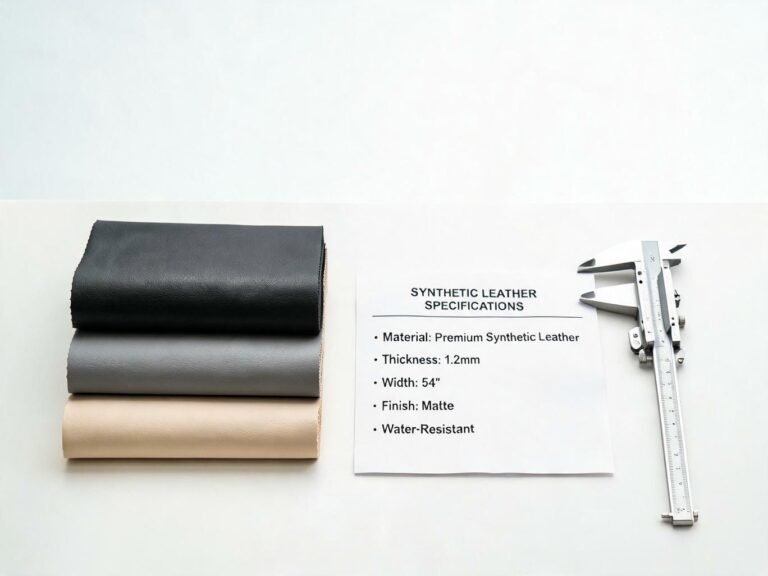
Sheet geometry directly affects yield and processing speed. TOPSUN produces faux leather sheet in thicknesses from 0.23 mm to 2.5 mm. Widths range from 1350 mm to 1800 mm. Standard roll length is 30 – 50 meters. Longer rolls reduce splice frequency on automated cutting tables. Shorter rolls improve handling for manual upholstery shops.
Thickness tolerance is ±0.03 mm for grades below 1.0 mm. It is ±0.05 mm for heavier grades. We verify thickness with a motorized dead-weight gauge across the full web width. Buyers should insist on CPK data for critical dimensions. A CPK below 1.33 indicates excessive variation. This variation causes lamination bubbles and sewing needle deflection.
Base fabric options include cotton, polyester, nylon, and blended knits. Each substrate changes hand feel, elongation, and cost. Cotton backing suits furniture applications requiring breathability. Polyester woven backing provides dimensional stability for automotive die-cutting. We match substrate to end-use during the quoting phase.

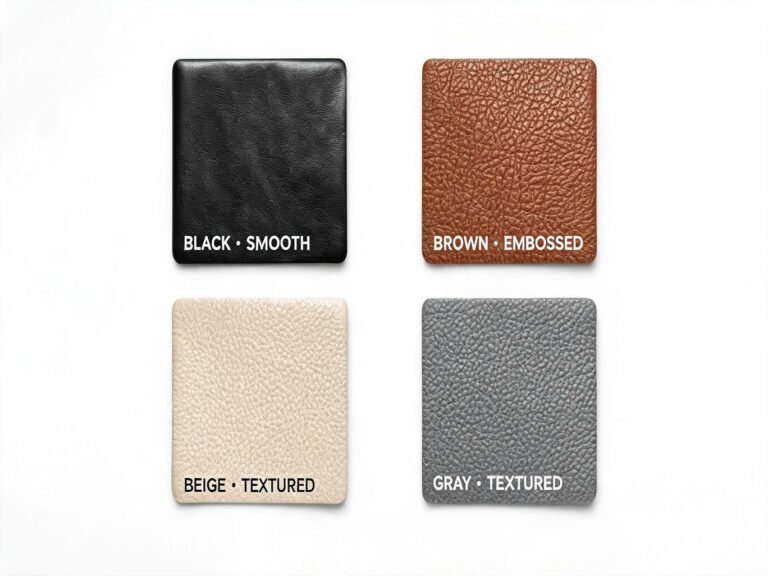
Standard and custom color swatches available with batch-to-batch Delta E < 1.0 consistency guarantee
Faux Leather Sheet Cost Drivers Beyond the Per-Meter Price
Unit price is the weakest predictor of total program cost. Yield loss from thickness variation adds 3 – 5% material overhead. Rework from color mismatch adds labor and delays. VOC failures trigger compliance penalties. Hydrolysis degradation drives warranty claims. We calculate true landed cost by adding these risk-adjusted factors.
Silicone sheet runs at higher line speeds during conversion. It does not require drying tunnels for solvent evaporation. This reduces energy cost per meter by 20 – 30% at the coating stage. The absence of plasticizer migration prevents adhesive failures in bonded assemblies. Automotive customers report reduced scrap rates during thermoforming.
We audited a 3C accessory program that switched from PVC to silicone sheet. Mold staining from plasticizer volatilization had previously required weekly cleaning. After conversion, mold cleaning intervals extended to monthly. Downtime reduction alone recovered the material premium within eight months.
Watch TOPSUN’s fully automated silicone leather sheet production line across 3 manufacturing bases
Conclusion: Specifying the Right Sheet for Your Product
Faux leather sheet selection demands engineering rigor. Define polymer chemistry, thickness range, base fabric, and performance test requirements before requesting quotes. Verify that suppliers test on production material, not idealized samples. Include thermal aging, UV exposure, and chemical compatibility in your specification. Request CPK data for critical dimensions. Model total cost across the product lifecycle.
TOPSUN provides technical datasheets with full test protocols and actual batch values. Our engineering team supports specification development for automotive, furniture, medical, and electronics applications. We align material properties to your processing methods and end-use environment.
About TOPSUN
TOPSUN manufactures faux leather sheet rolls in widths from 1350mm to 1800mm, serving automotive OEMs, furniture factories, and 3C accessory brands. We offer solvent-free coating, REACH-compliant formulations, and custom thickness from 0.23mm to 2.5mm with 7-15 day lead times.
External reference: For technical developments in coated textiles and sheet materials, see Textile World.