Search “faux leather companies” and you will find thousands of results, from Japanese material giants to one-room trading offices. The 2026 market splits cleanly: classic PU and PVC still carry bulk furniture and fashion volume, while silicone and bio-based players grow at the premium end. The list looks impressive. The real work is telling the partners apart, and these seven checks do exactly that.
Who Actually Leads the Faux Leather Company Landscape
At the top sit the Japanese and Korean material houses. Kuraray builds Clarino ultra-fine fiber leather for premium footwear and accessories. Toray supplies Ultrasuede to luxury automotive and fashion programs. Around them, industry rankings list Teijin, Kolon, and Ducksung as established innovators, with a deep manufacturing cluster across coastal China handling volume production for global buyers.
Sector requirements now shape the leaderboard. Marine grades answer to 1,000-hour UV and salt spray standards. Automotive programs demand low VOC, FMVSS 302 flammability compliance, and IATF 16949 style process control. Medical buyers specify ISO 10993 biocompatibility, and children’s products face EN71-2 and REACH scrutiny. A company that serves all four sectors carries the test reports to prove it.
Trader, Brand, or Factory: Who Are You Really Buying From?
Three business models hide behind the same word “company.” A factory owns coating lines, testing labs, and the QC responsibility for every roll. A trading company owns a website and a relationship with someone else’s factory. A brand owns designs and outsources everything. None of these is automatically bad, but each carries different risk when a batch fails.
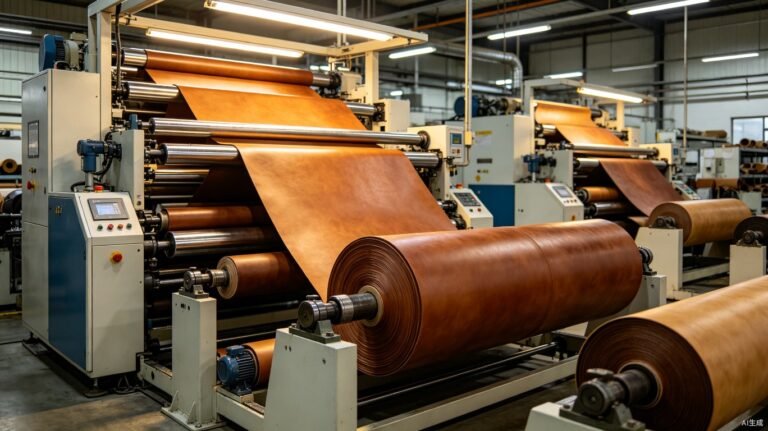
Factories respond to problems with process changes, because they control the process. Traders respond with emails, because that is what they control. When your program needs custom thickness, custom color, or a fast re-run, the difference shows up in days. Ask one direct question early: what is your monthly capacity, and may we inspect the line? A factory welcomes the visit. Our own factory production overview exists for exactly that reason.

A real manufacturing floor answers questions a brochure cannot.
Seven Checks Before You Sign With Faux Leather Companies
Sourcing specialists who vet suppliers for a living converge on the same list. We have adapted it for leather materials:
- 1. Legal and export basics. Verified business license, export history, and a real address you can geolocate.
- 2. Manufacturing proof. Photos or live video of coating lines and labs, not stock imagery.
- 3. Third-party audit. SGS, Intertek, or TÜV reports, and accreditation from bodies such as Sedex or BSCI.
- 4. Certification specifics. Named labs, report numbers, and standards matched to your sector, not vague “REACH compliant” claims.
- 5. QC independence. Quality control managed separately from production, with calibrated instruments and recorded checks.
- 6. Sample-to-batch consistency. The bulk roll must match the approved sample, verified by a pilot order.
- 7. Communication under pressure. Clear milestone updates during the pilot, when problems surface honestly.
Check three fails the deal more often than any other. Audit culture separates manufacturers who own their quality from companies that rent it.

Inspection stations inside the line, not after it, mark a serious producer.

A real factory floor answers questions that a brochure cannot.
What Real Manufacturers Put in Writing
Shortlisted companies differ in what they commit to on paper. Capacity is the first number: our lines run 500,000 meters per month with a 500 meter MOQ, which keeps pilot orders affordable. Lead time is the second: 7-15 days from confirmation covers most programs. Test documentation is the third, and we ship SGS reports with every order while welcoming third-party inspection from SGS, BV, or TÜV before loading.
Material transparency belongs on the same list. Buyers increasingly ask what is in the surface layer, which is why our silicone leather introduction details the solvent-free chemistry, and our eco-friendly silicone page maps each claim to a certification.
Company profile: lines, labs, and the team behind every order.
Questions Buyers Ask About Faux Leather Companies
Is a higher price always a better company? No. Price tracks material tier and service level, not integrity. A mid-price factory with open audits beats an expensive trader with vague answers every time.
How many companies should we shortlist? Three. One incumbent, one challenger, and one wildcard. Run the same pilot spec through all three, and the seven checks above will rank them for you.
Build Your Shortlist in This Order
The faux leather company you choose becomes part of your product for years, so sequence the decision:
- Filter the market by sector certifications first, then by capacity and MOQ fit.
- Run the seven checks on the remaining candidates and keep the ones that pass all of them.
- Order a paid pilot, inspect it on arrival, and only then commit volume.
Companies that survive this sequence rarely surprise you later. That predictability is the real product.
About TOPSUN
TOPSUN manufactures solvent-free silicone leather for furniture, automotive, marine, and healthcare programs in 30+ countries, with 8+ years of export experience.
500,000 m monthly capacity, 500 m MOQ, 7-15 day delivery, SGS reports with every order, and third-party inspection welcome.
References
- https://www.caiwingleather.com/top-faux-leather… — 2026 top faux leather manufacturers: Kuraray Clarino, Toray Ultrasuede lead; sector barriers include IMO marine standards, FMVSS 302, ISO 10993, EN71-2/REACH
- https://forthsource.io/blog/ultimate-guide-to-v… — supplier vetting framework: factory audits, QC independence from production, equipment calibration records, accreditation verification