Every October, trade-fair juries and catalog teams reach for the same phrase: latest fabrics. As the engineer who runs the coating trials behind our new releases, I read that phrase two ways. In a catalog, it means anything shipped this season. In our lab, it means a new chemistry, a new construction, or a new certificate that survived testing. The distance between those two meanings is where sourcing budgets quietly disappear. This article sorts genuinely new materials from relabeled ones, using benchmark numbers that 2026 award juries and our own test benches agree on.
I develop silicone-coated textiles for furniture, marine, fashion, and medical brands. When a buyer asks for the latest, my first question is: latest in what? Three answers are honest. New chemistry, new construction, and new verification. Everything else is usually a mood board with a part number.
What “Latest Fabrics” Means in a Lab Versus a Catalog
Catalogs treat new as a date. Laboratories treat it as evidence. The market rewards the confusion either way. The textile coatings market reached USD 8.1 billion in 2025 and is projected to hit USD 11.6 billion by 2032, a 5.2 percent CAGR. Much of that growth sits in functional systems such as polyurethane, TPU, acrylic, and silicone chemistries that add durability, water resistance, and antimicrobial behavior.
Growth this fast invites relabeling. When every supplier claims innovation, the word stops carrying information, and numbers have to do the work instead. For the chemistry behind our own category, the silicone leather introduction covers the polymer basics.
One 2026 development shows what real novelty looks like. Microencapsulated phase-change coatings can now store and release 20 to 50 joules of thermal energy per gram. That is enough to hold the temperature next to the skin between 28 and 32 degrees C in workwear, uniforms, and sports apparel.
A claim like that is falsifiable. Put the garment in a climate chamber, log the curve, and the material either holds the band or fails it. Falsifiability is the first filter I apply to any swatch, and it is the lens we bring to the fashion and sports program.

A new surface is a mold, a recipe, and a test report, in that order.
Three Latest Fabrics That Set the 2026 Benchmark
The October 2026 PERFORMANCE DAYS jury meeting in Munich sorted submissions across membranes, bio-based systems, and engineered wool. Three winners illustrate the three honest kinds of new. One is a construction breakthrough, one is a feedstock switch, and one is a systems play. Note the jury’s own caution as well: several entries carry supplier-submitted figures rather than independently replicated results. Treat award data as a starting specification, then demand the same numbers from any roll you actually buy.
| Award-Winning Material | Claimed Specification | What Makes It Genuinely New |
|---|---|---|
| FLYTEC DEFEND (Performance Award) | 89 g/m2 shell; 20,000 mm hydrostatic head; 20,000 g/m2/24h moisture transport | Stretch microporous PP membrane on a recycled-polyester face with a durable water-repellent finish |
| Pontetorto 61040/BIOBASED (Eco Award) | 100% bio-based polyester at 200 g/m2 | Wood-derived bio-PET replaces fossil feedstock while holding technical performance |
| Paltex PureCycle 2L (Innovation Award) | 175 g/m2; 5,000 mm water column; 500 g/m2/24h breathability | Whole laminate roughly 30% bio-based by weight, including a TPEE membrane from corn-stalk residue |
The jury flagged a second caution worth stealing: bio-based does not automatically mean sustainable. Feedstock origin, traceability, durability, processing, and recyclability all sit inside that judgment. A laminate can be 30 percent renewable by weight and still fail your product if its coating hydrolyzes in year three. Environmental percentage is one column in a spec sheet, never the whole sheet. Our approach to claims you can audit is documented on the eco-friendly silicone leather page.

New colors earn the word “new” only after fastness and Delta E data arrive.
The Latest Fabrics Pipeline: From Coating Chemistry to Certificate
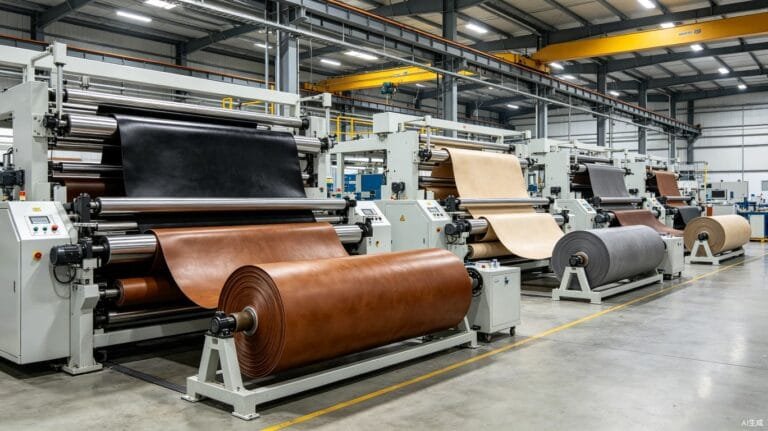
Inside our plant, a new fabric starts on the coating line, not in a catalog. Release paper defines the surface. We run more than 100 textures, from lychee grain to silk finish, and each one is a physical mold that shapes light and touch. A genuinely new surface goes through trial coats, in-line thickness monitoring, and cure verification before a sample ships.
Our monthly capacity of 500,000 meters only matters because the trial discipline scales with it. The factory production process page shows where those checkpoints sit.

Every texture in the range begins as release paper and a trial run.
Chemistry follows the same discipline. Our silicone system is 100 percent solvent-free with zero plasticizers, and every full-silicone batch can be checked by FTIR spectroscopy. The spectrum should show only PDMS peaks, with no polyurethane carbonyl signature. New curing routes, such as UV-cured outdoor grades, enter production only after hydrolysis testing in an 85 degrees C chamber at 85 percent relative humidity for up to 14 weeks. VOC results must come back non-detect under ISO 16000-6. A new fabric without this paper trail is a bet, not a material.

New curing chemistry earns outdoor duty only after the chamber agrees.
Certificates complete the loop. REACH, RoHS, FDA 21 CFR, and ISO 10993 documentation travels with every order, and third-party inspection from SGS, BV, or TUV is welcome on site. Thickness options from 0.23 to 3.0 millimeters, Pantone and RAL color matching, and a 500 meter minimum order turn the innovation into something a product team can pilot. Delivery runs 7 to 15 days, so the test loop stays fast.
Next-generation silicone coated fabrics under development at TOPSUN.
When you evaluate a supplier’s latest fabrics, run the same sequence our lab runs. First, ask what changed in chemistry, construction, or certification. Second, request the test method behind each number, not just the number. Third, order samples and repeat the critical tests yourself or through a third party. Fourth, pilot at production thickness, not swatch thickness. A genuine innovation survives that loop. A relabel rarely does.
The habit that protects budgets is simple. Treat every new claim as unverified until a method and a number arrive together. The latest fabrics worth buying in 2026 are the ones that survive that filter, and the suppliers worth keeping are the ones who hand you the chamber data before you ask.
Talk to Our R&D Team About Your Next Fabric
Request New-Release Samples with Test Documentation
About TOPSUN
TOPSUN manufactures full-silicone coated fabrics for furniture, marine, medical, and fashion brands in 30+ countries, with 8+ years of specialized coating experience and 500,000 meters of monthly capacity.
In-house R&D covers texture, color, and chemistry development, with FTIR verification, REACH and RoHS documentation, and SGS reports attached to every order.
Frequently Asked Questions
How can I tell a genuinely new fabric from a relabeled one? Ask what changed at the polymer, construction, or certification level. A relabel changes a color name; a real innovation changes a test result. Request the test method, the instrument class, and the latest third-party report behind any quoted figure. Then verify on a sample before committing a program.
Are bio-based percentages enough to justify switching materials? No. Feedstock share says nothing about hydrolysis life, abrasion cycles, or end-of-life handling. Weight the bio-based claim alongside durability data and certificates. A 30 percent renewable laminate with weak coating life will cost more over five years than a durable, solvent-free material with a smaller green fraction.
References
- https://www.usdanalytics.com/industry-reports/t… — Textile coatings market at USD 8.1 billion in 2025, projected to USD 11.6 billion by 2032; PCM coatings store 20-50 J/g.
- https://textination.de/en/news?cie=912&newstype… — PERFORMANCE DAYS October 2026 awards: FLYTEC DEFEND at 89 g/m2, 20,000 mm hydrostatic head, and supplier-data caution.
- https://kohantextilejournal.com/performance-day… — Full 2026 award list: bio-based Pontetorto fabric, PureCycle 2L laminate, and jury commentary on sustainability.