Last quarter, an automotive interior buyer rejected an entire production run. The complaint was not color or thickness. The lychee grain on the delivered rolls was visibly shallower than the approved sample. Both rolls were genuine vegan leather from the same supplier. The vegan leather texture simply did not match, and the seats had to be reupholstered at the supplier’s cost. Grain mismatch like this is rarely a material defect. It is an embossing process problem, and it is predictable. This guide explains what creates the texture, why batches drift, and how to lock consistency into your next order.
What Vegan Leather Texture Is Made of on the Line
Vegan leather texture is not printed on. It is formed. In embossing, the coated material passes under an engraved roller. Heat softens the surface, pressure transfers the pattern, and cooling locks the grain in place. Three variables run as one system: temperature, pressure, and line speed. Change any one of them and the pattern depth shifts across the roll. Cooling matters just as much. Skip proper stabilization and the grain relaxes back toward flat within weeks.
| Variable | What Happens if It Drifts | What to Ask Your Supplier |
|---|---|---|
| Roller temperature | Shallow detail, or gloss scorching | Ask for the working window in °C |
| Line pressure | Depth varies across roll width | Ask how uniformity is measured |
| Line speed | Inconsistent dwell, weak pattern | Ask about dwell time control |
| Cooling and stabilization | Grain relaxes flat after shipping | Ask when rolls are QC-checked |

The table is the practical takeaway. Suppliers who can quote a working window for each variable are telling you the process is measured. Suppliers who answer with adjectives are telling you the texture depends on the operator’s mood that day. One answer supports a 5,000-meter order. The other supports a claim.
Why Two Batches of the Same Grain Can Feel Different
Between two production runs, the engraved roller is the same. What drifts is everything around it. Even pressure across the roll width produces one consistent grain. Uneven pressure prints a pattern that looks weak on one edge and heavy on the other. Web tension changes how deeply the surface engages the roller. A worn roller prints a shallower grain than a fresh one.
This is why mature buyers audit the process, not just the sample. When we review a texture spec with a new client, we walk the line at our factory production facility and record the working window for every variable. The sample is a promise. The process window is the delivery.

The Texture Timeline: What Happens After Year One
Texture is not only a factory question. It is an aging question. Standard PU contains plasticizers that keep the coating soft. Over months in warm environments, those plasticizers migrate to the surface and evaporate. The material stiffens, flex points crack, and the embossed grain shallows as the polymer relaxes. Eventually the coating separates from the backing. That is delamination, and it ends the texture conversation permanently.
The visible stages arrive in order. First the handfeel turns from supple to firm. Then fine grains shallow faster than deep ones, because shallow relief has less depth to lose. Cracks follow at fold lines and seams. Buyers who touch only the new sample never see this sequence coming.
Genuine leather ages differently. It develops a patina, which buyers accept as character. Faux surfaces cannot take that path. This aging gap matters most in high-touch interiors such as automotive interior programs, where every door panel is compared against every other one. Watch how a full texture range behaves before you commit a fleet order.
Silicone Leather: Texture That Outlives the Roller
Silicone chemistry removes the aging clock entirely. There are no plasticizers to migrate, so the embossed grain you approve in the sample is the grain the buyer sees in year five. Our material passes ISO 11507 hydrolysis testing with no surface change. Flex testing runs past 100,000 cycles under ISO 5402, so the texture survives the bending that stiffens other surfaces.
For products that need a softer handfeel than standard silicone, our silicone microfiber leather pairs a denser base with the same stable surface chemistry. Engraved texture options now cover dozens of grains, from fine weaves to deep lychee, with the depth held to spec across the roll.

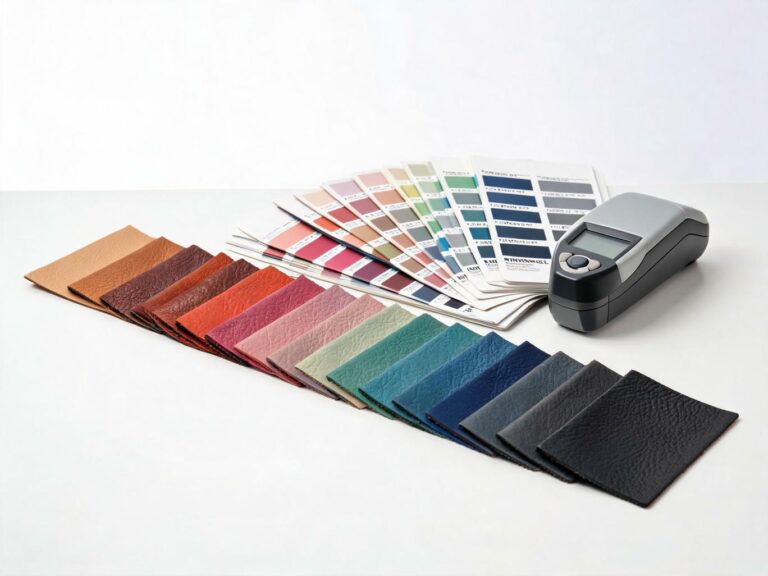
Texture swatches let you compare grain depth side by side before the order. Request Silicone Leather Texture Swatches
The Verdict on Texture Consistency
Texture consistency is not a sampling problem. It is a process-window problem, and it is solved on the production line, not in the showroom. Talk to Our Team About Texture Consistency
Why does my vegan leather texture feel different between batches?
Drift usually traces to embossing variables: roller temperature, line pressure, web tension, or roller wear. Ask your supplier for the recorded process window behind each batch.
Does embossed vegan leather keep its grain over time?
PU does not. Plasticizer loss stiffens the surface and shallows the grain before delamination. Silicone leather has no plasticizers, so grain depth stays stable for years.
References
1. https://jinzhihangmachinery.com/machine-embossi… — six embossing principles: temperature-pressure-speed as one process, pressure uniformity, cooling and stabilization
2. hildaleather.com: genuine leather vs faux leather — natural grain variation vs uniform repeating grain, patina development vs fading and peeling
3. leatheradvice.com: is synthetic leather durable? — delamination mechanism, plasticizer-driven stiffening, texture and wear performance