If 45% of global tanneries have adopted eco-friendly tanning chemicals, what are the other 55% doing? That’s the question every procurement team should ask before signing a leather supply contract in 2026. The Leather Working Group reports that 35% of tanneries have implemented water recycling systems and 20% have shifted to chrome-free tanning — meaningful progress, but it also means the majority of your potential suppliers are still operating with yesterday’s environmental standards. Not all eco efforts are created equal. Some deliver measurable CO₂ reductions and regulatory compliance. Others are marketing veneers over business-as-usual processes. Here’s how to tell the difference — and which three efforts genuinely move the needle.
See TOPSUN’s Eco Compliance Documentation
The 3 Eco Efforts Reshaping Leather Manufacturing
After auditing supplier sustainability claims across hundreds of factories, we’ve identified three eco efforts that produce verifiable environmental impact data. Everything else — recycled packaging, solar panels on office roofs, carbon offset purchases — may be genuine but doesn’t address the core environmental footprint of leather production. The three that matter operate at the manufacturing process level:
| Eco Effort | Industry Adoption | CO₂ Reduction | Water Savings | Key Risk Addressed |
|---|---|---|---|---|
| Chrome-free tanning | ~20% of specialty leather | 30–40% (LCA cradle-to-gate) | 16L per hide | Chromium VI, ECHA restrictions |
| Water recycling systems | ~35% of tanneries | Moderate | Up to 50% freshwater | Wastewater discharge, COD |
| Solvent-free silicone coating | <5% (emerging) | Significant (dry process) | 100% (no water needed) | VOC, REACH, FDA, DMF |

Production process flow: solvent-free dry coating eliminates wastewater at the source
Notice the adoption gap. Chrome-free tanning and water recycling are scaling — but they’re still incremental improvements to a fundamentally polluting process. Solvent-free silicone coating eliminates the pollution source entirely, yet adoption remains below 5% because it requires a completely different manufacturing infrastructure. That’s the tension B2B buyers need to understand: the most impactful leather industry sustainability efforts are also the hardest to scale.
Chrome-Free Tanning: Why 55% of Tanneries Still Lag
Chrome tanning accounts for roughly 80% of global leather production. The chemistry is efficient and cost-effective — but only 60–70% of the chromium actually binds to the leather. The remaining 30–40% discharges into wastewater, contaminating water sources and soil. Worse, chromium III can convert to chromium VI, a known carcinogen. California banned new hexavalent chromium facilities in 2025, and the ECHA’s restriction list keeps expanding.

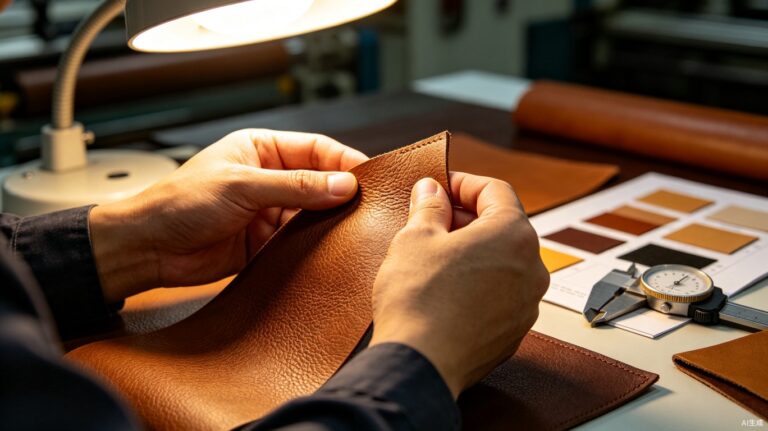
Chemical management: where chrome-free tanning replaces traditional chromium salts
So why haven’t more tanneries switched? Three reasons: chrome-free tanning requires longer processing times, produces leather with different physical characteristics (lower hydrolysis resistance in some formulations), and demands capital investment in new equipment. JBS Couros developed a proprietary technology called Savetan that improves chromium fixation — saving 16 liters of water per hide, reducing chemicals by 15%, salt by 42%, and sludge by 65%. That’s impressive, but it also highlights how far the industry still has to go when one company’s innovation is news rather than baseline.
Italian tanneries report CO₂ emissions of 2.03 kg CO₂ eq/m² and VOC emissions of 54 g/m² — among the lowest in the global industry, thanks to stringent EU regulation. But these numbers represent the best-case scenario. Most global production happens under far weaker regulatory oversight. When a supplier claims “chrome-compliant” leather, ask for the actual chromium VI test report. If they can’t produce it, their eco efforts are documentation, not transformation.
Water Recycling: The Eco Effort With Measurable ROI
Traditional leather tanning consumes enormous volumes of water — an estimated 240 liters per square meter for natural leather production. The good news: 35% of tanneries globally have implemented water recycling systems, and the technology has clear ROI. Closed-loop systems can reduce freshwater consumption by up to 50% and significantly cut COD (chemical oxygen demand) in effluent discharge.

Water-based production: a step forward, but still a wet process compared to dry coating
Here’s the catch: water recycling reduces the volume of pollution but doesn’t eliminate the chemistry. A tannery that recycles 50% of its water still discharges chromium-laden effluent in the remaining 50%. The recycling effort is real and valuable — but it’s an incremental improvement, not a paradigm shift. For B2B buyers evaluating leather certification standards, the question isn’t whether a supplier recycles water. It’s whether they can document the actual reduction in COD, BOD, and heavy metal discharge year-over-year.
In our factory, we took a different approach: eliminating water from the coating stage entirely. The solvent-free dry coating process uses no water, no DMF, and no volatile solvents. That’s not water recycling — it’s water elimination at the source. When you’re sourcing materials for applications requiring automotive, medical, or food-contact compliance, the distinction between “less pollution” and “no pollution” matters enormously. Our application-specific product lines are built around this principle.
Solvent-Free Silicone Coating: Zero-VOC Eco Effort That Scales
Of the three eco efforts we’ve analyzed, solvent-free silicone coating is the only one that eliminates the pollution source rather than managing it. The process uses a silicone polymer applied via dry coating — no organic solvents, no water, no DMF. The result is a material with zero VOC emissions during production and near-zero VOC during use.

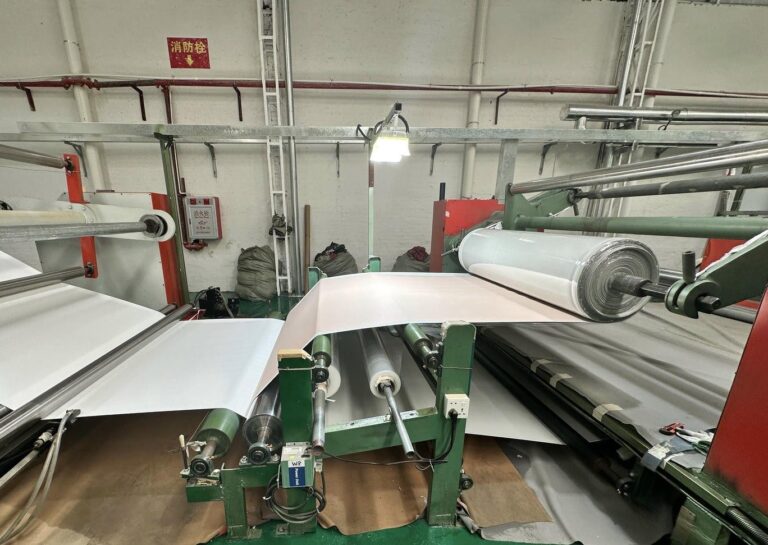
Solvent-free coating line: zero VOC emissions, zero wastewater discharge
In our SGS-verified testing, the material achieves ISO 16000-6 and VDA 277 compliance with near-zero VOC readings. It’s REACH-compliant, FDA 21 CFR 177.2600 food-contact certified, and ISO 10993-5 biocompatibility certified. But the environmental benefit goes beyond production: the finished material lasts 10+ years — 5× longer than PU or PVC alternatives. When a product lasts a decade instead of two years, the per-year environmental cost drops by 80%. That’s lifecycle thinking, not just process optimization.
Watch: How zero-VOC silicone coating eliminates the #1 source of air pollution in leather manufacturing
The Leather Working Group provides audit protocols for tannery environmental performance — but their framework still measures and manages pollution rather than eliminating it. A tannery can achieve LWG Gold rating while still using chromium and solvents. Silicone coating sidesteps the entire framework by removing the pollutant at the chemistry level.
How to Audit a Supplier’s Real Eco Efforts
If you’re a procurement manager evaluating leather suppliers, don’t accept a sustainability brochure as evidence. Run this audit before committing:
- Request the LCA (Lifecycle Assessment) — Not a marketing claim, but a cradle-to-gate or cradle-to-grave LCA with methodology disclosure. If they don’t have one, their eco efforts are unmeasured.
- Ask for chromium VI test data — Not “chrome-compliant” but the actual EN ISO 17075 test result with a number. Below 3 mg/kg is detectable limit; above 10 mg/kg triggers REACH restrictions.
- Verify VOC emission test reports — ISO 16000-6 or VDA 277 with actual emission values, not pass/fail. A supplier doing genuine eco work will have these on file.
- Check water discharge data — Year-over-year COD and BOD trends. If they recycle water, the numbers should show declining discharge volume and pollutant concentration.
- Inspect the process, not just the product — Visit the factory floor. Do you smell solvents? Do you see effluent discharge pipes? Compare silicone vs PU production methods firsthand — the difference is visible and audible.
Request Eco Compliance Samples
About TOPSUN
TOPSUN operates solvent-free silicone leather coating lines for B2B buyers who need verifiable eco compliance data across automotive, furniture, and medical supply chains — with 60,000+ m² of production capacity across three Chinese manufacturing sites.
Zero-VOC dry coating verified by SGS (ISO 16000-6) · 100% recyclable end-of-life · 200K+ Martindale cycles · REACH + FDA 21 CFR 177.2600 + ISO 10993-5 certified · LWG-audited production environment
Decision Framework: Which Eco Effort Matches Your Compliance Needs?
Not every eco effort addresses every compliance risk. Use this decision tree to match your sourcing requirements with the right supplier capabilities:
- If you need REACH / chromium VI compliance → Choose chrome-free tanned or silicone-coated leather. Verify with EN ISO 17075 test data. PVC and conventional chrome-tanned leather carry restriction risk.
- If you need low-VOC / indoor air quality compliance → Choose silicone-coated leather (zero VOC) or water-based PU (reduced VOC). Conventional solvent-based PU fails ISO 16000-6 thresholds in enclosed applications.
- If you need FDA food-contact compliance → Choose silicone leather (FDA 21 CFR 177.2600 certified). No other synthetic leather currently meets this standard.
- If you need 10+ year service life → Choose silicone leather (200K+ Martindale cycles, UV-stable 1,000+ hours). PU lasts 3–5 years; PVC lasts 2–3 years before cracking.
- If you need 100% recyclability at end-of-life → Choose silicone leather. PVC is not recyclable; PU recyclability is limited and economically unviable.
The bottom line: real eco efforts produce data. If a supplier can’t show you the numbers — VOC test reports, chromium VI results, water discharge trends, LCA documentation — their sustainability claims are marketing, not measurement. In 2026, with 75% of export-oriented buyers expected to demand verifiable environmental data, the suppliers who survive will be the ones who can prove their eco efforts with test reports, not brochures.
What’s the difference between eco efforts and greenwashing in leather?
Eco efforts produce measurable, documented environmental improvements — reduced VOC emissions, lower water consumption, verified chromium VI levels, lifecycle assessment data. Greenwashing produces claims without data: “eco-friendly,” “sustainable,” “green” labels unbacked by ISO 16000-6 test reports, EN ISO 17075 chromium VI results, or year-over-year discharge metrics. The simplest test: ask for the test report. If the supplier can produce it with a recognized lab logo (SGS, Intertek, TÜV), it’s a real eco effort. If they offer a brochure instead, it’s greenwashing.
Are silicone leather’s eco efforts more impactful than chrome-free tanning?
They address different stages of the supply chain. Chrome-free tanning improves the hide preparation stage — reducing chromium discharge and water pollution. Silicone coating improves the finishing stage — eliminating VOC emissions, solvent use, and wastewater from the coating process entirely. For B2B buyers sourcing finished synthetic leather (not raw hides), silicone coating’s zero-VOC dry process delivers more directly relevant environmental benefits than chrome-free tanning, which applies to animal hide processing. Both are valuable; they operate at different points in the leather manufacturing chain.