Imagine specifying upholstery for 500 airport terminal seats. The contract requires a 10-year service life. You review Martindale abrasion data from four suppliers: PU leather at 20K-50K cycles, PVC leather at 100K-150K, microfiber PU at 80K-120K, and silicone leather at 200K+. The durable fabric you choose will determine whether those seats survive a decade of daily public use — or fail mid-contract, triggering replacement costs, warranty claims, and brand damage. The Martindale abrasion test (ISO 12947-2) is the single most reliable predictor of fabric durability in B2B applications. Yet most procurement teams specify materials based on swatch appearance and price, not on the test data that reveals how long the fabric actually lasts. This article compares four upholstery materials by the numbers that matter.
Request Durable Fabric Test Data
What Makes a Durable Fabric: The Martindale Standard
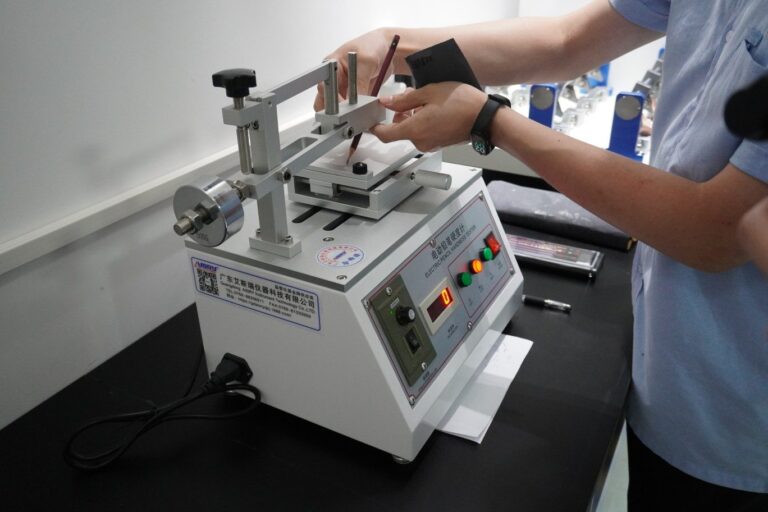
The Martindale abrasion test is the international standard for evaluating durable fabric performance. Under ISO 12947-2, a fabric sample is mounted under a known pressure and rubbed against an abrasive medium (typically wool felt) in a Lissajous pattern. The test continues until two yarns break or the sample shows visible wear. The number of cycles before failure is the Martindale rating — and it’s the number that separates a 3-year material from a 10-year material.
For B2B applications, the ISO 12947-2 Martindale standard defines durability tiers: below 10,000 cycles is unsuitable for commercial use; 10,000-20,000 is light domestic; 20,000-40,000 is general commercial; 40,000-60,000 is heavy commercial; and above 100,000 is heavy-duty public transport. Silicone leather’s 200,000+ rating places it in the highest tier — four times the minimum threshold for heavy-duty public use.

Folded leather texture detail — flexibility and surface integrity under stress are key indicators of durable fabric performance.
Durable Fabric Showdown: 4 Materials by Abrasion Data
| Material | Martindale | Flex Cycles | UV (1,000 hrs) | Service Life |
|---|---|---|---|---|
| PU Leather | 20K-50K | 25K (failed) | Yellowing, cracks | 3-5 yrs |
| PVC Leather | 100K-150K | 15K (failed) | Fading, brittle | 2-5 yrs |
| Microfiber PU | 80K-120K | 40K-60K | Moderate | 4-7 yrs |
| Silicone Leather | 200K+ | 50K-100K+ | No change | 10+ yrs |
The data reveals a paradox: PVC leather’s higher Martindale rating (100K-150K) doesn’t translate to longer service life. PVC achieves abrasion resistance through material hardness — the same property that causes it to crack at flex points within 24-36 months. A durable fabric must pass both Martindale and flex resistance tests, and only silicone leather passes both at levels that support 10+ year commercial deployment.
Beyond Martindale: Flex, UV, and Hydrolysis Testing
Martindale alone doesn’t define a durable fabric. A material that resists abrasion but cracks under flexing fails in real-world applications where seats, armrests, and curved surfaces experience repeated bending. That’s why the B2B material qualification process must include three additional tests: flex resistance (ISO 5402), UV stability (ASTM G154), and hydrolysis resistance (ISO 11507).
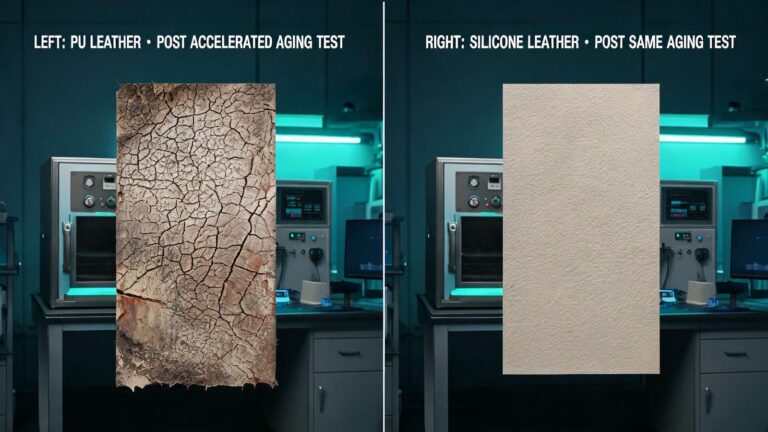
In our lab, PU leather fails flex testing at 25,000 cycles — visible cracking appears at armrest and seat edge curves. PVC fails even earlier at 15,000 cycles, confirming that hardness-driven abrasion resistance comes at the cost of flexibility. Silicone leather passes 50,000-100,000+ flex cycles with no visible damage, because the Si-O polymer backbone maintains flexibility across its entire -40°C to 250°C temperature range.
UV testing tells a similar story. After 1,000 hours of accelerated UV exposure per ASTM G154, PU samples show yellowing and micro-cracking. PVC samples exhibit fading and embrittlement as plasticizers degrade. Silicone leather shows no fading, no yellowing, and no surface change — the silicone polymer is inherently UV-stable, requiring no UV stabilizers or additives.

Lychee pattern leather fold closeup — surface texture must maintain integrity after repeated flexing, UV exposure, and cleaning cycles.
The 10-Year Service Life Gap
The service life gap between materials is where durable fabric specification decisions have real financial consequences. A 500-seat airport terminal project using PU leather at $10-18/meter faces 2-3 full replacement cycles within a 10-year contract. Each replacement means material cost, labor, logistics, downtime, and potential contract penalties. The same project using silicone leather at $20-30/meter specifies once and lasts the full contract term.
The 10-year total cost of ownership calculation is straightforward. PU leather: $10-18/meter × 3 replacement cycles = $30-54/meter, plus labor and downtime. PVC leather: $5-10/meter × 3-4 cycles = $15-40/meter, plus compliance risk. Silicone leather: $20-30/meter × 1 cycle = $20-30/meter, zero compliance risk, zero replacement labor. The material specification decision determines whether your durable fabric delivers value or burns budget.
10-Year TCO Comparison (per meter)
PU Leather: $30-54 (3 cycles) + DMF compliance documentation
PVC Leather: $15-40 (3-4 cycles) + phthalate compliance risk
Microfiber PU: $24-48 (2 cycles) + moderate hydrolysis risk
Silicone Leather: $20-30 (1 cycle) + zero compliance overhead

Outdoor durability test — silicone leather maintains waterproof performance and UV stability in outdoor applications where PU and PVC fail within 2-3 years.
Specification Verdict: Which Durable Fabric Lasts?
The test data, service life projections, and 10-year TCO calculations point to a clear specification hierarchy for durable fabric in B2B applications.
For short-life applications (1-3 years), PU leather at 20K-50K Martindale may suffice — but only if you’re not shipping to the EU (DMF compliance) and can accept replacement within 3 years. For medium-life applications (3-5 years), microfiber PU at 80K-120K Martindale offers better flex resistance, but still hydrolyzes and carries DMF residue risk. PVC leather’s 100K-150K Martindale looks impressive on paper but fails in flex testing and carries phthalate compliance burden.
For any application requiring 5+ years of service life — and certainly for 10-year contracts — only silicone leather qualifies as a durable fabric. The public seating material data confirms this: 200K+ Martindale, 50K-100K+ flex cycles, 1,000+ hours UV stability with zero degradation, and a 10+ year service life backed by REACH, ISO 10993, and FDA certifications. The Martindale numbers don’t lie. A durable fabric that delivers 200,000 abrasion cycles, passes 100,000 flex cycles, and maintains surface integrity after 1,000 hours of UV exposure is the material that lasts. Everything else is a shorter-lived material with a lower number on the same test.
About TOPSUN
TOPSUN manufactures silicone leather engineered as a durable fabric for B2B applications requiring 10+ year service life. Our materials deliver 200,000+ Martindale abrasion cycles, 50,000-100,000+ flex resistance cycles, 1,000+ hours UV stability, and hydrolysis-proof performance — verified through ISO 12947-2, ISO 5402, and ASTM G154 testing at SGS and Intertek laboratories. Serving automotive, furniture, hospitality, healthcare, and public seating sectors globally.