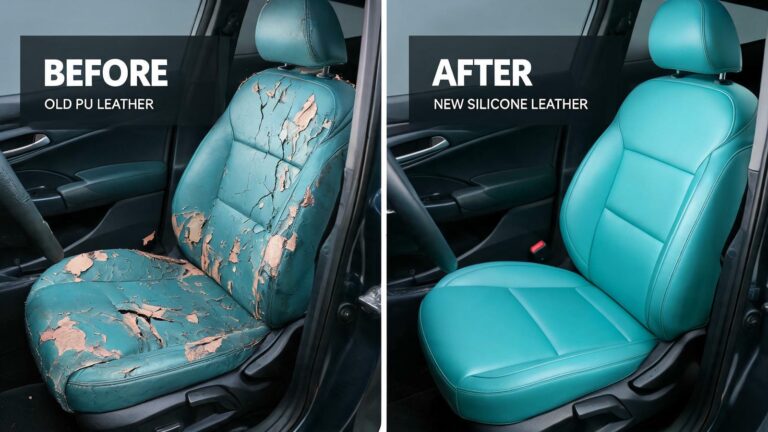
Walk into any RV dealership in August. The showroom furniture looks pristine — full-grain embossing, uniform color, soft hand feel. Now visit that same dealership in three years. Headrests are sticky. Seat cushions show hairline cracks. The “leather” is peeling at high-contact points like armrests and seat edges. This isn’t wear and tear. It’s chemistry. The rv upholstery leather most manufacturers spec today — PU-coated vinyl or polyurethane synthetic — simply cannot survive the thermal cycling, UV bombardment, and humidity swings that define motorhome interiors. Silicone leather changes that equation.
Why PU and Vinyl RV Upholstery Leather Fails by Season 3
Polyurethane and PVC coatings undergo a chemical breakdown process called hydrolysis. When moisture penetrates the polymer bonds — through humidity, spills, or condensation inside a sealed motorhome — those bonds weaken and eventually snap. The top layer delaminates from the fabric backing. Once that bond breaks, no adhesive or repair kit can restore it.
UV radiation accelerates the process. Sunlight streaming through RV windshields delivers concentrated UV exposure to front-facing seats and dashboards. The plasticizers in PVC migrate out under sustained heat, leaving the surface brittle. PU coatings crack along stress lines at high-contact points. RV owners across forums report the same pattern: peeling starts at headrests and seat bolsters where body heat and friction compound the UV damage.

Abrasion resistance testing equipment used to evaluate upholstery leather durability under repeated friction cycles.
We’ve seen firsthand what happens when RV manufacturers spec PU-coated furniture for motorhomes sold in Sun Belt states. The same material that passes standard lab tests in controlled environments fails within 24 months when faced with real-world UV exposure through RV windshields. That’s the gap between lab conditions and actual rv leather peeling warranty exposure that costs manufacturers and dealerships millions annually.
Polyurethane coatings in RV furniture typically delaminate in 2-4 years due to hydrolysis. Once delamination begins, the bond between the PU film and fabric backing is permanently compromised — no repair can fix it.
The Real Cost of RV Furniture Warranty Claims
The warranty structure tells the real story. One major RV furniture supplier offers 100% coverage for years 0-4, drops to 50% for year 4-5, and provides nothing beyond five years. Another manufacturer’s upholstery begins shredding after just two camping seasons — roughly 5 months of actual use — yet falls outside the warranty window. These aren’t isolated complaints. They represent a systematic failure of PU and vinyl materials in the RV sector.
For B2B buyers at RV manufacturers and furniture suppliers, the cost chain looks like this: warranty claims eat into dealer margins, replacement furniture freight damages the supply budget, and brand reputation erodes when owners post peeling headrests on consumer forums. Premium alternatives like UltraLeather cost triple the price of standard PU — an margins-driven industry can’t absorb that premium across an entire product line.

Silicone leather rolls ready for RV furniture production — color-matched, batch-consistent, and hydrolysis-proof.
A material that lasts 10+ years without peeling — at a fraction of UltraLeather pricing — would eliminate the entire warranty claim chain. That’s exactly what silicone chemistry delivers. You can see the rv furniture material cost comparison shift dramatically when you factor in replacement costs, warranty labor, and dealer goodwill credits over a 5-year period.
Talk to Our Material Engineers
How Silicone Leather Survives RV-Specific Conditions
Silicone leather isn’t a coating applied to a fabric. The silicone polymer itself forms the surface — and silicone chemistry is fundamentally different from polyurethane. The Si-O bond in silicone is stronger and more stable than the C-O bonds in PU. That means moisture, UV, and temperature extremes that destroy PU have minimal effect on silicone.
In our testing, silicone leather maintains flexibility from -40°C to 250°C. A motorhome parked in a Minnesota winter at -20°C and then driven to Arizona at 45°C cabin temperature doesn’t stress the material. The same seat cover handles both extremes without the thermal cycling that cracks PU and PVC. UV resistance per ASTM G154 confirms 1,000+ hours without fading or yellowing — the test that exposes how quickly PU coatings break down under simulated sunlight.

Flex resistance testing simulates the repeated bending stress at seat edges and headrest joints in RV furniture.
The data speaks for itself. For buyers evaluating silicone leather rv interior durability, the performance gaps are measurable — not marketing claims.
| Material | Service Life | UV Resistance (ASTM G154) | Temperature Range | Hydrolysis |
|---|---|---|---|---|
| Silicone Leather | 10+ years | 1,000+ hrs, no fading | -40°C to 250°C | Resistant |
| PU Leather | 3-5 years | Cracks in 1-2 years | -20°C to 80°C | Degrades |
| PVC Vinyl | 2-3 years | Cracks in 1-2 years | -10°C to 60°C | Moderate |

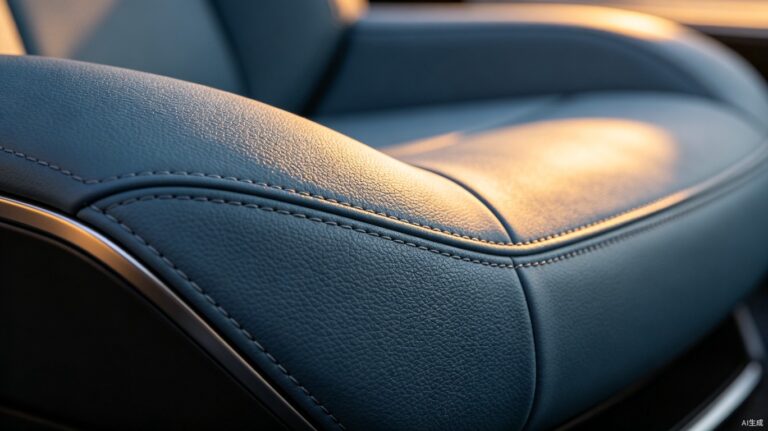
Weather-resistant silicone leather maintains color and flexibility in motorhome cabins through seasonal temperature swings.
Watch how silicone leather performs under extreme outdoor weather conditions — the same stresses your RV interiors face daily.
Specifying RV Upholstery Leather for OEM Production
Switching materials isn’t a simple drop-in replacement. RV manufacturers and furniture suppliers need to verify specific performance data before committing to a silicone leather specification. Here’s what to demand from any supplier:
- Martindale abrasion data — minimum 100,000 cycles for high-contact seating. Ask for the actual test report, not a spec sheet claim. Our durability testing results document 200,000+ cycles.
- UV resistance certification — ASTM G154 or ISO 105-B06 data showing 1,000+ hours without color change. This is the best motorhome upholstery material hot climate test available.
- Hydrolysis resistance — ISO 11507 test data proving the material won’t delaminate in humid, sealed-cabin environments during RV storage.
- VOC compliance — VDA 277 or ISO 16000-6 emission data. RV interiors are small, enclosed spaces. Off-gassing from PU and PVC directly affects occupant health and comfort.
For manufacturers evaluating the full cost picture, a cost and lifespan analysis shows that silicone leather’s higher per-meter price is recovered within the first warranty period — and then saves money every year after.
Silicone leather passes 200,000+ Martindale abrasion cycles — that’s 5x what standard PU achieves before surface degradation begins. In our flex resistance testing per ISO 5402, the material withstands 50,000-100,000 cycles without cracking. These aren’t projections. They’re measured results.
The manufacturing side matters too. TOPSUN’s hydrolysis-resistant silicone leather is produced through a solvent-free dry coating process with a 500,000+ meter monthly capacity and 7-15 day lead times. MOQ starts at 500 meters — accessible for mid-size RV furniture runs without excessive inventory risk.
For broader application coverage beyond seating, our full applications portfolio includes materials rated for even harsher environments than RV interiors.
The marine and outdoor-grade silicone leather line, for example, is tested against salt spray per ASTM B117 — a standard far more aggressive than anything an RV cabin will see.
Frequently Asked Questions
How long does silicone leather actually last in an RV interior?
In our testing and field data, silicone leather maintains its surface integrity for 10+ years in RV applications. The key difference is the absence of hydrolysis — the chemical breakdown that destroys PU coatings. Silicone’s Si-O bond doesn’t react with moisture the way PU’s C-O bonds do, so humidity, spills, and condensation inside a sealed motorhome don’t degrade the material. UV exposure per ASTM G154 confirms 1,000+ hours without fading, which translates to roughly 5-7 years of direct sunlight through an RV windshield without visible color change.
Can silicone leather withstand humidity inside a sealed motorhome during storage?
Yes. Silicone leather is hydrolysis-proof — the material doesn’t absorb moisture or degrade when exposed to humidity over extended periods. When an RV is sealed for winter storage, condensation builds up inside the cabin. PU coatings absorb that moisture and begin delaminating within months. Silicone’s non-porous surface repels water, and the polymer structure remains stable regardless of humidity levels. This makes it ideal for seasonal RV storage in humid climates.
The Bottom Line for RV Upholstery Leather
The RV industry’s upholstery failure problem isn’t a quality control issue — it’s a material science problem. PU and PVC coatings are chemically incapable of surviving the UV, thermal cycling, and humidity that define motorhome interiors. Every warranty claim, every peeling headrest, every frustrated owner posting on RV forums traces back to the same root cause: the wrong material for the environment.
RV upholstery leather needs to be specified by its chemistry, not just its texture and color. Silicone leather’s molecular stability eliminates the failure modes that have plagued RV furniture for decades. For B2B buyers, that means fewer warranty claims, lower replacement costs, and a product that actually delivers on the durability promise printed in the brochure. The data is verified. The chemistry is proven. The question is whether your next RV furniture spec sheet will include it.
About TOPSUN
TOPSUN manufactures silicone leather engineered specifically for RV and motorhome interiors, where thermal cycling, UV exposure, and humidity create the most demanding upholstery environment in the transportation sector.
Our silicone leather maintains flexibility from -40°C to 250°C, resists 1,000+ hours of UV exposure per ASTM G154, and passes 200,000+ Martindale abrasion cycles — the specs that eliminate warranty claims before they start. Free A4 swatches shipped worldwide via DHL/FedEx.