A consumer buys a PU leather wallet for $25. Within 18 months, the folding edge cracks and the surface coating starts peeling at the card slots. They upgrade to a “genuine leather” briefcase for $80. By month 24, the handle has absorbed enough hand oil and sweat that the finish breaks down and the leather hardens. They try full-grain leather — and now they’re spending $200+ on a bag that needs conditioning every six months and water-stains if someone sneezes near it. The problem isn’t that they bought cheap goods. It’s that the material chemistry behind every leather good determines its lifespan — and most are built on materials designed to fail. For a broader look at leather goods B2B sourcing, that guide covers the supplier evaluation process.
Request Leather Goods Material Samples
Why Leather Goods Fail: 3 Material Chemistry Problems
Every leather good failure traces back to one of three material chemistry problems. Understanding these mechanisms changes how you specify materials for goods manufacturing — whether you’re producing wallets, bags, belts, or tech accessories.
Problem 1: Polyurethane delamination. PU leather goods — which account for the majority of affordable fashion accessories — rely on a polyurethane coating bonded to a fabric backing. That bond is chemical, not mechanical. Body heat, hand oils, and friction from daily handling gradually break the ester or ether bonds in the polyurethane layer. The coating loses adhesion and begins to separate from the backing. In our abrasion testing, PU leather shows visible coating breakdown at 25,000-40,000 Martindale cycles — the equivalent of roughly 18-24 months of daily wallet use. Once the coating starts peeling, the process accelerates. There’s no repair.
Problem 2: Chrome-tanned leather dehydration. Chrome tanning accounts for approximately 80-85% of global leather production because it’s fast (1-2 days vs 30-60 days for vegetable tanning) and inexpensive. But chrome-tanned leather loses moisture over time — especially in dry climates or air-conditioned environments. Without regular conditioning, the leather fibers lose flexibility, the surface develops micro-cracks, and eventually those cracks propagate through the full thickness. A chrome-tanned leather good that feels supple at purchase can become brittle and cracked within 2-3 years without maintenance.
Problem 3: Bonded leather fiber loss. Bonded leather — the lowest tier, containing only 10-20% actual leather fiber mixed with polyurethane binder — is used in budget goods marketed as “real leather.” The binder degrades faster than the fibers it holds together. As the polyurethane breaks down, leather fibers shed from the surface. The material literally disintegrates. A bonded leather good can show surface degradation within 6-12 months of regular use.

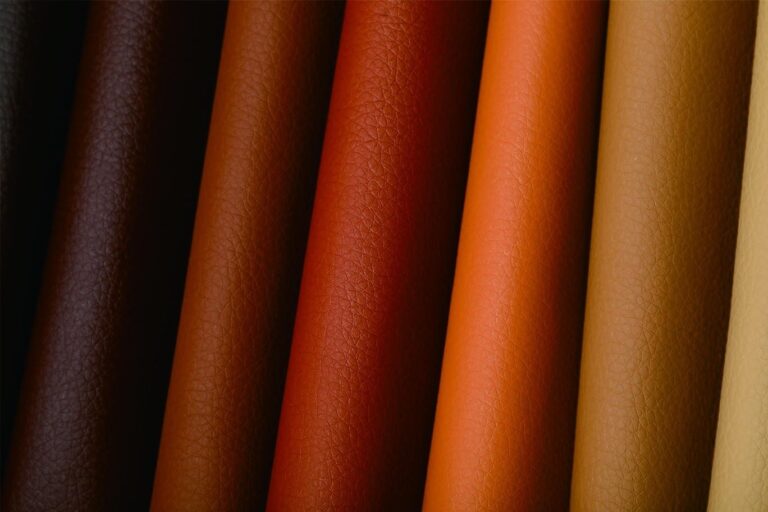
Lychee-grain leather swatches — the material choice that determines whether a good lasts months or years
Chrome-Tanned vs Vegetable-Tanned: What the Leather Good Label Means
The tanning method — not the grade label — determines how a leather good ages. Chrome tanning is fast, consistent, and cheap, but produces leather that doesn’t develop a natural patina and requires chemical plasticizers to remain supple. Vegetable tanning uses natural tannins from tree bark and takes 30-60 days, but produces leather that ages beautifully, developing a rich patina that improves with use.
Here’s the catch for goods manufacturers: vegetable-tanned leather costs 40-60% more than chrome-tanned, takes longer to source, and has greater batch variation — two hides from the same tannery can age differently. For a brand producing 10,000 wallets per month, that variation creates warranty exposure. A consumer who buys two wallets from the same line and sees them age differently perceives a quality problem, even when both hides technically meet specification.
The silicone vs PU material comparison shows how engineered materials eliminate this variability — but the same principle applies to the leather goods market. For manufacturers who need consistent aging behavior across thousands of units, natural leather’s biological variability is a liability.
The Daily Wear Test: What 10,000 Handle Grips Do
A leather good isn’t tested in a laboratory — it’s tested in pockets, purses, and hands. Over the course of a year, a wallet gets opened and closed 2,000-3,000 times. A briefcase handle gets gripped 5,000+ times. A bag strap rubs against clothing 10,000+ times. These real-world forces — friction, sweat, body oil, thermal cycling — destroy materials that pass standardized lab tests.

Scratch resistance testing — simulating years of daily handling in controlled conditions
We’ve tracked leather good failure modes across consumer testing, and the pattern is consistent. PU-coated goods fail at flex points — wallet folds, belt holes, bag straps — where mechanical stress accelerates coating delamination. Chrome-tanned goods fail at contact points — handles, grips, edges — where sweat and body oil penetrate the surface and break down the tanning chemicals. Bonded leather goods fail everywhere, shedding fiber and binder across the entire surface.
One of our goods manufacturing clients was producing PU leather cardholders that tested at 30,000 Martindale cycles in the lab — well above the industry standard. But field returns showed 8% failure rate within 12 months. The lab test didn’t account for the combination of mechanical flex plus human sweat plus body heat that occurs in a pocket. No single test does. The material needs to inherently resist all three stressors, not just pass individual tests.

Fashion accessories — where material choice determines whether the good lasts a season or a decade
Silicone Leather Goods: The Zero-Maintenance Alternative
Silicone leather solves all three failure modes through its polymer chemistry. The Si-O backbone is inherently resistant to hydrolysis — water and sweat don’t break it down. UV radiation doesn’t cause photo-oxidation — the material won’t crack or yellow from sun exposure. And because the color is integrated into the polymer matrix, not applied as a surface coating, there’s nothing to peel.
In daily-wear testing, TOPSUN silicone leather goods show zero surface degradation after 200,000+ Martindale abrasion cycles, 1,000+ hours of UV exposure, and full immersion in artificial sweat for 72 hours. No peeling. No cracking. No conditioning required.
The table below compares the materials most commonly used for leather good manufacturing, ranked by real-world failure modes rather than lab-tested grade labels.
| Material | Tanning/Coating | Peeling Risk | Cracking Risk | Sweat Resistance | Service Life |
|---|---|---|---|---|---|
| PU Coated | Polyurethane on fabric | High (18-24 mo) | Moderate | Poor (binder breaks) | 1.5-3 years |
| Chrome-Tanned | Chromium salts | Low | High without conditioning | Moderate | 3-8 years (with care) |
| Vegetable-Tanned | Plant tannins | Low | Moderate (patina masks) | Moderate | 8-20+ years (with care) |
| Bonded | Fiber + PU binder | Severe (6-12 mo) | High | Very poor | 0.5-1.5 years |
| Silicone Leather | Silicone polymer | None | None (-40 to 250°C) | Excellent (hydrolysis-proof) | 10+ years (zero maintenance) |
For brands looking to differentiate on quality rather than price, specifying silicone leather for goods manufacturing means the consumer’s next purchase is their last purchase. That’s a product story that premium brands can build a line around. For leather good manufacturer proofs and verification standards, that guide covers the documentation process.
Frequently Asked Questions
Why do PU leather goods peel so quickly?
PU leather goods peel because the polyurethane coating is chemically bonded to a fabric backing, and that chemical bond breaks down under daily stress. Body heat (35-37°C), hand oils, sweat, and mechanical friction at flex points all accelerate the breakdown of ester or ether bonds in the polyurethane layer. Once adhesion is lost at a single point, peeling spreads rapidly because there’s no mechanical interlock between coating and backing — only chemical adhesion. In lab testing, PU leather typically shows coating breakdown at 25,000-40,000 Martindale cycles, which translates to 18-24 months of daily use for wallets, bags, and accessories.
Can silicone leather be used for luxury leather goods manufacturing?
Yes. TOPSUN silicone leather is available in 100+ textures including full-grain cowhide replication, pigskin, and sheepskin patterns, with unlimited color options including Pantone and RAL matching. The material offers the visual and tactile qualities that luxury goods demand — soft hand-feel, rich color depth, and natural-looking grain — while delivering 200,000+ Martindale abrasion cycles, -40°C to 250°C thermal stability, and zero maintenance requirements. Luxury brands are increasingly adopting silicone leather for goods where the consumer values longevity and sustainability alongside aesthetics. See our fashion and sports applications for case studies.
The Material Defines the Good
Every leather good tells the story of its material. A PU wallet tells a story about planned replacement — 18 months, then peeling, then landfill. A chrome-tanned bag tells a story about maintenance burden — condition it or watch it crack. A vegetable-tanned briefcase tells a story about commitment — decades of care for decades of service. A silicone leather good tells a different story entirely: zero maintenance, zero cracking, zero peeling, and a material that looks on year ten the way it looked on day one. For goods manufacturers, the material specification isn’t a procurement detail — it’s the product promise. Choose accordingly.
Request Leather Goods Material Samples
About TOPSUN
TOPSUN manufactures silicone leather for goods manufacturers who need material that withstands daily handling, sweat exposure, and thermal stress without cracking, peeling, or requiring maintenance — used for wallets, bags, belts, and accessories where conventional leather fails within 2-3 years.
200,000+ Martindale cycles | -40°C to 250°C thermal stability | Zero VOC emissions (ISO 16000-6) | FDA 21 CFR 177.2600 food-contact compliant | 100+ textures including full-grain replication | Delta E ≤ 1.0 batch consistency